
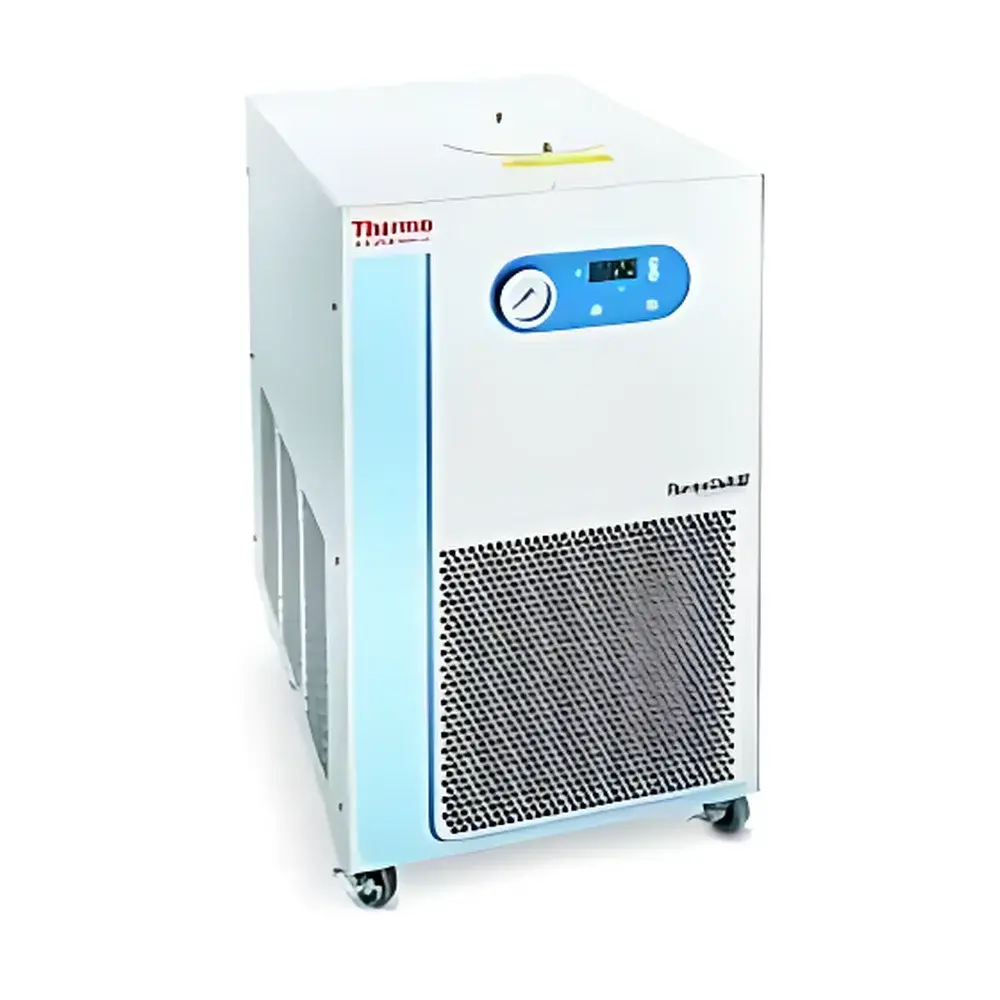
Thermo Fisher ThermoChill I/II/III LR Series Circulating Chillers
| Brand | Thermo Fisher |
|---|---|
| Origin | USA |
| Manufacturer | Thermo Fisher Scientific |
| Product Type | Imported |
| Model | ThermoChill I / II / III / I LR / II LR / III LR |
| Cooling Method | Air-Cooled |
| Temperature Range | –10 °C to +30 °C (LR models) |
| Cooling Capacity | 700 / 1000 / 2000 W @ 20 °C (60 Hz) |
| Temperature Stability | ±0.1 °C (standard & LR models), ±0.5 °C (III & III LR at extended range) |
| Reservoir Volume | 9.5 L (I/II/I LR/II LR), 19 L (III/III LR) |
| Pump Type | Positive Displacement (PD-1 or PD-2) or Magnetically Driven Centrifugal (MD30/MD) |
| Flow Rate | 4.5–13.6 L/min (adjustable, model- and pump-dependent) |
| Max. Pressure | 0.3–4.1 bar (pump-dependent) |
| Communication Interface | RS232 / RS485 |
| Certifications | CE, UL, IEC 61010-1:2004 compliant |
| Power Supply | 200–230 V, 50/60 Hz |
| Operating Environment | +10 °C to +35 °C |
| Duty Cycle | Continuous |
| Construction | Integrated, air-cooled chiller with stainless-steel reservoir and corrosion-resistant fluid path |
Overview
The Thermo Fisher ThermoChill I/II/III LR Series represents a family of precision-engineered, air-cooled circulating chillers designed for stable, continuous thermal management of laboratory instruments requiring reliable liquid cooling. These units operate on vapor-compression refrigeration using R134a refrigerant and integrate a closed-loop circulation system to maintain consistent coolant temperature and flow across connected equipment—including spectrophotometers, laser systems, NMR preamplifiers, rotary evaporators, and analytical instrumentation such as HPLC column ovens and ICP-MS interface coolers. The LR (Low-Temperature Ready) variants extend operational capability down to –10 °C, enabling compatibility with applications demanding sub-ambient thermal control while maintaining ±0.1 °C stability at setpoints within the –10 °C to +30 °C range. All models are engineered for long-term reliability in ambient environments between +10 °C and +35 °C and support uninterrupted 24/7 operation under nominal load conditions.
Key Features
- Intuitive digital controller with LED status indicators and real-time display of setpoint, actual temperature, and system status—no configuration software required for basic operation
- Modular pump architecture: choice of positive displacement (PD-1 or PD-2) or magnetically driven centrifugal (MD30/MD) pumps, each offering distinct pressure-flow profiles to match instrument backpressure requirements
- Full-flow, user-accessible filter assembly—removable without tools—to prevent particulate contamination and ensure fluid integrity over extended service intervals
- Top-mounted, wide-opening reservoir port with splash guard for rapid, spill-free coolant filling and maintenance
- Integrated analog pressure gauge on front panel for immediate verification of system hydraulic head and pump performance
- Locking casters for secure positioning and safe mobility within shared lab spaces
- Standard RS232 and optional RS485 interfaces support integration into centralized lab monitoring systems and enable remote parameter adjustment, data logging, and alarm notification per predefined protocols
- Robust mechanical design featuring stainless-steel reservoirs, corrosion-inhibited fluid paths, and thermally insulated compressor housings to minimize ambient heat gain and acoustic emissions
Sample Compatibility & Compliance
The ThermoChill series is compatible with standard aqueous glycol-water mixtures (e.g., 30% propylene glycol) and other non-corrosive, low-viscosity heat transfer fluids meeting ISO 8502-2 cleanliness specifications. It is not intended for use with organic solvents, oils, or aggressive chemical media. Units comply with IEC 61010-1:2004 for electrical safety in laboratory environments and carry both CE marking and UL recognition—validating conformance with North American and European regulatory frameworks. While not classified as medical devices, their construction and documentation support alignment with GLP and GMP infrastructure requirements where environmental monitoring and audit-trail-capable instrumentation are mandated. Firmware supports configurable event logging (e.g., temperature excursions, pump faults, power interruptions), and optional software packages can generate reports traceable to 21 CFR Part 11–compliant electronic records when deployed with validated host systems.
Software & Data Management
Basic operation requires no host computer; all parameters are managed locally via the front-panel controller. For automated labs, Thermo Fisher provides optional communication drivers and ASCII-based command sets compatible with LabVIEW, MATLAB, and custom SCADA platforms. Logged data—including timestamps, setpoint history, actual temperature readings, and alarm flags—can be exported via serial interface for post-processing in LIMS or statistical process control (SPC) software. Firmware updates are delivered through secure, authenticated channels and include version-controlled change logs to support equipment qualification (IQ/OQ/PQ) documentation. Audit trails record user-initiated changes (e.g., setpoint modification, pump speed adjustment), supporting accountability in regulated workflows.
Applications
- Stabilization of high-power laser diodes and optical cavities requiring precise thermal setpoints and low-noise cooling
- Temperature control of HPLC autosampler trays, column heaters, and detector cells to ensure retention time reproducibility
- Cooling of vacuum pump motor housings and diffusion pump forelines to sustain optimal pumping efficiency
- Thermal regulation of mass spectrometer ion sources and collision cells to reduce thermal drift in m/z calibration
- Support of electrophoresis systems, PCR thermal cyclers, and microplate readers where ambient fluctuations compromise assay fidelity
- Integration into pilot-scale reaction calorimeters and jacketed reactor systems for exotherm management during method development
FAQ
What is the minimum operating temperature for ThermoChill LR models?
The ThermoChill I LR, II LR, and III LR models are rated for continuous operation from –10 °C to +30 °C, with ±0.1 °C stability maintained across the full range when using recommended coolant formulations and within specified ambient conditions.
Can the ThermoChill be used with deionized water only?
Deionized water may be used short-term, but long-term operation is not recommended due to corrosion risk and microbiological growth. A 20–30% propylene glycol/water mixture is strongly advised for freeze protection, corrosion inhibition, and microbial suppression.
Is remote monitoring supported out of the box?
Yes—RS232 is standard; RS485 is available as a factory-configurable option. Both interfaces support bi-directional communication using documented ASCII command syntax for temperature control, status polling, and alarm acknowledgment.
How often should the inlet filter be serviced?
Under typical lab conditions with clean coolant, inspection is recommended every 3 months; replacement frequency depends on fluid quality and usage intensity—typically every 6–12 months.
Does the unit require external ventilation or ducting?
No. The air-cooled condenser is designed for free-air operation in unobstructed space. Maintain ≥15 cm clearance around rear and side grilles to ensure adequate airflow and prevent compressor overheating.



