
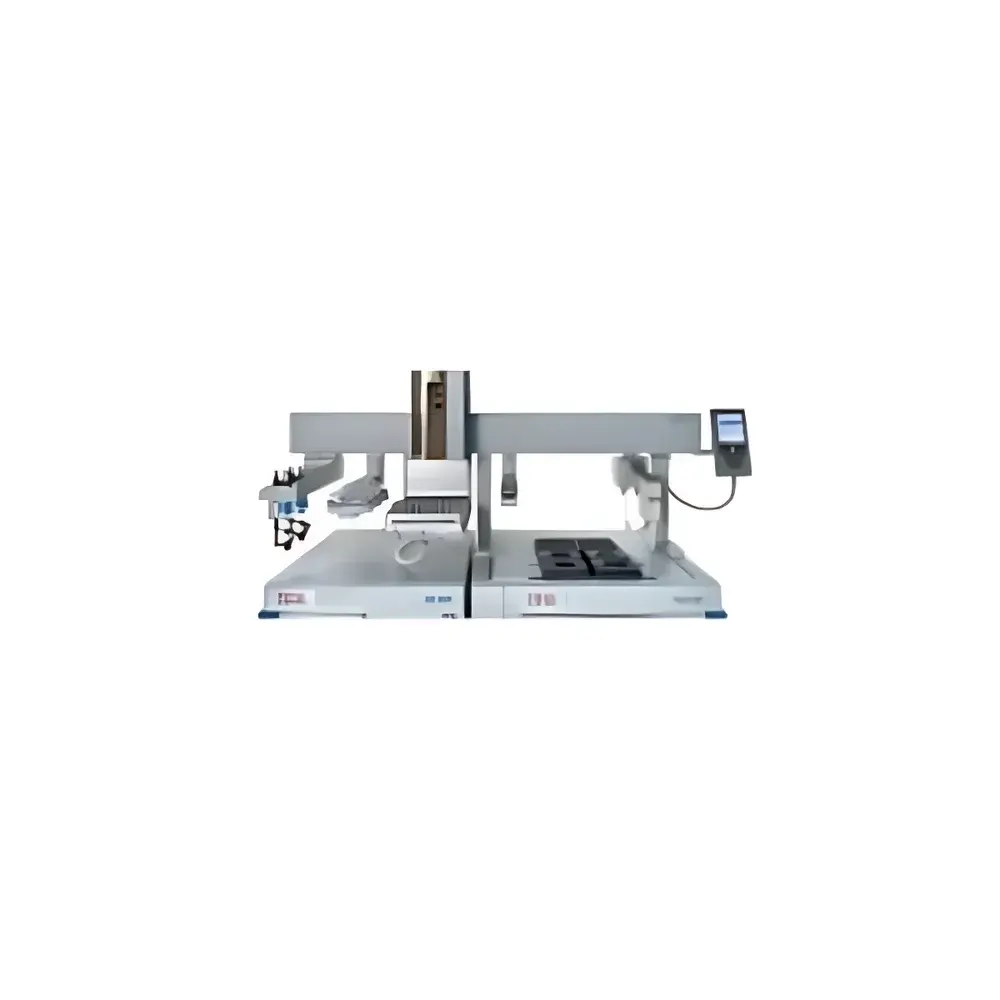
Thermo Fisher TriPlus 500 Headspace Autosampler for GC
| Brand | Thermo Fisher |
|---|---|
| Origin | Shanghai, China |
| Manufacturer Type | Authorized Distributor |
| Product Origin | Domestic (China) |
| Model | TriPlus 500 Headspace Autosampler |
| Quotation | Upon Request |
| Sample Capacity | 12–240 vials (field-upgradable) |
| Sampling Technology | Valve-and-loop headspace sampling |
| Operating Modes | Standard, Multiple-Head-Space Extraction (MHE), Multiple-Head-Space Injection (MHI) |
| Software Integration | Thermo Chromeleon CDS, TraceFinder, XCalibur |
| Compliance | FDA 21 CFR Part 11, GLP/GMP-ready |
| Compatible GC Systems | Thermo TRACE 1600 series (direct column coupling or transfer line), third-party GCs via TriPlus 100 LS / RSH / RSH SMART interfaces |
| Sample Path Design | Direct column connection option |
| Shaking Mechanism | Quick Spin Shaking (QSS) |
| Footprint Reduction | ~30% vs. conventional HS-GC systems |
Overview
The Thermo Fisher TriPlus 500 Headspace Autosampler is an engineered solution for quantitative volatile and semi-volatile compound analysis in gas chromatography (GC) workflows. It operates on the principle of equilibrium headspace sampling—where analytes partition between a liquid/solid sample matrix and its vapor phase under controlled temperature and pressure conditions—followed by precise valve-and-loop injection into the GC system. Designed for laboratories requiring high reproducibility, regulatory compliance, and operational flexibility, the TriPlus 500 integrates seamlessly with Thermo Scientific™ TRACE™ 1600 series GC instruments and supports interoperability with third-party GC platforms via standardized transfer line interfaces. Its modular architecture enables scalability from routine QC environments to method development labs, supporting applications ranging from residual solvent testing per ICH Q3C guidelines to environmental VOC monitoring aligned with EPA Method 502.1 and ASTM D3699.
Key Features
- Valve-and-loop sampling mechanism ensures high precision and long-term repeatability (RSD < 1.5% for typical volatile analytes), minimizing carryover through automated path purging and real-time leak detection during injection.
- Quick Spin Shaking (QSS) technology accelerates equilibration kinetics—reducing cycle time by up to 40% compared to conventional orbital shakers—while maintaining thermal homogeneity across all vial positions.
- Direct column coupling option eliminates transfer line dead volume, preserving peak shape integrity for polar and reactive compounds (e.g., aldehydes, organic acids) and improving recovery of high-boiling-point analytes (up to 300 °C).
- Field-upgradable sample capacity: starts at 12 vials and scales to 120 or 240 vials without hardware replacement or footprint expansion—maintaining identical thermal control and mechanical timing performance.
- Compact footprint reduces benchtop space requirement by approximately 30% versus legacy headspace autosamplers, enabling denser instrument layout in regulated laboratory environments.
- Three operational modes: Standard headspace injection, Multiple-Head-Space Extraction (MHE) for trace-level quantitation in complex matrices, and Multiple-Head-Space Injection (MHI) for enhanced calibration linearity and dynamic range extension.
Sample Compatibility & Compliance
The TriPlus 500 accommodates standard 10 mL, 20 mL, and 22 mL crimp-top or screw-cap headspace vials—including those with PTFE/silicone septa—and supports custom vial geometries via adjustable carrier trays. It maintains ISO/IEC 17025-compliant thermal stability (±0.1 °C over full 30–200 °C operating range) and pressure regulation (0–30 psi). System validation is supported by built-in IQ/OQ/PQ wizards within Chromeleon CDS software, generating audit-trail-enabled reports compliant with FDA 21 CFR Part 11, EU Annex 11, and WHO TRS 992 requirements. Daily system suitability tests—including blank run verification, retention time stability checks, and peak area reproducibility assessment—are programmable and auto-documented.
Software & Data Management
Fully integrated with Thermo Scientific™ Chromeleon Chromatography Data System (CDS) v7.3+, the TriPlus 500 enables method transfer across instruments without reconfiguration. Chromeleon provides electronic signature support, role-based access control, and immutable audit trails for all sequence edits, calibration updates, and instrument parameter changes. Optional integration with TraceFinder (for targeted screening) and XCalibur (for high-resolution GC-MS workflows) extends method portability across analytical platforms. All raw data files (.CDF, .RAW) are stored in vendor-neutral formats compatible with LIMS and ELN systems, supporting ALCOA+ (Attributable, Legible, Contemporaneous, Original, Accurate, Complete, Consistent, Enduring, Available) data integrity principles.
Applications
- Pharmaceutical QC: Residual solvent analysis per USP , ICH Q3C, and EP 2.4.24.
- Food & Beverage: Ethanol quantitation, flavor compound profiling, packaging migration studies (e.g., acetaldehyde in PET bottles).
- Environmental Testing: VOC analysis in water per EPA Methods 502.1, 524.2, and 8260D.
- Polymers & Materials: Monomer residue testing (e.g., styrene, vinyl chloride), plasticizer leaching assessments.
- Clinical Toxicology: Blood alcohol concentration (BAC) determination and volatile metabolite screening.
FAQ
Can the TriPlus 500 be used with non-Thermo GC systems?
Yes—it supports third-party GC instruments via transfer line interface, including configurations where TriPlus 100 LS or RSH-series autosamplers share the same GC inlet.
Is method transfer between different TriPlus models supported?
Chromeleon CDS enables cross-platform method portability; however, MHE/MHI parameters require empirical re-optimization due to hardware-specific thermal mass and valve timing differences.
What validation documentation is provided with the system?
Factory-installed IQ/OQ protocols, pre-validated test scripts for PQ execution, and a comprehensive URS (User Requirement Specification) template are included in the installation package.
Does the system support unattended overnight operation?
Yes—full sequence automation, vial position tracking, and fault-condition escalation (e.g., vial cap misalignment, pressure deviation) ensure robust 24/7 operation without manual intervention.
How is sample integrity maintained during high-temperature headspace analysis?
The inert flow path—constructed from deactivated fused silica and electropolished stainless steel—minimizes adsorption and degradation; active cooling of the needle and loop between injections further prevents thermal carryover.




