
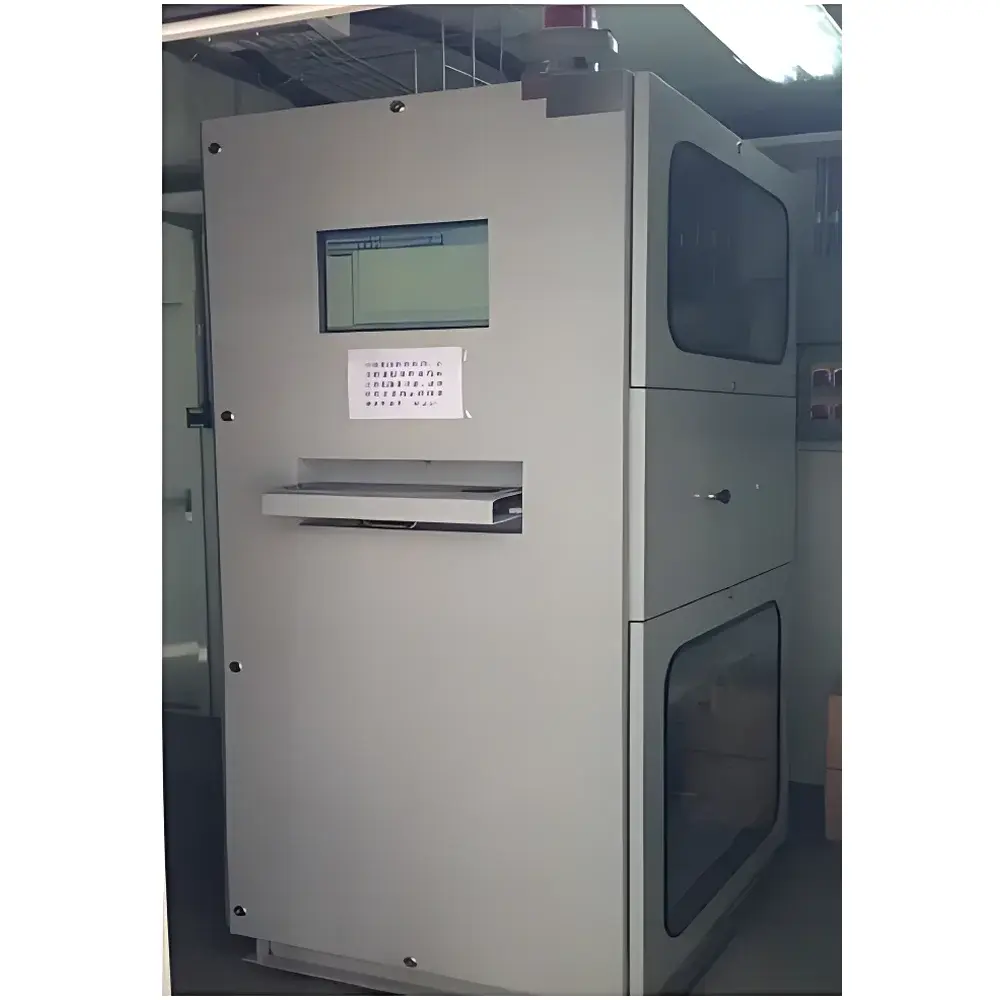
Thermo Fisher TVC-5800 Continuous Methane / Non-Methane Hydrocarbons and Speciated VOC Emission Monitoring System
| Brand | Thermo Fisher |
|---|---|
| Origin | Taiwan |
| Manufacturer Type | Manufacturer |
| Origin Category | Domestic |
| Model | TVC-5800 |
| Detection Principle | Gas Chromatography with Flame Ionization Detection (GC-FID) |
| Instrument Type | Online Analyzer |
| Typical Configuration | Multi-Component Speciated VOC Analyzer |
| Measurement Range | 0–50 ppm / 500 ppm / 5,000 ppm / 5% / 50% as CH₄ |
| Resolution | 0.05 ppm |
| Accuracy | ±1% F.S. or ±0.1 ppm (whichever is tighter) |
| Response Time | 60 s (average) |
Overview
The Thermo Fisher TVC-5800 is a fully integrated, online continuous emission monitoring system (CEMS) engineered for regulatory-compliant measurement of total hydrocarbons (THC), methane (CH₄), non-methane hydrocarbons (NMHC), and up to 90 individual volatile organic compounds (VOCs) — including benzene, toluene, xylenes (o-, m-, p-), ethylbenzene, styrene, isopropylbenzene, and high-reactivity VOCs (HRVOCs) per U.S. Photochemical Assessment Monitoring Stations (PAMS) specifications. Built upon gas chromatography coupled with flame ionization detection (GC-FID), the system delivers trace-level quantification with high reproducibility and robustness in demanding industrial exhaust streams. Its thermal management architecture supports hot-wet sampling — enabling direct extraction and analysis of undiluted, uncooled flue gas up to 220 °C — thereby eliminating condensation-related losses, adsorption artifacts, and speciation bias commonly observed in chilled sample conditioning systems.
Key Features
- Hot-wet sampling design: Heated probe (up to 200 °C) and stainless-steel heated transfer line (80–150 °C) preserve volatile analyte integrity across the full boiling point range of target VOCs (50–260 °C)
- Multi-channel GC-FID configuration: Simultaneous parallel analysis of CH₄, NMHC, and speciated aromatics via dedicated capillary columns — molecular sieve for CH₄ isolation; fused-silica packed or porous polymer columns for C₂–C₁₂ hydrocarbon separation
- High-efficiency particulate and heavy-end removal: Dual-stage filtration (0.1 µm ceramic pre-filter + internal high-temp precision filter) achieves >99.995% capture efficiency for particulates and condensable tars (boiling point >250 °C)
- Full-system calibration traceability: Integrated zero/span calibration with programmable frequency (daily to weekly); certified calibration gases traceable to NIST or equivalent national standards
- Intrinsic safety and explosion protection: Available with pressurized “Ex pX” cabinet (IEC 60079-2) rated for Zone 1/2, Group IIC, T4; optional explosion-proof analyzer shelter compliant with GB 3836.1–2000 and ISO 8573-1 Class 0 air quality requirements
- Real-time data acquisition: Sub-minute reporting (60 s average cycle time); dual analog (4–20 mA) and digital outputs (Modbus TCP/IP, RS232/RS485, USB)
Sample Compatibility & Compliance
The TVC-5800 is validated for use in high-dust (≤10 g/m³), high-humidity, and thermally variable exhaust streams typical of petrochemical crackers, semiconductor etch tools, PCB lamination ovens, pharmaceutical drying tunnels, rubber vulcanization lines, coating cure ovens, and automotive paint booths. Its hot-wet methodology meets the technical requirements of China’s HJ 1013–2018, HJ 75–2017, and HJ 76–2017 for VOC CEMS; aligns with EPA Method 25A and TO-17 for speciated hydrocarbon analysis; and supports compliance with EU Industrial Emissions Directive (IED) 2010/75/EU Annex VI monitoring protocols. All hardware components — from heated probe to GC oven — are constructed from 316L stainless steel and high-purity quartz to prevent catalytic degradation or surface adsorption of reactive VOCs.
Software & Data Management
The embedded control software provides automated sequence execution, real-time chromatogram visualization, peak integration with retention time locking, and configurable alarm thresholds (e.g., detector fault, calibration deviation >±2% F.S., temperature excursion). Audit trails comply with GLP/GMP principles and FDA 21 CFR Part 11 requirements, including electronic signatures, user-access controls, and immutable event logging. Raw chromatographic data (time-stamped .csv and .cdf formats) and processed concentration reports are exportable via Ethernet or USB. Optional integration with DCS/SCADA platforms enables closed-loop feedback for abatement system optimization (e.g., RTO/RCO temperature modulation based on inlet VOC load).
Applications
- Petrochemical refining: Monitoring flare stack emissions, storage tank breathing vents, and process unit exhaust for benzene, butadiene, and olefinic HRVOCs
- Semiconductor fabrication: Quantifying photoresist outgassing (e.g., PGMEA, EL, DCM) and etchant residuals (e.g., C₂F₆, CHF₃) in tool exhaust manifolds
- Pharmaceutical manufacturing: Verifying solvent recovery efficiency (acetone, IPA, ethyl acetate) during fluid-bed dryer and lyophilizer vent streams
- Automotive coating: Real-time tracking of xylene isomers and glycol ether solvents across spray booth and bake oven ducts
- Printing & packaging: Measuring toluene, MEK, and ethanol concentrations in flexographic and gravure dryers
- Surface treatment facilities: Validating VOC abatement performance in anodizing, plating, and powder coating lines
FAQ
What detection principle does the TVC-5800 employ?
Gas chromatography with flame ionization detection (GC-FID), enabling quantitative speciation of individual hydrocarbons and NMHC calculation by subtraction.
Can the system operate without sample cooling or drying?
Yes — it uses hot-wet sampling architecture with no refrigerant-based condensers, preserving thermally labile and water-soluble VOCs.
Is the system suitable for explosive atmospheres?
Yes — configured with Ex pX pressurized enclosures or certified explosion-proof shelters meeting IEC 60079-2 and GB 3836.1–2000 standards.
How is calibration performed and verified?
Automated multi-point span calibration using certified standard gases; zero calibration with ultra-low-hydrocarbon zero air or nitrogen; all calibrations logged with full audit trail.
What maintenance intervals are recommended for field operation?
Filter replacement every 3 months under typical industrial conditions; FID jet cleaning and detector optimization annually; GC column replacement every 18–24 months depending on matrix complexity.
Does the system support remote diagnostics and firmware updates?
Yes — via secure TLS-enabled web interface and Modbus TCP; remote access requires authenticated VPN tunneling per IT security policy.
Related Products







