
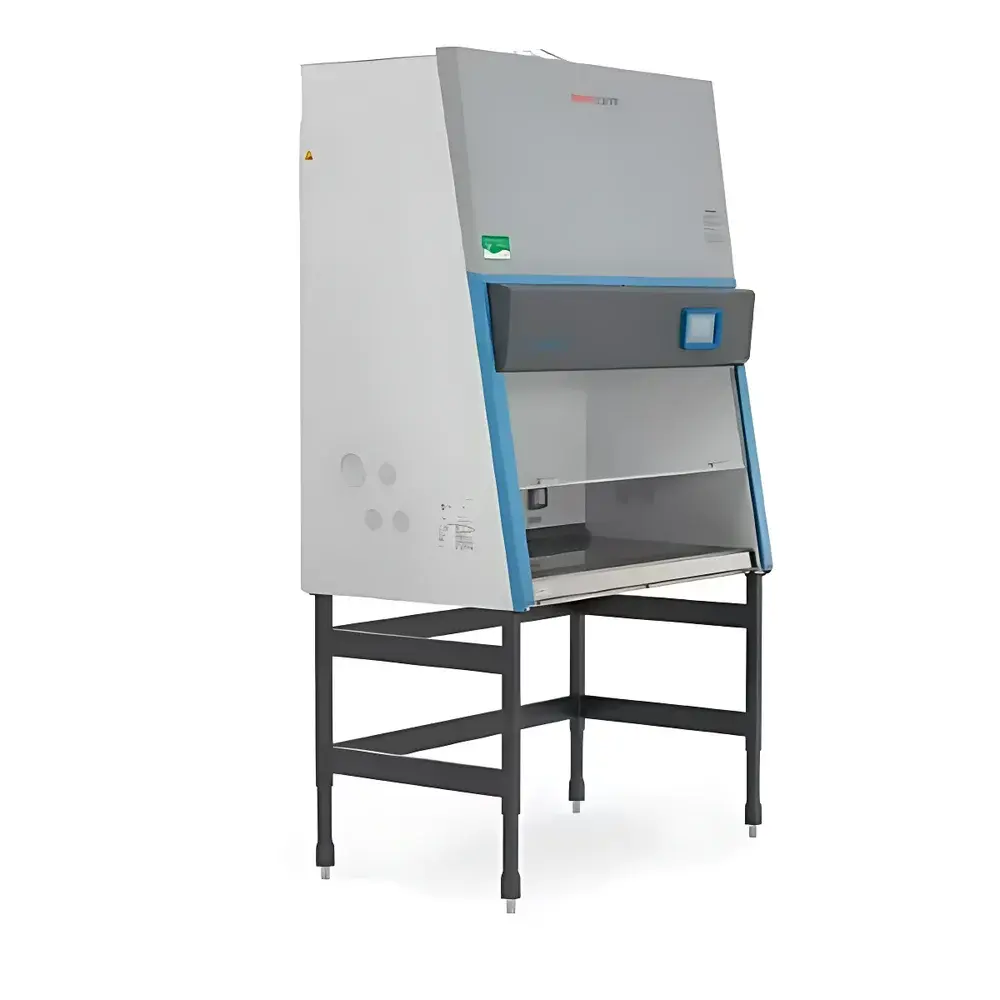
Thermo Scientific™ 1500 Series Class II, Type A2 Biological Safety Cabinet
| Brand | Thermo Fisher Scientific |
|---|---|
| Model | 1500 Series |
| Certification | NSF/ANSI 49-2022 |
| Airflow Type | Recirculating (70% re-circulated, 30% exhausted) |
| Work Area Dimensions (W×D×H) | 1524 × 610 × 610 mm |
| Max. Sash Height | 200 mm |
| Average Inflow Velocity | ≥0.50 m/s |
| Average Downflow Velocity | ≥0.25 m/s |
| Noise Level | ≤65 dBA |
| Illumination | ≥650 lux at work surface |
| UV Lamp | Programmable, 254 nm low-pressure mercury lamp |
| Display | 7-inch capacitive touchscreen GUI |
| SmartFlow Plus | Real-time airflow monitoring with automatic fan speed adjustment |
| SmartClean Front Window Mechanism | Patented dual-gear positioning system |
| SmartPort Side Access Ports | Dual-side cable and tubing pass-throughs |
| Energy Mode | Automatic fan speed reduction when sash is fully closed |
| Mobility Option | Fixed-height stand with locking casters |
| Compliance | Designed and validated per NSF/ANSI 49-2022, suitable for GLP/GMP environments requiring documented airflow integrity and audit-ready operation |
Overview
The Thermo Scientific™ 1500 Series Class II, Type A2 Biological Safety Cabinet is an engineered solution for laboratories requiring simultaneous personnel, product, and environmental protection during handling of low- to moderate-risk biological agents (BSL-1 to BSL-2). It operates on the principle of laminar downflow combined with inward-facing inflow—both filtered through high-efficiency particulate air (HEPA) filters—to create a physical barrier between the operator and hazardous aerosols. Approximately 70% of the air is recirculated within the work area after passing through a supply HEPA filter, while 30% is exhausted externally via a dedicated ducted or thimble-connected system. This configuration balances containment integrity with operational efficiency and reduced energy demand—critical for high-throughput academic, clinical, and pharmaceutical labs where regulatory traceability and consistent airflow performance are non-negotiable.
Key Features
- SmartFlow Plus Intelligent Airflow Management: Continuously monitors inflow and downflow velocities in real time using calibrated thermal anemometry sensors; automatically adjusts blower speed to maintain NSF/ANSI 49-specified minimum velocities (≥0.50 m/s inflow, ≥0.25 m/s downflow) across sash positions—even during filter loading or ambient pressure fluctuations.
- 7-inch Capacitive Touchscreen Interface: Provides at-a-glance visualization of cabinet health metrics—including real-time airflow velocity, filter differential pressure, UV lamp status, and alarm history—with intuitive navigation and multilingual support (English, Chinese, Japanese, Korean).
- Patented SmartClean Front Window Mechanism: A dual-gear, friction-damped positioning system enables precise, repeatable sash height adjustment with tactile feedback, minimizing vibration-induced turbulence and ensuring stable laminar flow during prolonged procedures.
- SmartPort Dual-Side Utility Access: Integrated, gasket-sealed side ports allow sterile passage of vacuum lines, power cables, gas tubing, and sensor leads without compromising containment—reducing clutter, improving ergonomics, and simplifying decontamination workflows.
- Programmable UV Decontamination Cycle: 254 nm low-pressure mercury UV lamp with configurable start time, duration, and safety interlock (automatically disables UV when sash is raised >25 mm), supporting routine pre-use sterilization and reducing reliance on chemical disinfectants.
- Energy-Efficient Operation Mode: When the sash is fully closed, the system reduces fan speed by up to 40%, maintaining positive pressure and residual containment while lowering power consumption—validated to preserve sample integrity during unattended overnight standby.
Sample Compatibility & Compliance
The 1500 Series is validated for use with cell culture, microbial isolation, recombinant DNA work, and diagnostic specimen processing involving Risk Group 2 (RG2) agents per WHO classification. Its NSF/ANSI 49-2022 certification confirms compliance with rigorous performance criteria for containment leakage (≤1 × 10⁻⁷ mg/m³ tracer gas penetration), airflow uniformity (±15% across work surface), and structural integrity under static and dynamic load testing. The cabinet supports integration into ISO 14644-1 Class 5 cleanroom environments and meets prerequisite conditions for FDA 21 CFR Part 11–compliant electronic record systems when paired with Thermo Fisher’s optional data logging software. All materials contacting the work area—including stainless steel 304 interior surfaces, seamless seams, and rounded corners—are compatible with standard laboratory disinfectants (e.g., 70% ethanol, 10% bleach, hydrogen peroxide vapor) and withstand repeated decontamination cycles without degradation.
Software & Data Management
The embedded firmware logs all critical operational events—including sash position changes, airflow deviations, filter pressure differentials, UV cycle execution, and alarm triggers—with timestamped entries stored locally for ≥12 months. Optional Thermo Fisher Connect™ Integration enables secure export of CSV-formatted audit trails for GLP/GMP documentation, including user ID attribution (via optional RFID badge reader), electronic signatures, and change control tracking. Firmware updates are delivered via encrypted USB key or network-based push deployment, adhering to IEC 62304 medical device software lifecycle requirements. Data export complies with ALCOA+ principles (Attributable, Legible, Contemporaneous, Original, Accurate, Complete, Consistent, Enduring, Available) for regulatory inspection readiness.
Applications
This cabinet is routinely deployed in university core facilities for stem cell expansion and CRISPR editing workflows; in clinical microbiology labs for Mycobacterium tuberculosis culture and antimicrobial susceptibility testing; in biopharmaceutical QC labs for aseptic fill simulation and media fill studies; and in contract research organizations supporting IND-enabling toxicology studies. Its robust airflow stability supports sensitive applications such as lentiviral vector production, primary neuron culture, and mycoplasma detection assays—where even transient turbulence can compromise sterility or transduction efficiency. The SmartPort architecture also facilitates integration with automated liquid handlers, centrifuges, and CO₂ incubators in modular lab configurations.
FAQ
Does the 1500 Series require external ducting?
Yes—Type A2 cabinets must be connected to either a hard-ducted exhaust system or a thimble-type canopy with dedicated make-up air supply to ensure safe removal of contaminated effluent air.
Can the UV lamp be scheduled to operate overnight?
Yes—the programmable timer allows users to set start time, duration (1–12 hours), and recurrence (daily, weekly), with automatic activation only when the sash is fully closed and interlocked.
Is the touchscreen interface compliant with 21 CFR Part 11?
The base unit provides audit-trail-capable event logging; full Part 11 compliance requires optional Thermo Fisher Connect™ software with role-based access control, electronic signatures, and secure data archiving.
What maintenance intervals are recommended for HEPA filters?
Supply and exhaust HEPA filters should be tested annually per NSF/ANSI 49, with replacement triggered by ≥20% increase in differential pressure or failure to meet specified airflow velocities during certification.
Is mobility supported without compromising containment integrity?
The optional fixed-height stand with locking casters maintains structural rigidity and vibration damping; all casters are ISO 14644-1 Class 5–rated and include leveling feet to ensure plumb alignment and seal integrity during relocation.




