
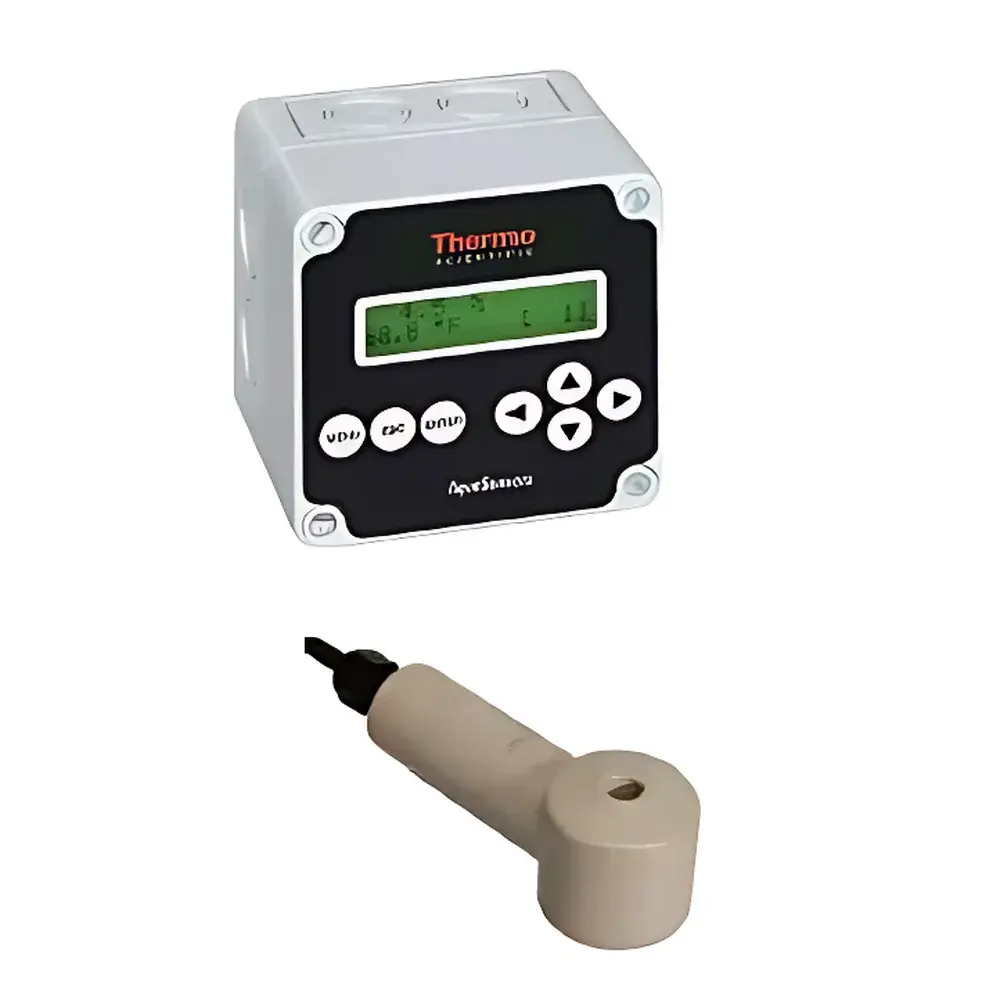
Thermo Scientific 2105AB Acid-Base Concentration Analyzer
| Brand | Thermo Fisher |
|---|---|
| Origin | USA |
| Manufacturer | Thermo Fisher Scientific |
| Product Type | Imported Industrial Online Analyzer |
| Model | Thermo Scientific 2105AB |
| Output | 0–20 mA or 4–20 mA analog signal |
| Conductivity Range | 0–2,000,000 µS/cm |
| Concentration Range | 0–10% w/w (acid/base) |
| Temperature Compensation | High-accuracy automatic compensation |
| Fouling Resistance | Engineered for long-term stability in fouling-prone water streams |
| Calibration | User-definable multi-point calibration curves |
Overview
The Thermo Scientific 2105AB Acid-Base Concentration Analyzer is an industrial-grade online process analyzer engineered for continuous, real-time measurement of acid or base concentration in aqueous solutions. It operates on the fundamental principle of conductivity-based concentration determination—leveraging the linear relationship between electrolyte concentration and solution conductivity within defined chemical and temperature boundaries. Unlike single-point pH-based estimation, the 2105AB employs a calibrated conductivity-to-concentration algorithm, corrected dynamically via integrated Pt1000 temperature sensing to ensure traceable accuracy across varying thermal conditions. Designed specifically for integration into automated water treatment infrastructure, it delivers stable, maintenance-light performance in demanding environments including municipal wastewater effluent polishing, pharmaceutical purified water loops, and food-grade CIP (Clean-in-Place) rinse monitoring. Its architecture complies with IEC 61508 functional safety guidelines for SIL 2-capable system integration and meets NEMA 4X/IP66 enclosure requirements for outdoor or washdown-area deployment.
Key Features
- Wide operational range: 0–10% w/w concentration for common strong acids (e.g., HCl, H₂SO₄) and bases (e.g., NaOH, Na₂CO₃), validated per ASTM D1125 and ISO 7888 conductivity correlation protocols
- Extended conductivity measurement capability up to 2,000,000 µS/cm—enabling reliable quantification even in highly concentrated regeneration brines or caustic soda solutions
- Programmable multi-point calibration curves: Users may define up to eight custom concentration-conductivity reference points, supporting non-linear behavior of weak electrolytes or mixed-salt systems
- High-fidelity temperature compensation using dual-sensor redundancy (process + reference junction), minimizing drift to ≤±0.15% of reading/°C deviation
- Fouling-resistant electrode design featuring ceramic junctions and pulsed current excitation—reducing biofilm adhesion and scaling by >70% compared to conventional DC-driven sensors
- Dual analog output options (0–20 mA or 4–20 mA) with HART® 7 protocol support for bidirectional configuration and diagnostics without interrupting process control signals
Sample Compatibility & Compliance
The 2105AB is validated for use with potable water, secondary-treated wastewater, reverse osmosis permeate, and low-turbidity process streams (≤5 NTU). It is not intended for undiluted chemical stock solutions (>20% w/w) or suspensions containing particulates >50 µm. All wetted materials—including the flow cell body (316L stainless steel), sensor housing (PVDF), and electrodes (platinum-coated titanium)—comply with USP Class VI biocompatibility standards and FDA 21 CFR 177.2400 for repeated contact with food-contact water. The analyzer supports GLP/GMP data integrity requirements through audit-trail-enabled firmware logging (timestamped calibration events, sensor diagnostics, and configuration changes), aligning with Annex 11 and FDA 21 CFR Part 11 electronic record provisions when paired with compatible SCADA or DCS historian systems.
Software & Data Management
Configuration and diagnostics are performed via Thermo Scientific Process Insight™ Desktop Utility—a Windows-based application supporting secure USB or Ethernet connection. The utility enables full parameterization of alarm thresholds (high/low concentration, sensor fault, temperature out-of-range), data logging intervals (1 sec to 24 hr), and HART variable mapping. Raw conductivity, compensated concentration, temperature, and diagnostic flags are timestamped and exportable in CSV or OPC UA format. Optional integration with Thermo Fisher’s Centralized Asset Monitoring Platform (CAMP) provides remote health monitoring, predictive maintenance alerts based on impedance trend analysis, and automated report generation compliant with ISO 17025 laboratory management system documentation requirements.
Applications
- Effluent compliance monitoring: Continuous verification of neutralized pH-adjusted discharge streams prior to environmental release
- Pharmaceutical water systems: Real-time tracking of sodium hydroxide concentration during WFI (Water for Injection) sanitization cycles
- Food & beverage CIP validation: Quantitative assurance of acid (nitric/phosphoric) and caustic (NaOH) concentrations in cleaning solutions per 3-A Sanitary Standards
- Industrial boiler feedwater pretreatment: Monitoring sulfuric acid dosing in ion exchange resin regeneration circuits
- Membrane desalination plants: Control of antiscalant and acid dosing to maintain optimal LSI (Langelier Saturation Index)
FAQ
Does the 2105AB require periodic recalibration? Why?
Yes—calibration verification is recommended every 7–14 days in high-fouling applications and quarterly in clean-water service. Conductivity-based concentration models are sensitive to electrode polarization and surface contamination; scheduled verification ensures traceability to NIST-traceable KCl standards.
Can the analyzer distinguish between different acids (e.g., HCl vs. H₂SO₄)?
No—it reports total ionic strength-derived concentration assuming a single dominant electrolyte. Accurate speciation requires complementary techniques such as ion chromatography or titration.
Is explosion-proof certification available?
The standard 2105AB carries ATEX II 2G Ex d IIB T4 Gb and IECEx certification for Zone 1 hazardous areas when ordered with optional flameproof enclosure (suffix -EX).
What flow rate range is supported for accurate measurement?
Optimal operation occurs at 0.5–5 L/min in the standard 1/2″ NPT flow cell; lower flows induce residence-time errors, while higher flows may cause turbulent-induced noise above 100 kHz bandwidth.
How is sensor cleaning managed in unattended operation?
The unit supports programmable ultrasonic cleaning cycles (via external transducer interface) and optional air-purge ports for intermittent dry-wipe functionality—both configurable through Process Insight™ software.
Related Products







