
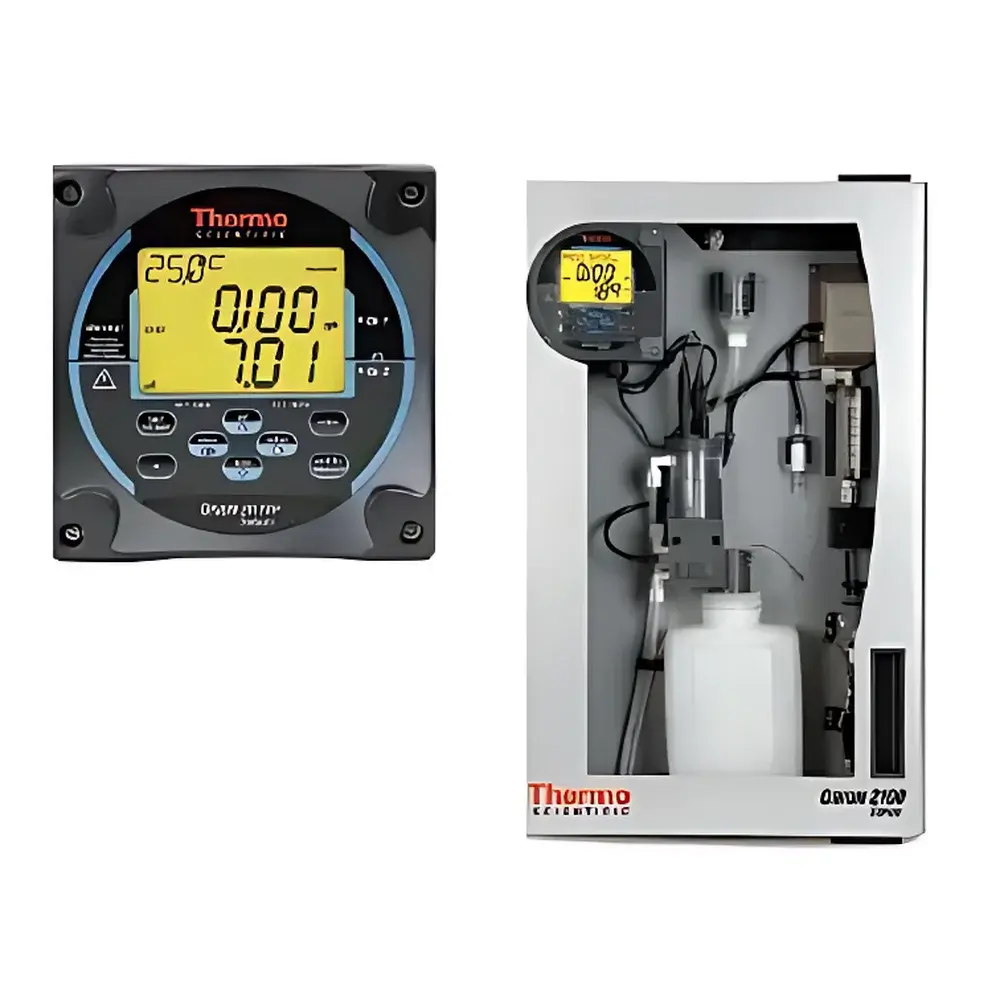
Thermo Scientific 2111AO Cation Exchange Bed Sodium Analyzer
| Brand | Thermo Fisher Scientific |
|---|---|
| Origin | USA |
| Manufacturer | Thermo Fisher Scientific |
| Product Type | Imported |
| Model | Thermo Scientific 2111AO |
| Instrument Category | Sodium Ion Analyzer |
| Installation Type | Online |
| Measurement Range | 1.0 ppb – 200 ppm Na⁺ |
| Response Time | ≤2 min to 95% of final value |
| Accuracy | ±5% of reading or ±2 ppb (whichever is greater) |
| Operating Temperature | 5–45 °C |
Overview
The Thermo Scientific 2111AO Sodium Analyzer is an online, potentiometric ion-selective measurement system engineered for continuous, high-reliability monitoring of sodium ion concentration in cation exchange effluent—particularly critical in high-purity water applications within power generation, semiconductor manufacturing, and pharmaceutical water systems. It employs a solid-state Orion sodium-selective electrode based on lanthanum aluminate membrane technology, operating on the Nernst principle to deliver stable, low-drift measurements across a wide dynamic range (1.0 ppb to 200 ppm). Unlike optical or colorimetric methods, this electrochemical approach eliminates reagent consumption for primary detection, significantly reducing operational complexity and long-term cost of ownership. The analyzer is specifically calibrated and validated for acidic cation-exchange bed outlet streams (pH < 3), where sodium breakthrough serves as the definitive indicator of resin exhaustion—enabling predictive maintenance and optimizing regenerant usage.
Key Features
- Wide linear measurement range (1.0 ppb – 200 ppm Na⁺) supports both ultra-trace detection during early resin breakthrough and higher-concentration verification post-regeneration.
- Orion solid-state sodium electrode with enhanced selectivity over interfering ions (e.g., H⁺, K⁺, NH₄⁺) under low-pH conditions, validated per ASTM D4582 and ISO 10523.
- Two-point known-addition calibration protocol ensures traceable accuracy without reliance on unstable standard solutions; completed in under 5 minutes with automated sequence control.
- Integrated pH-adjustment module uses minimal, metered addition of tetraethylammonium hydroxide (TEAH) to elevate sample pH transiently—suppressing hydrogen ion interference while preserving electrode integrity and minimizing waste generation.
- Passive sampling architecture: no peristaltic pumps, solenoid valves, or complex fluidic manifolds—reducing failure points, MTBF > 18 months, and eliminating recurring consumable costs associated with pump tubing or valve seals.
- Backlit 320 × 240 pixel graphical LCD display with intuitive menu navigation, real-time trend plots, and context-sensitive prompts for setup, calibration, and diagnostics.
- Modular expansion capability: optional second channel for simultaneous pH or conductivity measurement; field-upgradable digital communication modules (RS-485 Modbus RTU, Ethernet/IP, or Profibus DP).
Sample Compatibility & Compliance
The 2111AO is designed for direct installation into low-flow (10–50 mL/min), pressurized sample streams from cation exchange vessels. It accommodates inlet pressures up to 100 psi and tolerates suspended solids <5 µm when paired with standard 5-µm particulate filtration. All wetted materials—including PFA sample tubing, Hastelloy C-276 flow cell, and ceramic reference junction—are compliant with USP Class VI and FDA 21 CFR Part 11 requirements for pharmaceutical-grade water systems. Calibration and measurement data logs include full audit trail metadata (user ID, timestamp, action type, parameter values), satisfying GLP/GMP documentation standards. System validation documentation aligns with ASTM D1129 (Standard Terminology Relating to Water) and EP 2.2.38 (Sodium Determination in Purified Water).
Software & Data Management
Embedded firmware supports configurable data logging intervals (1 sec to 60 min), local storage of ≥12 months of compressed measurement history, and CSV export via USB port. Optional Thermo Scientific Orion Link™ software enables remote configuration, alarm management (high/low, rate-of-change, deviation-from-calibration), and integration into DCS/SCADA platforms via OPC UA. All calibration events are digitally signed and time-stamped, with electronic signatures enforceable under 21 CFR Part 11 when used with network-authenticated user roles and password policies.
Applications
- Real-time sodium monitoring at cation exchanger outlets in fossil fuel and nuclear power plant makeup water systems (per EPRI TR-102303 guidelines).
- Final polish loop surveillance in semiconductor ultrapure water (UPW) distribution networks (SEMI F63 compliance support).
- Resin bed health assessment in pharmaceutical purified water (PW) and water for injection (WFI) generation skids.
- Process control feedback for automated regeneration scheduling in industrial demineralization plants serving pulp & paper or petrochemical facilities.
FAQ
What is the minimum detectable sodium concentration, and how is detection limit verified?
The instrument specifies a lower limit of quantitation (LLOQ) of 1.0 ppb, determined per ICH Q2(R2) using signal-to-noise ratio ≥10 under representative matrix conditions (0.01 M H₂SO₄, 25 °C).
Does the 2111AO require daily maintenance or routine electrolyte refilling?
No—its solid-state sodium electrode contains no liquid inner filling solution; only periodic (quarterly) verification of reference junction integrity and cleaning of the flow cell is recommended.
Can the analyzer be integrated into an existing PLC-based control system?
Yes—standard RS-485 Modbus RTU interface is included; optional EtherNet/IP or Profibus DP modules are available for native DCS integration.
How does the system handle temperature fluctuations in unconditioned sample enclosures?
An integrated Pt100 RTD sensor provides real-time temperature compensation per the Nernst equation; accuracy specification accounts for operation across the full 5–45 °C ambient range.
Is third-party certification available for ISO/IEC 17025 traceability?
Factory calibration certificates are issued with NIST-traceable standards; on-site IQ/OQ/PQ validation packages—including uncertainty budgets per GUM—are available upon request.
Related Products







