
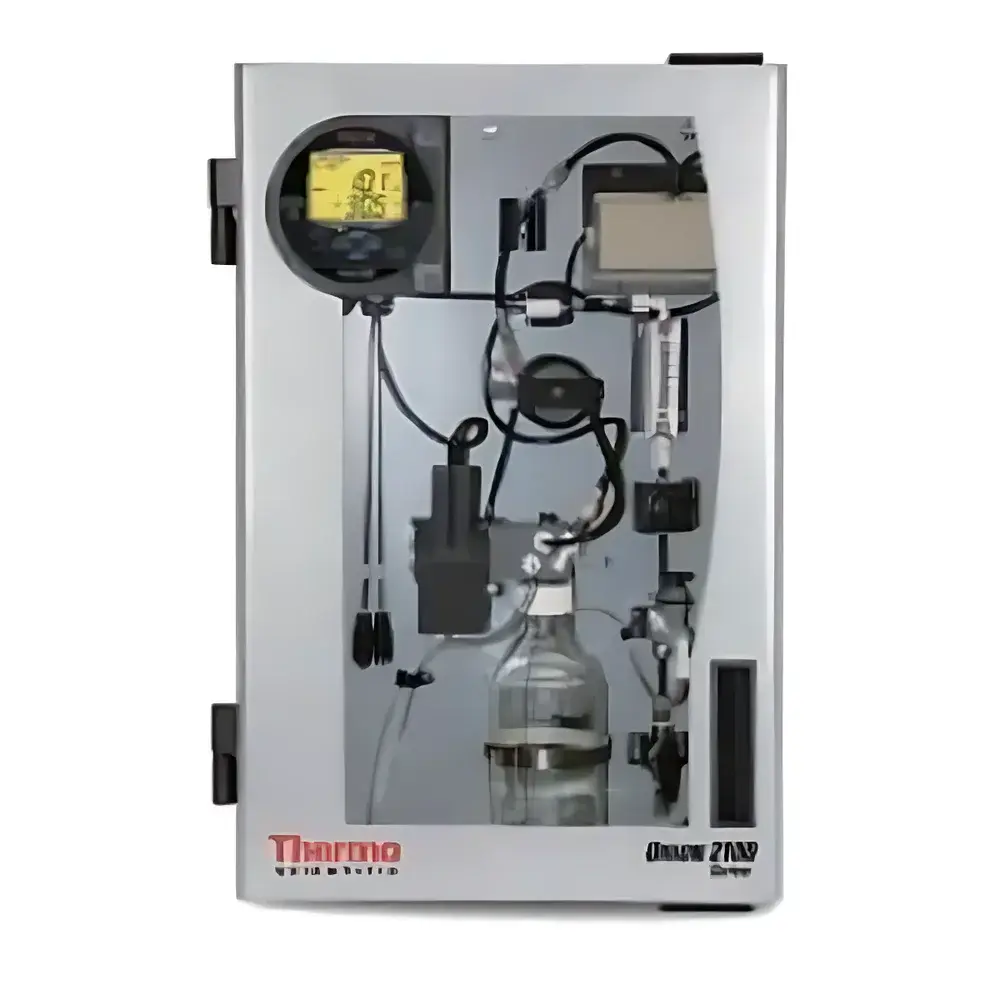
Thermo Scientific 2118XP Hydrazine Analyzer
| Brand | Thermo Fisher |
|---|---|
| Origin | USA |
| Model | Thermo Scientific 2118XP |
| Type | Online Analyzer |
| Detection Range | 0–200 ppb |
| Sensor Principle | Iodide-Selective Electrode (ISE) |
| Display | Backlit LCD |
| Compliance | Designed for ASTM D4356, ISO 10523, and USP <645> water quality monitoring environments |
| Communication Options | Optional digital communication module (Modbus RTU/ASCII, 4–20 mA analog output) |
| Expandability | Optional second channel for pH or conductivity measurement |
Overview
The Thermo Scientific 2118XP Hydrazine Analyzer is a dedicated online analytical instrument engineered for continuous, low-level hydrazine (N₂H₄) quantification in high-purity water systems. It operates on the principle of iodide-selective electrode (ISE) potentiometry, leveraging the stoichiometric oxidation of hydrazine by iodine in acidic medium to generate a measurable potential shift proportional to hydrazine concentration. This electrochemical detection method ensures high specificity in the presence of common interferents such as ammonia, amines, and dissolved oxygen—critical for boiler feedwater, nuclear steam generator condensate, and ultrapure water (UPW) loops where hydrazine is used as an oxygen scavenger. The analyzer delivers stable, drift-free measurements across its full 0–200 ppb range with typical response time (t₉₀) under 90 seconds and long-term baseline stability exceeding 72 hours between calibrations.
Key Features
- Continuous real-time hydrazine monitoring at sub-ppb resolution, supporting proactive chemical dosing control and minimizing overfeed of expensive hydrazine reagents
- Orion iodide-selective electrode with optimized membrane formulation—provides rapid equilibration (12 months under typical power plant conditions)
- Reagent-free measurement architecture: eliminates peristaltic pumps, solenoid valves, and consumable reagent cartridges, reducing mean time to failure (MTTF) and eliminating scheduled maintenance intervals associated with fluid-handling subsystems
- Backlit monochrome LCD display with intuitive menu navigation—supports multilingual interface (English, Spanish, German, Chinese) and real-time visualization of measured value, temperature, electrode status, and system diagnostics
- Self-diagnostic firmware continuously monitors electrode slope, asymmetry potential, and reference junction integrity—automatically flags degradation trends before measurement uncertainty exceeds ±5% of reading
- Modular hardware design allows field-upgradable functionality without instrument replacement, including optional dual-channel configuration for concurrent hydrazine + pH or hydrazine + conductivity analysis
Sample Compatibility & Compliance
The 2118XP is validated for use with deionized water, reverse osmosis permeate, condensate, and once-through boiler feedwater streams operating at temperatures from 5–45 °C and pressures up to 10 bar. It meets material compatibility requirements per ASTM F2217 for wetted components (316L stainless steel flow cell, PFA tubing, EPDM seals). Regulatory alignment includes support for GLP/GMP data integrity workflows: audit trail logging (user actions, calibration events, alarm triggers), electronic signature capability via optional software license, and compliance with FDA 21 CFR Part 11 when integrated with Thermo Fisher’s Orion StarLink™ Data Management Suite. Calibration traceability adheres to NIST-traceable standards (e.g., certified hydrazine reference solutions per ISO Guide 35).
Software & Data Management
The embedded firmware supports configurable alarm thresholds (high/low, rate-of-change), event-triggered data logging (1–3600 second intervals), and buffered storage of ≥30 days of 1-minute averaged data. Analog outputs (4–20 mA) are assignable to hydrazine concentration, temperature, or diagnostic status. Optional digital modules enable Modbus RTU/ASCII over RS-485 for integration into DCS/SCADA platforms. When paired with Orion StarLink™ software, the analyzer supports automated report generation (PDF/CSV), remote firmware updates, and trend analysis with statistical process control (SPC) charting—including X-bar/R charts aligned with ISO 7870-2.
Applications
- Power generation: Monitoring hydrazine residual in fossil-fuel and nuclear plant feedwater circuits to ensure corrosion inhibition without excessive reductant carryover
- Pharmaceutical water systems: Verification of hydrazine absence in purified water (PW) and water for injection (WFI) distribution loops per USP
- Microelectronics UPW networks: Detecting trace hydrazine breakthrough following ion exchange polishing stages where residual reducing agents compromise wafer cleaning efficacy
- Chemical process water: Control of hydrazine-based passivation rinse concentrations in stainless-steel piping validation protocols
- Municipal secondary treatment effluent: Research-grade monitoring of hydrazine persistence during advanced oxidation process (AOP) evaluation studies
FAQ
What is the recommended calibration frequency for the 2118XP under continuous operation?
Calibration is typically performed every 7–14 days using two-point bracketing (0 ppb and 100 ppb NIST-traceable standards), though extended intervals up to 30 days are achievable with stable sample matrices and routine electrode slope verification.
Can the 2118XP operate in hazardous area classifications?
The base analyzer is rated for Class 1, Division 2 (CID2) / ATEX Zone 2 environments when installed with appropriate barrier kits; intrinsic safety certification requires factory-configured explosion-proof housing option.
Does the instrument support automatic temperature compensation?
Yes—integrated Pt1000 RTD sensor provides real-time temperature measurement (range: 0–50 °C, ±0.2 °C accuracy) and applies empirically derived Nernstian correction coefficients specific to the iodide electrode/hydrazine redox system.
How is electrode drift managed during long-term unattended operation?
The firmware implements adaptive baseline tracking using periodic zero-point checks against deionized water flush cycles, combined with slope monitoring algorithms that trigger preventive maintenance alerts when electrode sensitivity deviates >15% from initial calibration.
Is there a service contract available for predictive maintenance support?
Thermo Fisher offers the Orion PredictiveCare™ program, which includes remote diagnostics, annual performance verification, electrode replacement scheduling, and priority technical escalation—all aligned with ISO/IEC 17025-compliant laboratory practices.







