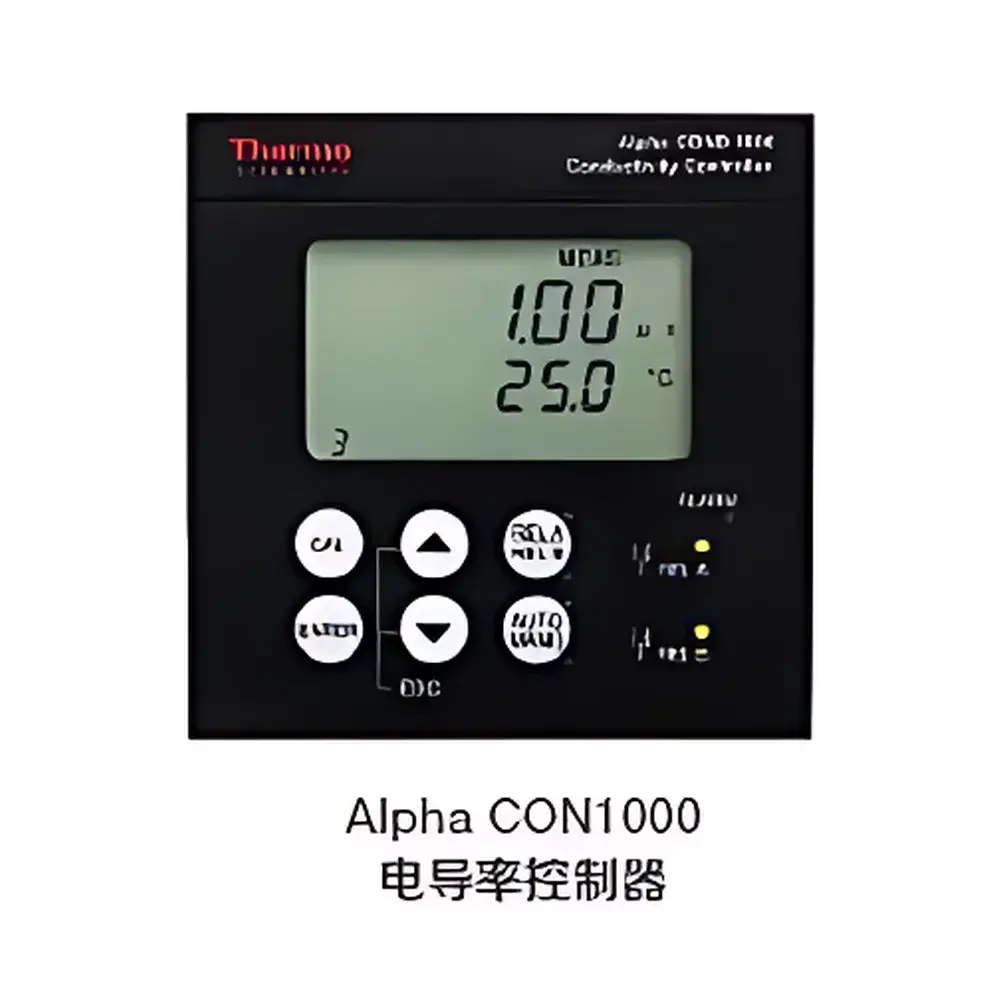
Thermo Scientific Alpha CON1000 Conductivity Controller
| Brand | Thermo Fisher |
|---|---|
| Origin | USA |
| Manufacturer | Thermo Fisher Scientific |
| Product Category | Imported Industrial Online Conductivity Analyzer |
| Model | Thermo Scientific Alpha CON1000 |
| Pricing | Upon Request |
Overview
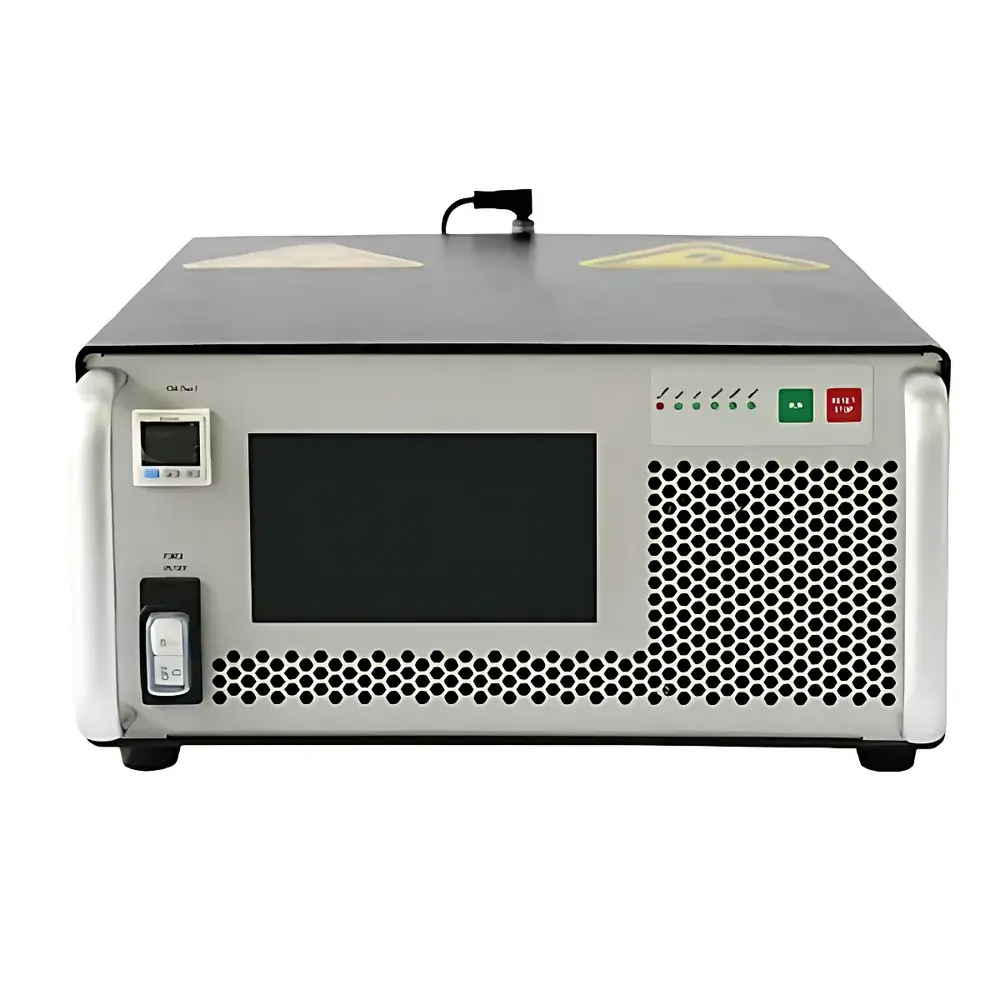
The Thermo Scientific Alpha CON1000 Conductivity Controller is an industrial-grade, microprocessor-based online conductivity analyzer engineered for continuous, high-stability measurement and control of aqueous process solutions in demanding production environments. It operates on the principle of two-electrode or four-electrode conductometric measurement—applying an alternating current (AC) excitation signal to minimize polarization effects and electrode fouling—enabling reliable determination of solution conductivity across a wide dynamic range (from ultra-pure water to highly concentrated electrolytes). Designed specifically for integration into closed-loop process control systems, the Alpha CON1000 delivers real-time conductivity and temperature data with configurable analog outputs, programmable relay logic, and robust environmental protection (IP65 front panel rating), making it suitable for deployment in chemical processing, pharmaceutical water systems, electroplating baths, semiconductor rinse stations, and municipal wastewater treatment plants.
Key Features
- 10 selectable conductivity ranges (e.g., 0–2 µS/cm to 0–2000 mS/cm), enabling optimal resolution and accuracy (±1% of full scale when paired with appropriate cell constant and temperature compensation)
- Configurable temperature compensation algorithms—including linear (α), non-linear (NaCl curve), and user-defined polynomial models—supporting Pt100/Pt1000 RTD inputs (2-wire or 3-wire)
- Dual independent 4–20 mA analog outputs, assignable to conductivity, temperature, or derived parameters (e.g., TDS, salinity); each output supports split-range configuration
- Four programmable relays: two for control (on/off or proportional-interval mode), one for alarm (with adjustable hysteresis/deadband), and one dedicated to automatic electrode cleaning cycles
- Time-delayed relay activation (0–2000 s) for staggered response in cascaded control schemes or to suppress transient spikes
- Non-volatile EEPROM memory retains calibration coefficients, setpoints, relay configurations, and system parameters during power loss or unexpected shutdown
- Backlit dual-line LCD display showing simultaneous conductivity and temperature values, status icons (e.g., sensor fault, calibration due, relay active), setpoint indicators, and diagnostic messages
- Two-level password protection (operator and engineer levels) restricting access to calibration, advanced setup, and system configuration menus
- Cable resistance compensation (up to 100 Ω) for accurate readings over extended cable runs between transmitter and conductivity cell
- Modular terminal block design with removable connectors for rapid field installation and maintenance without rewiring
Sample Compatibility & Compliance
The Alpha CON1000 is compatible with standard industrial conductivity cells (e.g., 2-electrode stainless steel, graphite, or titanium electrodes; 4-electrode toroidal sensors) across cell constants from 0.01 to 10.0 cm⁻¹. It meets IEC 61000-6-2 (immunity) and IEC 61000-6-4 (emission) for industrial electromagnetic compatibility. The device supports compliance-critical workflows in regulated industries: its non-volatile memory and audit-ready parameter logging align with GLP/GMP documentation requirements; configurable relay logic enables fail-safe interlocks per ISA-84 SIS principles; and optional firmware upgrades may support FDA 21 CFR Part 11 electronic signature readiness when integrated with validated SCADA platforms.
Software & Data Management
While the Alpha CON1000 operates as a standalone controller with local HMI, it supports serial communication via RS-485 (Modbus RTU protocol) for integration into distributed control systems (DCS) or supervisory control and data acquisition (SCADA) networks. Configuration and calibration history can be exported via Modbus registers for external trending or validation reporting. No proprietary PC software is required for basic operation; however, Thermo Scientific’s optional Process Insight Suite (sold separately) provides centralized fleet management, remote diagnostics, calibration traceability logs, and automated report generation compliant with ISO/IEC 17025 and ASTM D1125 standards.
Applications
- Continuous monitoring and control of conductivity in purified water (PW) and water-for-injection (WFI) loops per USP and EP 2.2.38
- Concentration control in etching, pickling, and passivation baths for metal finishing lines
- Real-time detection of rinse water contamination in printed circuit board (PCB) manufacturing
- Feedwater and condensate quality assurance in boiler and steam generation systems
- Regeneration endpoint detection in ion exchange resin beds
- Monitoring of cleaning-in-place (CIP) solution concentration and rinse efficiency in food & beverage and biopharma facilities
FAQ
What temperature compensation methods does the Alpha CON1000 support?
It supports linear (α-coefficient), NaCl reference curve, and custom polynomial compensation models, configurable per application requirement.
Can the device interface with a PLC using standard protocols?
Yes—it supports Modbus RTU over RS-485, enabling seamless integration with Allen-Bradley, Siemens, Schneider, and other major PLC platforms.
Is the relay logic suitable for SIL-rated safety functions?
The Alpha CON1000 is not certified to IEC 61508 SIL levels; it is intended for process control—not safety instrumented systems—though its HOLD relay function may be used in conjunction with external SIS hardware.
How is calibration data secured against accidental overwrite?
Calibration parameters are stored in protected EEPROM sectors and require Level 2 (engineer) password access to modify.
Does the unit support automatic temperature compensation for non-aqueous solutions?
No—temperature compensation algorithms are optimized for aqueous electrolyte systems; non-aqueous media require manual correction or external calculation.