
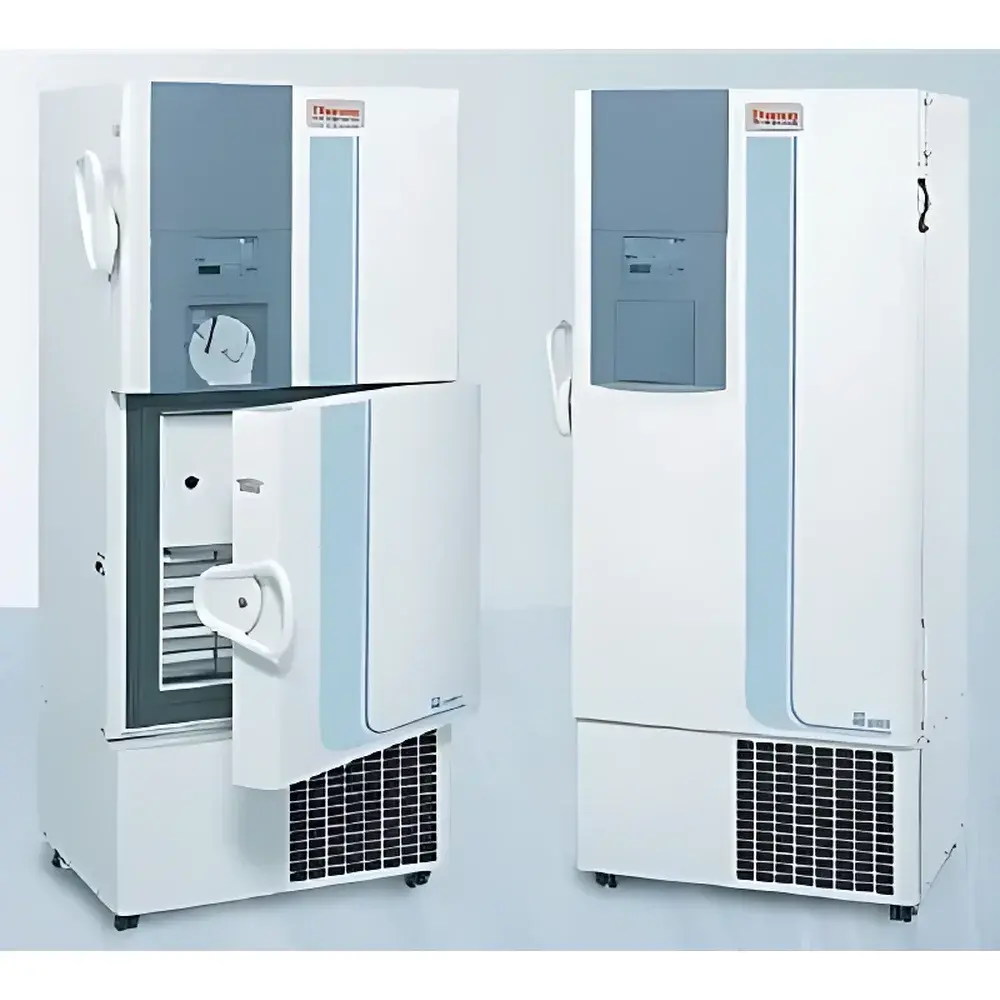
Thermo Scientific Forma ULT -86°C Ultra Low Temperature Freezer Model 991
| Brand | Thermo Fisher |
|---|---|
| Origin | USA |
| Manufacturer | Thermo Fisher Scientific |
| Product Category | Imported |
| Model | 991 |
| Price | Upon Request |
| Temperature Range | –50°C to –86°C |
| Capacity | 368 L |
| Ambient Operating Limit | Up to 32°C |
| Compressors | Dual 1 HP hermetic compressors |
| Cabinet Insulation | 127 mm in-situ foamed polyurethane (cabinet), 117 mm (door) |
| Refrigerant | DuPont™ Eco-friendly refrigerant blend |
| Condenser Filter | Washable dust filter |
| Power Input | Automatic voltage compensator integrated |
| Alarm System | Audible/visual alarm with battery-backed backup, remote alarm interface |
| Casters | Lockable heavy-duty casters |
| Interior Doors | Four removable inner doors |
| Vacuum Relief Port | Integrated |
| Height | 1970 mm |
Overview
The Thermo Scientific Forma ULT –86°C Ultra Low Temperature Freezer Model 991 is an engineered solution for long-term cryogenic storage of temperature-sensitive biological materials. As the originator of commercial ultra-low temperature freezers—having developed the world’s first –86°C unit—the Thermo Scientific Forma platform embodies over four decades of thermal management expertise and reliability validation in life science laboratories. This freezer operates on a dual-compressor cascade refrigeration architecture, utilizing a proprietary PEAK™ (Precision Enhanced Advanced Kinetics) cooling system to maintain stable, uniform temperatures across the entire 368 L storage volume—even under ambient conditions up to 32°C. Its thermally optimized cabinet design features 127 mm of high-density, CFC-free in-situ foamed polyurethane insulation in the main chamber and 117 mm in the door, minimizing thermal bridging and reducing energy consumption without compromising cold retention. The unit complies with international safety and performance standards including IEC 61010-1 (Laboratory Equipment Safety) and meets essential requirements for GLP-compliant environments where traceability and environmental stability are critical.
Key Features
- Dual independent 1 HP hermetic compressors with dedicated evaporators—enabling redundancy, extended service intervals, and consistent thermal performance during compressor cycling
- PEAK™ refrigeration system: Optimized heat exchange dynamics with dual centrifugal condenser fans for rapid thermal recovery after door openings
- ENVIRO-SCAN™ microprocessor-based control and monitoring system: Provides real-time logging of internal temperature, compressor status, door-open duration, and alarm history with configurable setpoints and hysteresis
- Four removable, vacuum-sealed inner doors with gasketed seals—reducing cold air loss by up to 70% per access event compared to single-door configurations
- Integrated vacuum relief port—eliminates suction resistance during re-opening, improving ergonomics and reducing mechanical stress on door seals
- Washable, front-access condenser dust filter—ensures sustained heat transfer efficiency and extends maintenance cycles
- Touch-sensitive membrane keypad with digital LED display—supporting intuitive navigation, password-protected parameter adjustment, and alarm acknowledgment
- Comprehensive alarm suite: High/low temperature deviation, power failure, door ajar, compressor fault, and sensor failure—with battery-backed audible/visual alerts and dry-contact remote alarm output (compatible with building management systems)
Sample Compatibility & Compliance
The Model 991 is validated for the secure storage of primary and secondary biological specimens including human tissue samples, stem cell lines, recombinant proteins, monoclonal antibodies, viral vectors, mRNA formulations, and lyophilized vaccines. Its temperature uniformity (±2.5°C at –80°C, per ISO 14644-1 Class 5 mapping protocol) and stability (< ±0.5°C over 24 h, load-dependent) meet the operational prerequisites of ISO 20387:2018 (Biobanking) and support compliance with FDA 21 CFR Part 11 when paired with Thermo Fisher’s optional ChronoLog™ data logger (validated audit trail, electronic signatures, user access controls). The absence of CFCs and use of low-GWP refrigerants align with EU F-Gas Regulation (EU No. 517/2014) and U.S. EPA SNAP program requirements.
Software & Data Management
While the base ENVIRO-SCAN™ controller provides local data logging (up to 30 days of 1-minute interval temperature and event logs), integration with Thermo Fisher’s optional ChronoLog™ Cloud Connect module enables secure, encrypted transmission of temperature records to a centralized server or LIMS. All data exports comply with ALCOA+ principles (Attributable, Legible, Contemporaneous, Original, Accurate, Complete, Consistent, Enduring, Available) and support 21 CFR Part 11–compliant electronic record retention. The system supports role-based user permissions, automatic report generation (PDF/CSV), and configurable email/SMS notifications triggered by predefined alarm thresholds.
Applications
- Long-term archival storage of clinical biospecimens in biorepositories and biobanks
- Stability testing of biologics and advanced therapeutics under ICH Q5C guidelines
- Cryopreservation of induced pluripotent stem cells (iPSCs) and primary neuronal cultures
- Storage of temperature-critical reagents such as restriction enzymes, polymerases, and CRISPR-Cas components
- Supporting GMP manufacturing workflows for viral vector production and cell therapy product release
- Backup cold chain infrastructure for pandemic response labs handling SARS-CoV-2 isolates or emerging pathogen strains
FAQ
What is the recommended calibration frequency for the internal temperature sensors?
Annual verification against NIST-traceable reference probes is recommended; factory calibration certificates are provided with each unit.
Can the freezer operate continuously at its maximum rated ambient temperature of 32°C?
Yes—thermal performance validation per ASTM F745-22 confirms stable operation at –80°C setpoint with ≤3°C uniformity across all zones at 32°C ambient and 80% RH.
Is the ENVIRO-SCAN™ system compatible with third-party BMS platforms?
Yes—via dry-contact relay outputs and Modbus RTU (RS-485) interface (optional module required).
Does the unit include a defrost cycle, and how is it managed?
No manual or timed defrost is required; the PEAK™ system employs adaptive frost management through controlled evaporator temperature modulation and periodic compressor sequencing.
What documentation is supplied for regulatory submissions?
IQ/OQ protocols, Factory Acceptance Test (FAT) reports, and Material Compliance Declarations (RoHS, REACH, WEEE) are included in the delivery package.
Related Products





