
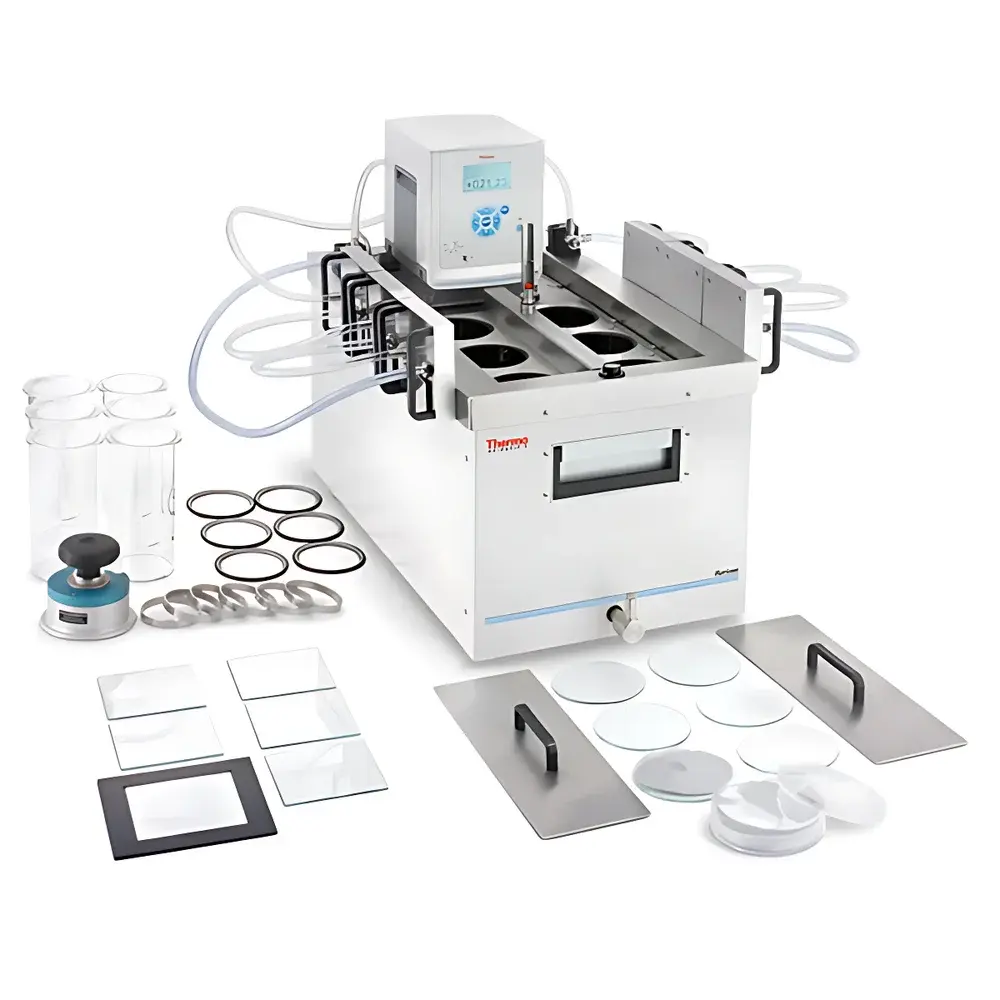
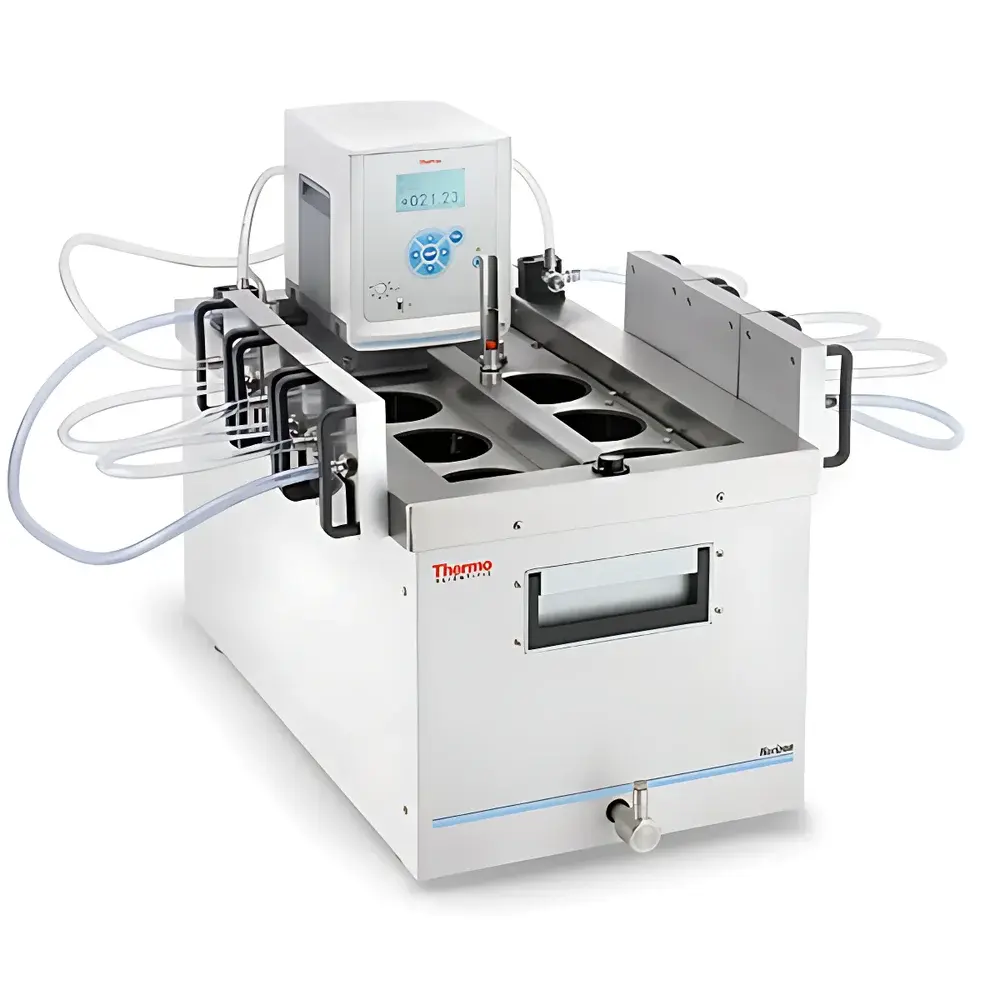
Thermo Scientific Horizon FTS Fogging Tester
| Brand | Thermo Fisher Scientific |
|---|---|
| Origin | USA |
| Manufacturer Type | Original Equipment Manufacturer (OEM) |
| Origin Category | Imported Instrument |
| Model | Horizon FTS |
| Pricing | Available Upon Request |
Overview
The Thermo Scientific™ Horizon FTS Fogging Tester is a precision-engineered instrument designed for the quantitative determination of volatile condensable substances (VCS) — including semi-volatile organic compounds (SVOCs) and volatile organic compounds (VOCs) — emitted from automotive, aerospace, and architectural interior materials. Operating on the principle of cold-finger condensation, the system simulates real-world thermal desorption conditions under controlled temperature and time parameters. A standardized test specimen is heated in a sealed chamber; volatilized compounds migrate through the vapor phase and condense onto a cooled glass or aluminum substrate (the “cold finger”) positioned at a fixed distance above the sample. The mass gain of the condensate — measured gravimetrically — or optical density (for glass substrates) serves as the primary fogging index. This methodology is foundational to internationally recognized material emission standards, including DIN 75201 (Germany), ISO 6452 (International Organization for Standardization), and SAE J1756 (Society of Automotive Engineers), all of which define strict limits for fogging behavior in safety-critical interior components.
Key Features
- Thermally stable test chamber with ±0.5 °C temperature uniformity across the sample zone, ensuring reproducible volatilization kinetics.
- Modular controller architecture supporting three operational tiers: Basic Temperature Control (fixed setpoint), Programmable Ramp-and-Soak Profiles (for multi-stage thermal conditioning), and Integrated Data Logging with USB export capability.
- Robust stainless-steel construction and corrosion-resistant internal surfaces minimize maintenance and extend service life under continuous laboratory use.
- Dual cold-finger options: Precision-ground borosilicate glass substrates (for optical density measurement per DIN 75201-B) and polished aluminum plates (for gravimetric analysis per DIN 75201-C and ISO 6452).
- Integrated chamber purge port compatible with inert gas (N₂) supply, enabling oxygen-sensitive testing and reducing oxidative artifact formation during extended heating cycles.
Sample Compatibility & Compliance
The Horizon FTS accommodates flat, solid specimens up to 30 mm × 30 mm × 5 mm (L × W × H), including textiles, leather, polymeric foams, adhesives, sealants, thermoplastic elastomers, and composite laminates. It supports both conditioned and as-received samples per ASTM D618 pre-test requirements. The system is validated for full compliance with DIN 75201:2018-06, ISO 6452:2019, SAE J1756:2021, and GB/T 27630–2011 (China’s passenger vehicle interior air quality standard). Its design facilitates audit-ready documentation aligned with GLP (Good Laboratory Practice) and ICH guidelines, and optional software modules support 21 CFR Part 11-compliant electronic signatures and audit trails when integrated with Thermo Scientific SampleManager LIMS.
Software & Data Management
While the Horizon FTS operates as a stand-alone benchtop unit, its programmable controllers generate timestamped CSV log files containing temperature profiles, dwell times, and user-defined metadata. These files are directly importable into laboratory informatics platforms or custom QA/QC dashboards. Optional Thermo Connect™ firmware enables remote status monitoring via Ethernet, with configurable email alerts for cycle completion or thermal deviation events. All calibration records — including cold-finger surface temperature verification using traceable NIST-certified thermocouples and balance calibration logs — are retained per ISO/IEC 17025:2017 Clause 7.7 requirements.
Applications
- Automotive Tier-1 suppliers validating dashboard, headliner, seat upholstery, and gasket materials against OEM-specific fogging specifications (e.g., VW TL 52250, Ford WSS-M99P1111-A).
- Aerospace component manufacturers qualifying interior trim for EASA CS-25.853 flammability and emissions compliance.
- Architectural glass fabricators assessing silicone sealants and laminated interlayers used in high-rise curtain wall systems.
- R&D laboratories conducting comparative VOC/SVOC screening of bio-based polymers versus petroleum-derived analogues.
- Regulatory testing labs performing accredited conformance testing for CE marking (EU Construction Products Regulation) and China Compulsory Certification (CCC).
FAQ
What standards does the Horizon FTS natively support without hardware modification?
DIN 75201 (all variants), ISO 6452, SAE J1756, and GB/T 27630 — all implemented via standardized fixture geometry, thermal ramp profiles, and substrate specifications.
Is gravimetric fogging measurement possible with glass substrates?
No — glass substrates are used exclusively for optical density (OD) measurement per DIN 75201-B; gravimetric analysis requires aluminum cold fingers per DIN 75201-C and ISO 6452.
Can the Horizon FTS be integrated into an automated test cell?
Yes — digital I/O ports and Modbus TCP support enable synchronization with robotic sample loaders and environmental chambers in high-throughput QA environments.
What is the recommended calibration frequency for routine QC use?
Temperature sensors and balance interfaces should be verified before each test series; full system calibration is recommended every six months or after 200 test cycles, per ISO/IEC 17025 Clause 6.4.6.
Does Thermo Fisher provide method validation documentation?
Yes — the Horizon FTS User Manual includes IQ/OQ protocols, uncertainty budgets per GUM (JCGM 100:2008), and representative interlaboratory study data demonstrating repeatability (r ≤ 8.2%) and reproducibility (R ≤ 14.6%) across five global labs.





