
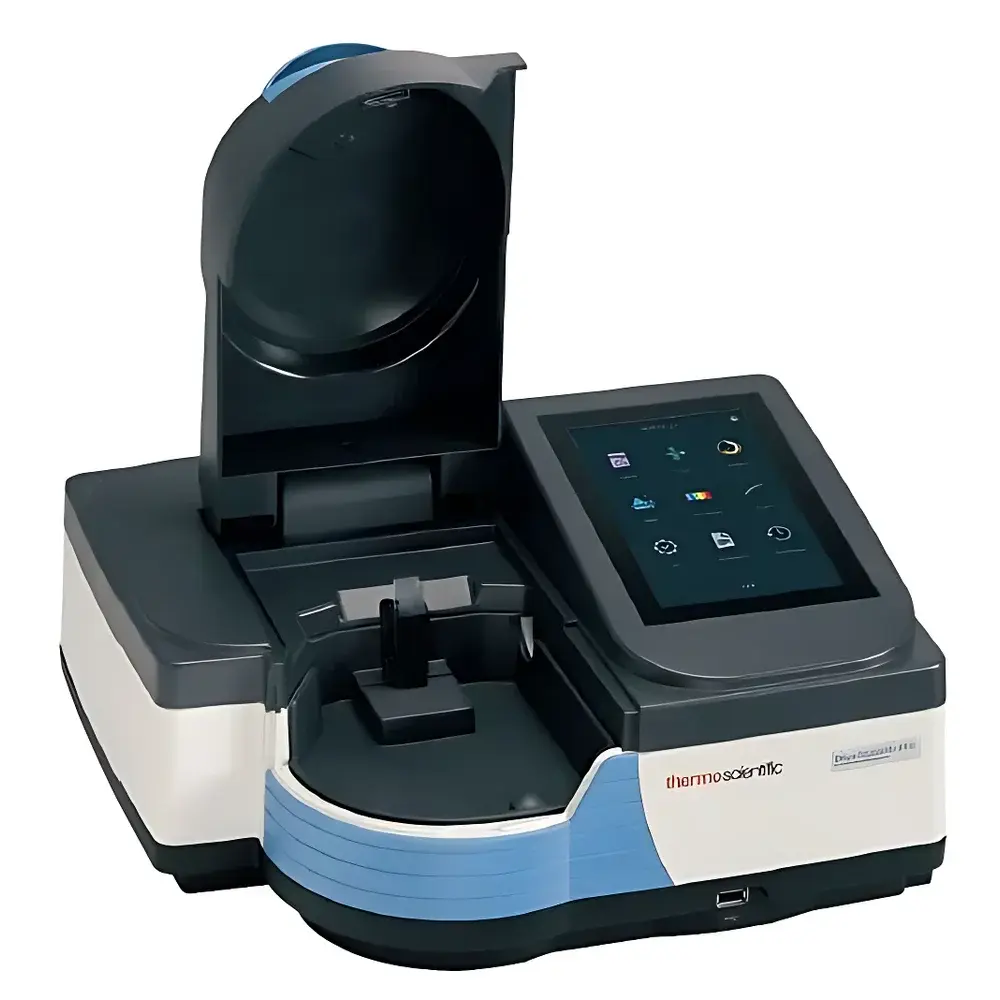
Thermo Scientific Orion AquaMate 8100 UV-Visible Spectrophotometer
| Brand | Thermo Fisher |
|---|---|
| Origin | USA |
| Manufacturer Type | Original Equipment Manufacturer (OEM) |
| Product Category | Imported Instrument |
| Model | Orion AquaMate 8100 |
| Optical Design | Double-Beam |
| Detector | CCD Array |
| Wavelength Range | 190–1100 nm |
| Wavelength Accuracy | ±1.0 nm |
| Spectral Bandwidth | 2.0 nm |
| Stray Light | <1.0%T @ 198 nm (KCl), <0.05%T @ 220 nm (NaI), <0.03%T @ 340 nm (NaNO₂) |
| Automation Level | Automatic Wavelength Selection |
| Display | 7-inch High-Resolution Touchscreen |
Overview
The Thermo Scientific Orion AquaMate 8100 UV-Visible Spectrophotometer is a double-beam, xenon flash lamp–based analytical instrument engineered for high-precision quantitative and qualitative analysis in environmental water and wastewater laboratories. Operating across a broad spectral range of 190–1100 nm, it employs a CCD array detector and fixed-slit optical architecture to deliver stable photometric performance without thermal drift or warm-up delay. Unlike continuous-source instruments, its pulsed xenon lamp activates only during measurement—minimizing sample photodegradation, eliminating preheating time, and ensuring consistent thermal stability within the sample compartment. The double-beam design continuously references each data point against an internal reference beam, correcting for source intensity fluctuations, detector response drift, and environmental perturbations in real time. This architecture underpins trace-level accuracy in absorbance measurements (e.g., low-concentration nitrate, phosphate, or heavy metals) and supports regulatory compliance workflows aligned with U.S. EPA methods, ISO 7027, ASTM D1253, and EN ISO 15705.
Key Features
- Double-beam optical system with real-time reference beam correction for enhanced photometric stability and reproducibility
- Pulsed xenon lamp (190–1100 nm) providing high-intensity UV output without warm-up; rated for ≥3 years of typical laboratory use (≈10⁶ flashes)
- 2.0 nm spectral bandwidth optimized for resolution/sensitivity balance in environmental matrix applications
- 7-inch capacitive touchscreen interface with intuitive icon-driven navigation and context-sensitive help
- Preloaded library of 260+ EPA-compliant, vendor-validated test methods—including AQUAfast™, Merck, and CHEMetrics reagent protocols
- Three USB 2.0 ports supporting direct data export to flash drives, external printers, and firmware/software updates
- GLP/GMP-compliant audit trail: timestamped performance verification reports include instrument serial number, operator ID (if configured), and calibration event history
Sample Compatibility & Compliance
The AquaMate 8100 accommodates diverse cuvette geometries via interchangeable holders: magnetic, autoclavable fixtures for round cells (12–25 mm), square cells (10 mm pathlength), and rectangular multicell racks (20–100 mm). A variable-diameter circular holder (13–24 mm) enables compatibility with legacy or specialty vials. All holders are designed for rapid installation and cleaning without tools. Instrument compliance extends beyond physical design: built-in Performance Verification Tests validate wavelength accuracy per NIST-traceable standards (e.g., holmium oxide filter at 241.1, 279.4, 333.7 nm) and photometric linearity across 0–3.0 A. Data integrity meets FDA 21 CFR Part 11 requirements when used with Thermo Fisher’s optional secure user authentication and electronic signature modules. Method validation documentation aligns with ISO/IEC 17025 and EU Water Framework Directive analytical quality criteria.
Software & Data Management
The embedded AquaMate software suite provides method editing, custom curve generation (up to 10-point polynomial fits), and multi-wavelength kinetics. Users may import third-party calibration curves via USB, modify existing EPA methods (e.g., adjusting dilution factors or reagent lot-specific corrections), or create entirely new assays using absorbance, %T, or concentration modes. All methods—including edited or user-defined protocols—are stored on removable USB media, enabling lab-wide standardization and version-controlled deployment. Raw spectral scans (up to 1600 nm/min), kinetic time courses, and multi-sample batch reports export in CSV, PDF, or XML formats. Audit logs record every method execution, parameter change, and calibration event—supporting retrospective review during regulatory inspections or internal QA audits.
Applications
This spectrophotometer is routinely deployed for regulatory testing in municipal wastewater treatment plants, drinking water utilities, and environmental contract labs. Key applications include: determination of total phosphorus (EPA 365.4), nitrate/nitrite (EPA 353.2), chemical oxygen demand (EPA 410.4), heavy metals (e.g., Cr(VI) by EPA 7196A), residual chlorine species (DPD method), turbidity (ISO 7027), and organic contaminants (e.g., phenol, formaldehyde, cyanide). Its UV capability enables detection of aromatic compounds and nucleic acid quantification in bio-monitoring studies. The instrument also supports non-regulatory research applications such as enzyme kinetics, ligand-binding assays, and nanoparticle characterization where spectral fidelity across deep-UV wavelengths is critical.
FAQ
Does the AquaMate 8100 support GLP-compliant data archiving?
Yes—when configured with user access controls and electronic signatures, it generates timestamped, instrument-serialized audit trails compliant with GLP and 21 CFR Part 11.
Can I use non-Thermo reagents with preprogrammed methods?
Yes—methods can be adjusted for alternate reagent lots or vendors using one-point recalibration; all modifications are logged in the audit trail.
What is the expected lifetime of the xenon lamp?
Engineering data indicate ≥3 years (or ~1 million flashes) under typical usage; no routine replacement is required during standard warranty coverage.
Is stray light performance verified at installation?
Yes—stray light is validated during factory calibration using KCl, NaI, and NaNO₂ filters per ASTM E387 and documented in the Certificate of Conformance.
How does the double-beam design improve long-term measurement stability?
By continuously comparing sample and reference beam intensities at each wavelength, it compensates for lamp aging, detector sensitivity drift, and ambient temperature fluctuations—ensuring ≤0.002 A/h baseline stability over 8-hour operation.




