
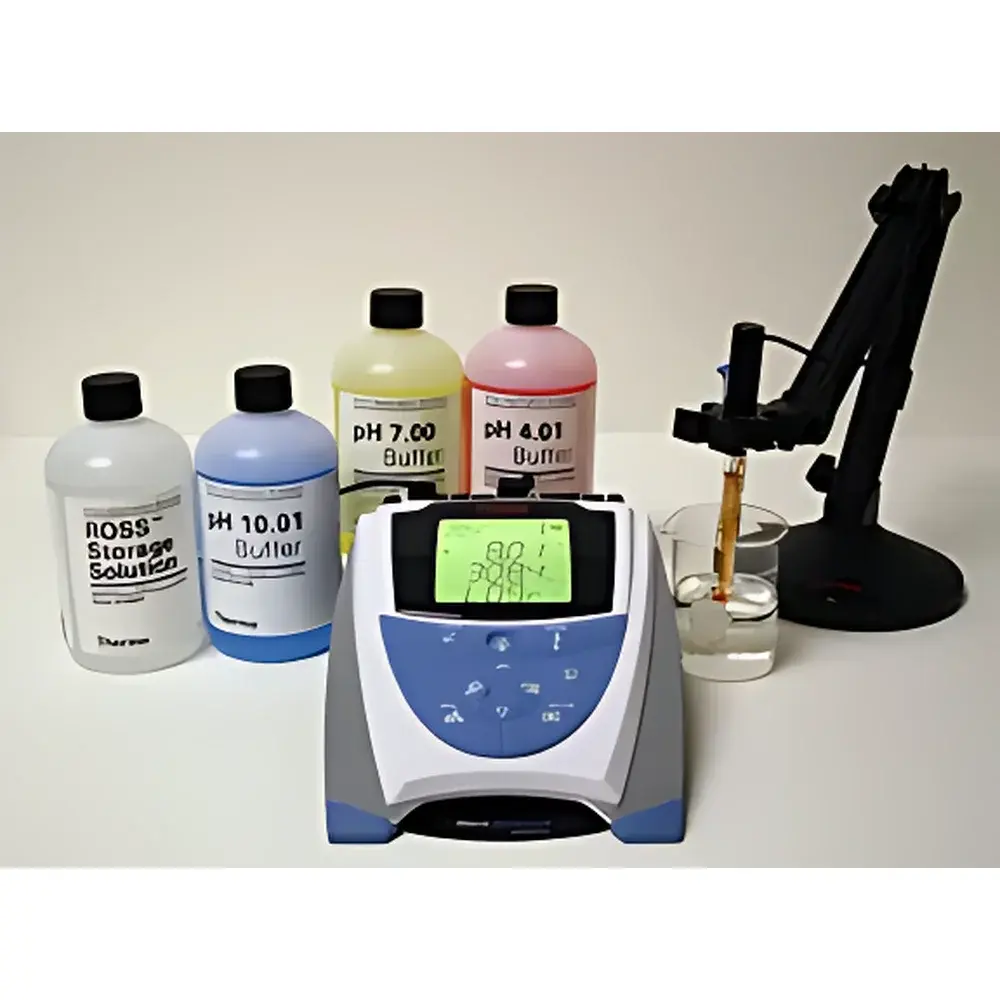
Thermo Scientific Orion Star LogR pH/ISE Meter
| Brand | Thermo Fisher |
|---|---|
| Origin | USA |
| Manufacturer | Thermo Fisher Scientific |
| Product Line | Orion Star LogR Series |
| Model | LogR pH/ISE |
| Measurement Principle | Potentiometric (Glass Electrode + ISE) with LogR™ Membrane Resistance-Based Temperature Sensing |
| Compliance | ASTM D1293, ISO 10523, USP <791>, EPA Method 150.1, GLP-Ready |
Overview
The Thermo Scientific Orion Star LogR pH/ISE Meter is a laboratory-grade potentiometric measurement system engineered for high-reproducibility pH and ion-selective electrode (ISE) analysis in environmental, regulatory, and quality control laboratories. Unlike conventional pH meters requiring separate temperature probes, the LogR Meter implements Thermo Fisher’s proprietary LogR™ technology—measuring the electrical resistance of the pH electrode’s glass membrane to derive sample temperature in real time. This intrinsic temperature determination eliminates thermal lag, reduces calibration complexity, and enables automatic, electrode-specific temperature compensation without auxiliary sensors. The instrument operates on a dual-mode architecture: dedicated pH mode and combined pH/ISE mode, supporting quantitative analysis of monovalent and multivalent ions (e.g., F⁻, Cl⁻, NO₃⁻, NH₄⁺, Ca²⁺) via direct concentration or standard addition methods. Designed as a direct successor to the Orion PerpHecT® LogR™ 320/350/370 series, it meets the functional and compliance requirements of modern water quality testing workflows under ISO/IEC 17025-accredited environments.
Key Features
- LogR™ Technology: Real-time membrane resistance measurement (0–6000 MΩ) for accurate, electrode-integrated temperature determination; eliminates need for external ATC probes
- Enhanced Calibration Intelligence: Up to 5-point pH calibration with auto-buffer recognition (USA/NIST, EURO/DIN); 5-point ISE calibration with linear/nonlinear options, automatic blank correction, and low-concentration optimization
- SMART STABILITY™ and SMART AVERAGING™ algorithms: Dynamically adjust response criteria based on signal drift and noise level to ensure measurement validity before data capture
- High-Resolution Display: Backlit LCD showing simultaneous pH/mV/°C/LogR resistance values; configurable decimal places (1–3) for ISE results
- Data Integrity Architecture: Time-stamped storage of up to 1000 measurements; password-protected method recall (up to 10 user-defined protocols); RS232 interface for secure data export and firmware updates
- Comprehensive Diagnostics: On-screen LogR resistance value enables rapid electrode health assessment—abnormal resistance (>2000 MΩ at 25°C or sudden drift) triggers visual alerts for proactive maintenance
Sample Compatibility & Compliance
The Orion Star LogR pH/ISE Meter is validated for aqueous samples across environmental monitoring applications—including raw water, drinking water, wastewater effluents, surface runoff, and groundwater. It supports measurement of pH (–2.000 to 19.999), mV/ORP (±1999.9 mV), ion concentration (0–19999 in selectable units: M, mg/L, %, ppb), and temperature (0–100 °C). Its design conforms to critical regulatory frameworks: ASTM D1293 (pH of water), ISO 10523 (water quality — determination of pH), USP (pH measurement for pharmaceutical waters), and EPA Method 150.1 (pH and conductivity in ambient water). When operated with audit-trail-enabled software (e.g., Thermo Fisher Orion CompuLab™), the system supports 21 CFR Part 11-compliant electronic records and signatures, making it suitable for GLP and GMP-regulated laboratories.
Software & Data Management
Data export is performed via RS232 serial interface to compatible PCs running Thermo Fisher’s Orion CompuLab™ software or third-party LIMS platforms. The meter stores full metadata—including date/time stamp, electrode ID (if encoded), calibration history, slope/offset values, and LogR resistance readings—for each measurement. All stored entries are immutable post-acquisition; deletion requires administrator-level password authentication. Firmware updates preserve calibration coefficients and method configurations. For traceability, the system logs operator-initiated events (e.g., calibration start/end, mode change, buffer selection) with timestamps—supporting internal QA audits and external accreditation reviews per ISO/IEC 17025 Clause 7.7.
Applications
- Regulatory water quality testing per EPA, WHO, and EU Drinking Water Directive requirements
- pH and fluoride monitoring in municipal water treatment plants
- Nitrate and ammonium analysis in agricultural runoff and aquaculture systems
- Calibration verification and electrode performance trending using LogR resistance baselines
- Method development for low-level ion detection in ultrapure water systems
- Educational labs requiring robust, teachable potentiometric principles with diagnostic transparency
FAQ
How does LogR technology eliminate the need for a separate temperature probe?
LogR measures the inherent resistance of the pH electrode’s hydrated glass membrane, which exhibits a predictable, temperature-dependent resistivity curve. By correlating resistance to temperature using NIST-traceable calibration coefficients, the meter calculates sample temperature directly from the electrode—removing sensor mismatch and thermal inertia errors.
Can the LogR Meter be used for non-aqueous or high-ionic-strength samples?
It is optimized for aqueous matrices. For non-aqueous solvents or samples >1 M ionic strength, use of a double-junction reference electrode (e.g., Orion 927007) and appropriate ISE conditioning is required; consult Thermo Fisher Application Note AN-128 for extended matrix validation.
Is the LogR resistance value traceable to international standards?
Yes—LogR calibration is referenced to NIST Standard Reference Materials (SRMs) 186, 187, and 188 for pH, and certified resistance standards (e.g., Fluke 742A) for impedance verification during factory certification.
Does the meter support GLP-compliant audit trails?
When paired with Orion CompuLab™ software and configured with user roles/passwords, it generates compliant audit trails including calibration logs, data edits, and instrument configuration changes—all timestamped and digitally signed per 21 CFR Part 11 requirements.
What happens if LogR resistance exceeds 3000 MΩ during measurement?
The display shows a warning icon and “HIGH R” flag; this indicates potential electrode dehydration, clogged junction, or aging membrane—prompting recalibration, cleaning, or replacement per Orion Technical Bulletin TB-117.
Related Products







