
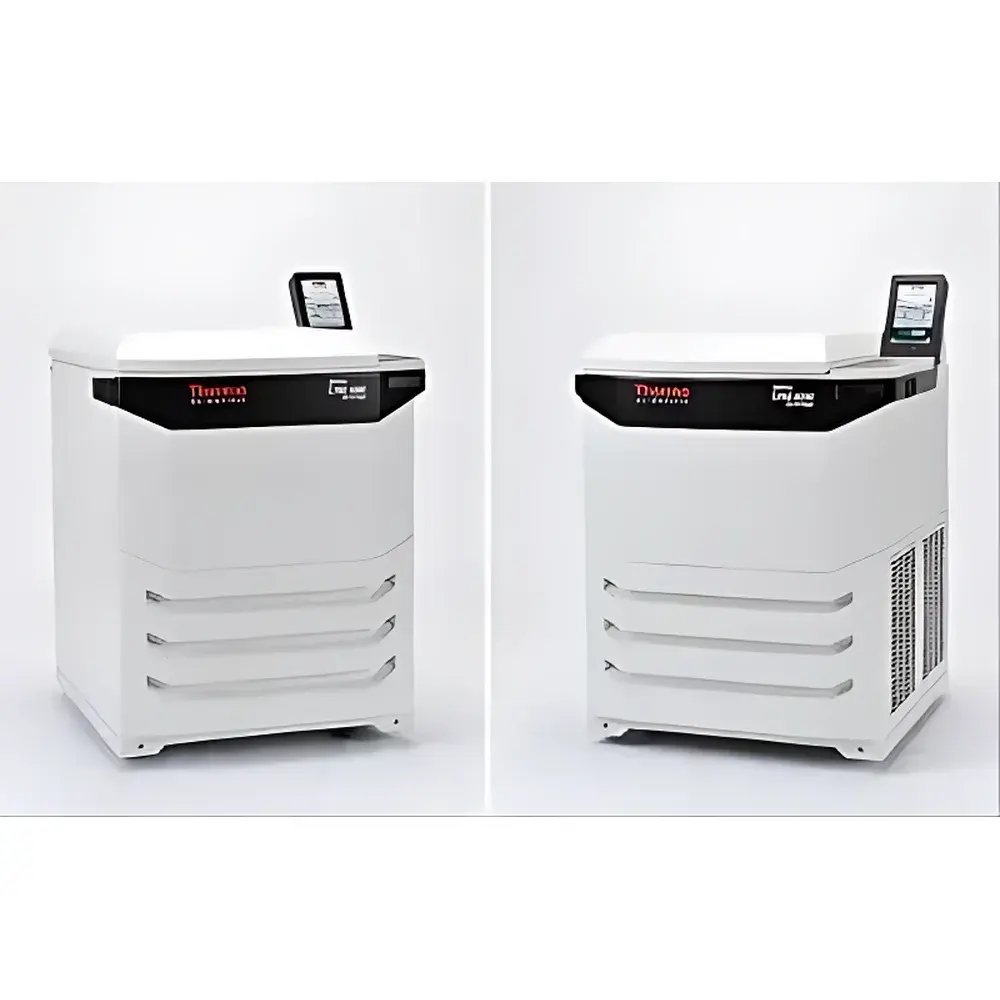
Thermo Scientific Sorvall LYNX4000 High-Speed Floor Model Centrifuge
| Brand | Thermo Fisher |
|---|---|
| Origin | Germany |
| Manufacturer | Thermo Fisher Scientific |
| Product Category | Imported |
| Model | LYNX 4000 |
| Maximum Speed | 24,000 rpm |
| Maximum RCF | 100,605 × g |
| Maximum Capacity | 4 × 1000 mL (with A27-8×50 rotor) |
| Dimensions (H×W×D, lid open) | 93 cm × 80.5 cm × 70 cm |
| Rotor Interface | Auto-Lock® self-locking mechanism |
| Rotor Recognition | Auto-ID® instant rotor identification |
| Safety System | ClickSeal® biocontainment lid (third-party certified) |
| Rotor Material | Fiberlite® carbon-fiber composite |
| Available Rotors | 19 configurations |
| Acceleration/Deceleration | Optimized for rapid ramp-up and controlled coast-down |
Overview
The Thermo Scientific Sorvall LYNX4000 is a high-performance floor-standing centrifuge engineered for demanding laboratory and pilot-scale applications requiring both high g-force and large-volume processing capability. Operating on the principle of sedimentation under controlled rotational acceleration, the LYNX4000 delivers up to 100,605 × g at its maximum speed of 24,000 rpm—enabling efficient separation of subcellular organelles, viral particles, macromolecular complexes, and process-scale biologics. Its robust architecture supports continuous operation in research, quality control, and GMP-aligned manufacturing environments. Designed and manufactured in Germany, the system integrates precision-machined components with thermally stable drive electronics and an advanced vacuum-assisted refrigeration system (–10 °C to +40 °C), ensuring consistent thermal management across extended runs.
Key Features
- Auto-Lock® rotor engagement system: Push-button mechanical locking eliminates manual torque application, reducing operator error and enhancing reproducibility across shifts.
- Auto-ID® instantaneous rotor recognition: Embedded RFID tags in each Fiberlite® rotor communicate geometry, material limits, and calibration data directly to the control firmware—preventing incompatible speed or temperature settings.
- ClickSeal® biocontainment lid: Independently tested and certified to ISO 15189 and EN 61000-6-3 standards for aerosol containment during high-speed operation; operable with one hand and compatible with standard biosafety cabinet workflows.
- Fiberlite® carbon-fiber rotors: Lightweight (up to 40% lighter than equivalent titanium rotors), chemically inert, and fatigue-resistant—ideal for repeated sterilization cycles and aggressive solvents including chlorinated hydrocarbons and concentrated acids.
- High-throughput capacity: Supports up to 4 × 1000 mL bottles (A27-8×50 rotor), 40 × 50 mL conical tubes, or 24 standard microplate carriers per run—minimizing batch-to-batch variability in downstream purification or assay preparation.
- Optimized acceleration/deceleration profiles: Programmable ramp rates (0.1–9.9 min to full speed; 0.1–12.0 min to stop) preserve sample integrity, especially for shear-sensitive biologics such as extracellular vesicles or protein aggregates.
Sample Compatibility & Compliance
The LYNX4000 accommodates a broad range of primary and secondary containment formats—including polypropylene, polycarbonate, and stainless-steel vessels rated for ≥24,000 rpm operation. All rotors comply with ISO 21501-4 (particle size distribution measurement of rotor materials) and meet IEC 61000-6-2 electromagnetic compatibility requirements. The system supports audit-ready operation under GLP and GMP frameworks: embedded event logging captures rotor ID, run parameters, temperature history, and door interlock status with timestamped records stored internally for ≥10,000 cycles. Optional 21 CFR Part 11-compliant software modules enable electronic signatures, role-based access control, and immutable audit trails for regulated environments.
Software & Data Management
Controlled via a 10.4-inch capacitive touchscreen interface with haptic feedback, the LYNX4000’s firmware supports multi-user profiles, password-protected method libraries, and real-time graphical display of RCF, speed, temperature, and elapsed time. Export options include CSV and PDF reports compliant with ISO/IEC 17025 documentation requirements. Integration with Thermo Fisher Connect™ enables remote monitoring, predictive maintenance alerts (based on bearing vibration harmonics and compressor duty cycle), and automatic firmware updates validated against internal release testing protocols.
Applications
- Cell fractionation workflows requiring isolation of mitochondria, lysosomes, or nuclei from mammalian tissue homogenates.
- Downstream processing of monoclonal antibodies and viral vectors, where high-g-force clarification reduces filter fouling in subsequent chromatography steps.
- Environmental microbiology: Concentration of low-abundance pathogens from large-volume water samples (e.g., 1–6 L per run) prior to qPCR or metagenomic sequencing.
- Materials science: Separation of nanoparticle dispersions by size-classified sedimentation velocity, supporting ASTM E2456-22 methodology for colloidal stability assessment.
- Vaccine development: Rapid pelleting of whole-inactivated virus preparations without compromising antigenic epitope conformation.
FAQ
What is the maximum relative centrifugal force (RCF) achievable with the LYNX4000 using the A27-8×50 rotor?
The LYNX4000 achieves 100,605 × g at 24,000 rpm with the A27-8×50 rotor (radius = 185 mm).
Is the system compatible with third-party rotors?
No—only Thermo Fisher–certified Fiberlite® and titanium rotors with integrated Auto-ID® chips are recognized and permitted for operation.
Does the LYNX4000 support validation documentation for IQ/OQ/PQ protocols?
Yes—factory-issued validation kits include calibrated thermistors, tachometer verification tools, and traceable certificates aligned with ISO/IEC 17025-accredited calibration laboratories.
Can the centrifuge operate unattended overnight?
Yes—programmable auto-start/stop, door-lid interlock redundancy, and overtemperature/imbalance shutdown safeguards meet UL 61010-1 safety certification for unsupervised use.
What refrigerant is used in the cooling system?
R-513A (GWP = 631), an ASHRAE-approved low-global-warming-potential alternative to R-134a, compliant with EU F-Gas Regulation No. 517/2014.



