
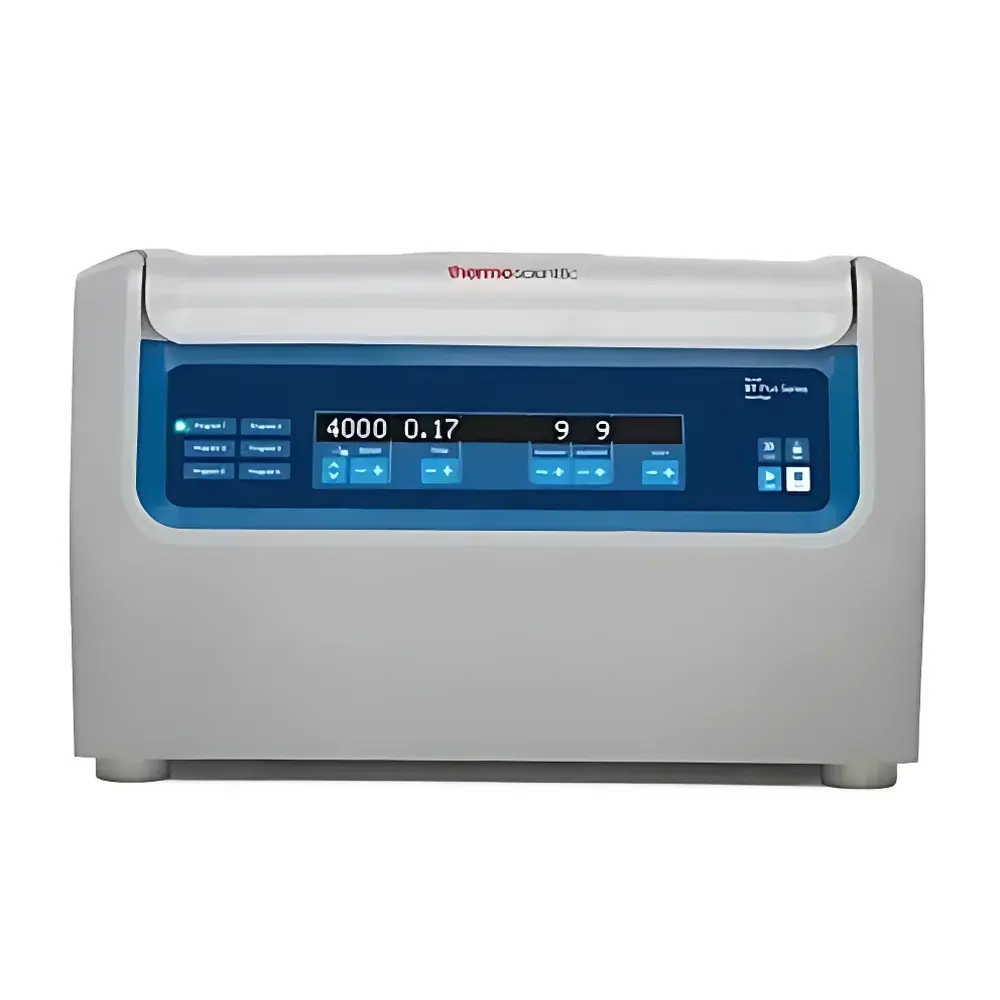
Thermo Scientific Sorvall ST4/ST4R Plus Benchtop Centrifuge
| Brand | Thermo Fisher |
|---|---|
| Origin | Germany |
| Manufacturer | Thermo Fisher Scientific |
| Product Type | Benchtop Centrifuge |
| Model | Sorvall ST4/ST4R Plus |
| Centrifuge Category | High-Speed Benchtop Centrifuge (10,000–30,000 rpm) |
| Rotor Type | Fixed-Angle & Swinging-Bucket Configurations |
| Maximum Capacity | 6 × 100 mL (with F20-6×100 rotor) |
| Max Relative Centrifugal Force (RCF) | 25,830 × g (fixed-angle, with 30 × 2 mL rotor) / 5,590 × g (swinging-bucket, with BIOShield1000 A rotor) |
| Dimensions | 690 mm × 566 mm × 362 mm |
| Energy Efficiency | Up to 40% lower energy consumption vs. conventional benchtop centrifuges for standard tube processing |
Overview
The Thermo Scientific Sorvall ST4/ST4R Plus is a high-performance benchtop centrifuge engineered for precision, safety, and operational efficiency in routine and demanding laboratory workflows. Designed and manufactured in Germany by Thermo Fisher Scientific, this dual-mode platform supports both fixed-angle and swinging-bucket rotors—enabling flexible adaptation across cell pelleting, plasma separation, microbial harvesting, and biomolecule purification applications. Its core architecture integrates robust brushless induction motor technology, active imbalance detection, and real-time RCF calculation based on rotor type and speed—ensuring reproducible sedimentation outcomes compliant with ISO 21501-4 (particle size analysis instrumentation) and aligned with GLP/GMP operational expectations. The ST4R Plus variant adds refrigeration control (–9 °C to +40 °C), making it suitable for temperature-sensitive samples such as enzymes, nucleic acids, and primary cell suspensions.
Key Features
- Auto-Lock™ III Quick-Change Rotor System: Enables tool-free, one-button rotor installation and removal—reducing setup time and minimizing mechanical wear on spindle interfaces.
- ClickSeal™ Biocontainment Lid: Certified by the UK Defence Science and Technology Laboratory (DSTL) at Porton Down for biosafety level 2 (BSL-2) containment; features glove-compatible, single-hand operation and eliminates threaded caps or latch mechanisms.
- Fiberlite™ Carbon-Fiber Rotors: Lightweight construction reduces inertia, accelerates spin-up/spin-down cycles, and extends rotor service life—certified to >100,000 cycles under full-load conditions per ISO 15197 Annex B.
- SMARTSpin™ Intelligent Rotor Management: Dynamically adjusts acceleration/deceleration profiles and torque delivery per rotor geometry and load distribution—enhancing run stability and mitigating vibration-induced sample resuspension.
- Intuitive High-Contrast Display Interface: Stores up to six user-defined protocols with editable parameters (speed, time, temperature, brake profile); displays real-time RCF, elapsed time, remaining time, and status alerts.
- Ergonomic Cavity Design: Optimized chamber height and sloped front panel enable effortless tube loading/unloading—even when installed on elevated workbenches; cavity surfaces are chemically resistant and smooth for rapid decontamination.
Sample Compatibility & Compliance
The Sorvall ST4/ST4R Plus accommodates a broad range of primary and secondary containers—including 0.2–100 mL conical tubes, blood collection tubes (e.g., Vacutainer®), microcentrifuge tubes, and PCR strips—across 12 certified rotor configurations. All rotors comply with IEC 61010-2-020 (safety requirements for laboratory centrifuges) and carry CE marking under EU Machinery Directive 2006/42/EC. The ClickSeal™ lid meets EN 14122-3:2016 (safety of machinery – permanent means of access) and is validated for aerosol containment during high-speed runs per CAMR Porton Down test protocol PR-1027. Refrigerated operation (ST4R Plus) adheres to ISO 13485:2016 requirements for medical device manufacturing environments.
Software & Data Management
While the ST4/ST4R Plus operates via standalone front-panel interface, its parameter logs—including date/time stamp, rotor ID, speed, RCF, temperature (ST4R Plus), run duration, and error codes—are retained in non-volatile memory for audit trail generation. The system supports manual export via USB flash drive (optional accessory) for integration into LIMS or electronic lab notebook (ELN) platforms. For laboratories requiring 21 CFR Part 11 compliance, Thermo Fisher offers optional IQ/OQ documentation packages and validation support services—covering installation qualification (IQ), operational qualification (OQ), and performance verification against manufacturer-specified tolerances.
Applications
- Routine clinical diagnostics: Separation of whole blood into serum/plasma layers using 15–50 mL conical tubes at 2,000–3,500 × g.
- Cell culture processing: Harvesting mammalian or bacterial cells at 3,000–10,000 × g with Fiberlite™ F14-6×50cy or F13-14×50 rotors.
- Nucleic acid isolation: Clarification of lysates prior to column-based purification using 2 mL microtubes at 15,200 × g (fixed-angle).
- Virus/bacteriophage concentration: Pellet recovery from large-volume supernatants using the F20-6×100 rotor (max 600 mL total capacity).
- Quality control testing: Particle removal from reagent solutions or buffer preparations in pharmaceutical QC labs operating under ISO/IEC 17025 accreditation.
FAQ
What is the difference between the ST4 and ST4R Plus models?
The ST4R Plus includes an integrated refrigeration system (-9 °C to +40 °C), while the ST4 operates at ambient temperature only.
Is rotor calibration required before use?
No—each Fiberlite™ and metal rotor is factory-calibrated and auto-recognized via embedded RFID tags compatible with SMARTSpin™ firmware.
Can the centrifuge be used in a biosafety cabinet?
Yes—the compact footprint (690 mm depth) and rear-mounted exhaust allow safe placement inside Class II A2 cabinets when operated without refrigeration.
Does the system support remote monitoring or network connectivity?
Not natively; however, analog output signals (0–10 V) for speed and temperature are available via optional I/O module for integration into building management systems.
How often should the rotor be inspected for fatigue or corrosion?
Per Thermo Fisher’s maintenance guidelines, visual inspection is recommended before each use; full rotor certification (including non-destructive testing) is advised every 5 years or after 10,000 runs—whichever occurs first.



