
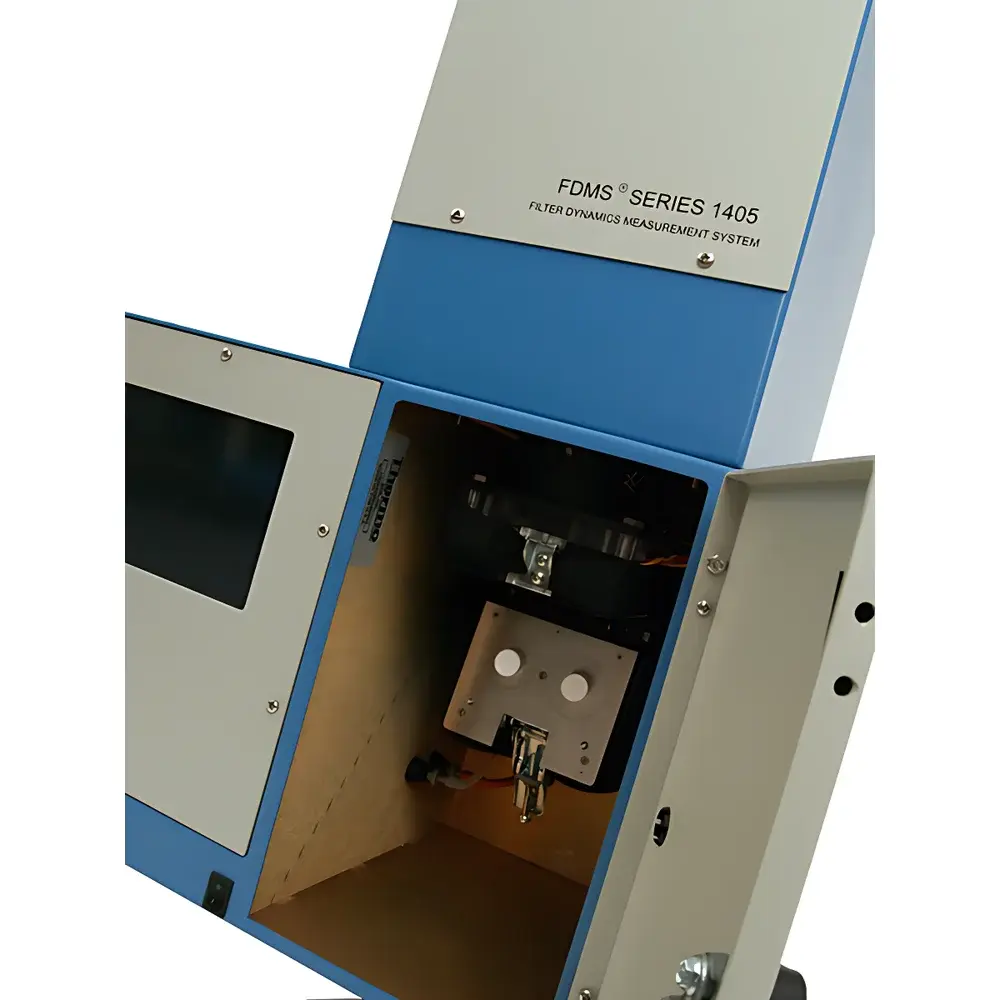
Thermo Scientific TEOM 1405-D Dual-Channel Atmospheric Particulate Matter Monitor
| Brand | Thermo Fisher |
|---|---|
| Origin | USA |
| Manufacturer Type | Original Equipment Manufacturer (OEM) |
| Product Category | Imported Instrument |
| Model | TEOM 1405-D |
| Measurement Principle | Tapered Element Oscillating Microbalance (TEOM™) |
| Measured Parameters | PM₁₀, PM₂.₅, and PM<sub>coarse</sub> (PM₁₀ − PM₂.₅) |
| Data Averaging Intervals | 10 s to 24 h |
| Mass Concentration Range | 0–1,000,000 µg/m³ |
| Resolution | 0.1 µg/m³ |
| Accuracy | ±2.0 µg/m³ (1-hr avg), ±1.0 µg/m³ (24-hr avg) |
| Mass Measurement Uncertainty | ±0.75% |
| Sampling Flow Rates | Fine channel: 3.0 L/min |
| Coarse channel | 1.67 L/min |
| Bypass | 12.0 L/min |
| Operating Ambient Temperature | −40 °C to +60 °C (sensor/control unit maintained at 2–40 °C) |
| Communication Interfaces | Ethernet, USB, RS-232, RS-485, FTP server |
| Analog I/O | 8 configurable 0–1 V or 0–5 V outputs |
| Power Requirements | Main unit: 100–240 VAC, 440 VA, 47–63 Hz |
| Vacuum pump | 120 VAC/60 Hz (4.25 A) or 240 VAC/50 Hz (2.25 A) |
| Dimensions (W×D×H) | 42.5 in × 47.5 in × 73.8 in (1080 mm × 1207.5 mm × 1875 mm) |
| Weight | 18 kg |
| Compliance | CE (EN 61326, EN 61010-1), UL 61010-1:2004, CSA C22.2 No. 61010-1:2004, FCC Part 15 Subpart B Class B |
Overview
The Thermo Scientific™ TEOM™ 1405-D Dual-Channel Atmospheric Particulate Matter Monitor is an EPA-designated Federal Reference Method (FRM) and Federal Equivalent Method (FEM) compliant instrument engineered for continuous, real-time gravimetric measurement of ambient airborne particulate mass concentrations. It employs the proven Tapered Element Oscillating Microbalance (TEOM) principle — a direct, NIST-traceable mass measurement technique that eliminates reliance on optical or radiometric proxies. Unlike β-ray attenuation, light scattering, or pressure-drop-based methods, the TEOM 1405-D quantifies particle mass dynamically by detecting resonant frequency shifts of a precision-tapered oscillating element as particulate matter accumulates on its filter substrate. This fundamental physical approach ensures metrological traceability, high reproducibility, and immunity to hygroscopic artifact or refractive index bias commonly encountered in indirect measurement technologies.
Key Features
- Dual independent TEOM sensor channels enabling simultaneous, co-located measurement of PM10, PM2.5, and PMcoarse (calculated as PM10 − PM2.5) using a virtual impactor-based size-selective inlet configuration
- Integrated Activol™ active volumetric flow control system with real-time temperature and barometric pressure compensation to maintain constant sampling volume across ambient conditions
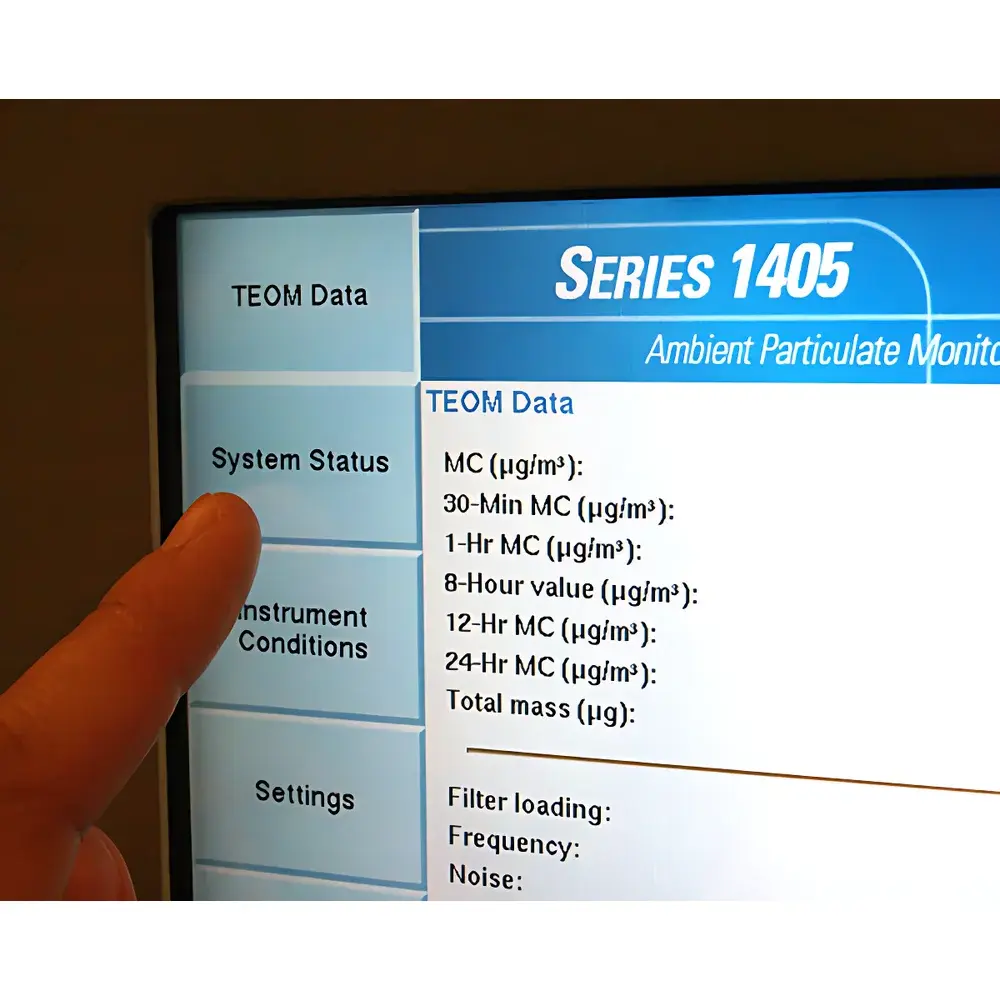
- High-resolution 1/4 VGA touchscreen interface with intuitive menu-driven operation — no external PC required for routine monitoring or calibration verification
- Comprehensive communications suite including Ethernet (TCP/IP), USB host/device, RS-232, RS-485, and embedded FTP server for remote data retrieval and firmware updates
- Robust environmental design: sensor and electronics enclosure rated for stable operation within 2–40 °C; optional outdoor-rated cabinet available for unconditioned deployment
- Configurable analog I/O architecture supporting eight user-defined voltage outputs, four scaled analog inputs, and two programmable relay alarms for integration into SCADA or facility control systems
Sample Compatibility & Compliance
The TEOM 1405-D accepts standard 47-mm Pallflex™ TX40 hydrophobic polytetrafluoroethylene (PTFE) filters with 13-mm effective collection area, ensuring compatibility with long-term archival requirements and inter-laboratory comparison protocols. Its measurement methodology satisfies U.S. EPA Performance Specifications for PM2.5 and PM10 monitors (40 CFR Part 53), and has been verified against ISO 12103-1 A2 test dust and NIST Standard Reference Materials (SRMs). The instrument’s hardware and firmware architecture supports audit-ready data integrity: all raw sensor readings, environmental metadata (T, P, RH), and operator actions are timestamped and stored with immutable logging. While not inherently 21 CFR Part 11-compliant out-of-the-box, its ePort™ software platform enables secure user authentication, electronic signatures, and full audit trail generation when deployed in GLP/GMP-regulated environments.
Software & Data Management
Local operation and diagnostics are managed via the built-in touchscreen UI, while remote access and advanced analysis are enabled through Thermo Scientific ePort™ and RPCOMM™ software suites. These applications provide real-time visualization of dual-channel mass concentration time series, diagnostic health metrics (e.g., oscillation amplitude, flow stability, temperature drift), and configurable alarm thresholds. Data are stored internally in non-volatile memory (500,000 records capacity) with user-definable variables and export formats (CSV, ASCII). All output intervals — from 10-second instantaneous values to 24-hour rolling averages — are programmable without firmware modification. Time-synchronized data streams support automated ingestion into third-party environmental data management systems (EDMS) via Modbus TCP or HTTP POST protocols.
Applications
The TEOM 1405-D serves as a primary reference-grade monitor in national air quality networks (e.g., U.S. EPA AirNow, European EEA EoI), regulatory compliance stations, and industrial fence-line monitoring programs. Its dual-channel architecture is especially valuable for source apportionment studies requiring concurrent coarse and fine mode resolution — such as construction site emissions characterization, cement kiln stack monitoring, or wildfire smoke event analysis. The instrument’s rapid temporal response (sub-minute resolution) also supports epidemiological exposure assessment, urban microscale dispersion modeling validation, and real-time public health alerting systems. Field deployments have demonstrated sustained operational uptime exceeding 98% over multi-year periods under diverse climatic regimes — from arctic tundra to desert heat islands.
FAQ
Is the TEOM 1405-D certified as a Federal Reference Method (FRM) or Federal Equivalent Method (FEM) for PM2.5 and PM10?
Yes — it is designated as an FEM for both PM2.5 and PM10 under 40 CFR Part 53, and meets all applicable performance requirements for regulatory monitoring networks.
How does the TEOM method handle humidity-induced mass artifacts during sampling?
The instrument incorporates a heated sample line (typically 30–40 °C) upstream of the TEOM sensor to minimize water adsorption on collected particles. Optional integrated denuders or Nafion dryers may be added for high-humidity environments where volatile semi-volatile organic compound (SVOC) losses must also be controlled.
Can the TEOM 1405-D operate unattended for extended periods?
Yes — with scheduled filter changes (typically every 14–30 days depending on ambient loading), annual calibration verification, and use of the optional outdoor cabinet, the system supports continuous unattended operation for >12 months per maintenance cycle.
What data security and traceability features are included?
All measurements include embedded UTC timestamps, sensor serial numbers, and environmental metadata. ePort™ software provides role-based access control, electronic signature workflows, and tamper-evident audit logs compliant with GLP and ISO/IEC 17025 documentation requirements.
Does the instrument require external vacuum pumps or ancillary gas supplies?
A dedicated vacuum pump is supplied as standard equipment. No zero-air or calibration gas sources are required for routine operation, as the TEOM method relies solely on physical mass accumulation and does not depend on optical or radiometric standards.
Related Products







