
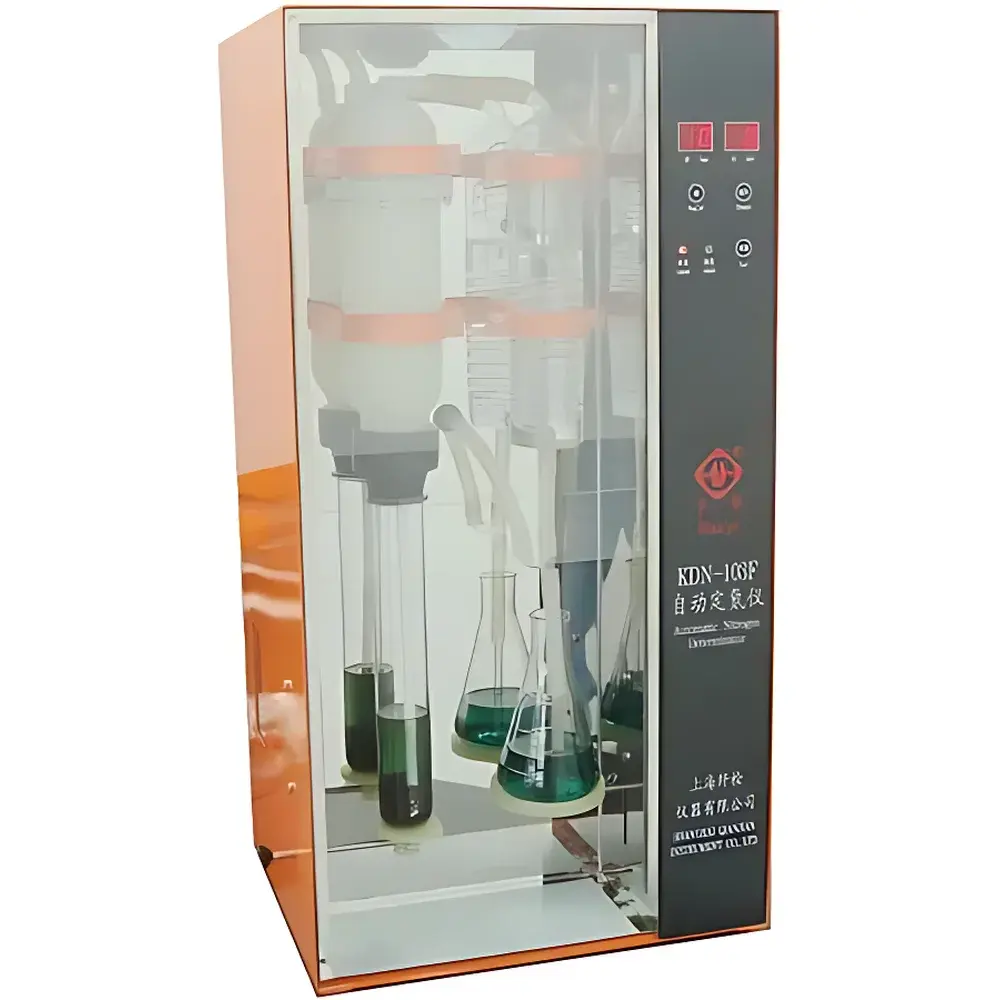
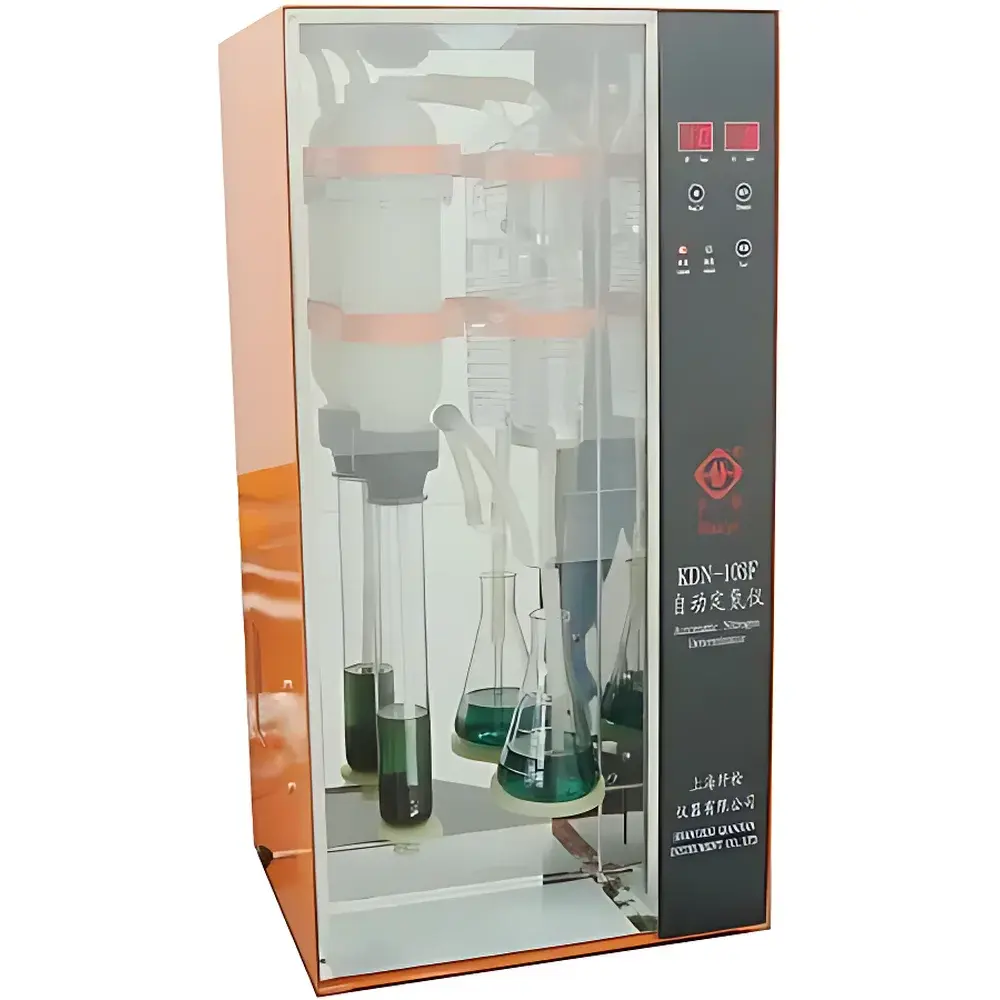
Truelab KDN-103F Semi-Automatic Kjeldahl Nitrogen Determinator
| Brand | Truelab |
|---|---|
| Origin | Shanghai, China |
| Model | KDN-103F |
| Instrument Type | Kjeldahl Nitrogen Determinator |
| Automation Level | Semi-Automatic |
| Nitrogen Determination Range | 0.1–200 mg N |
| Steam Distillation Rate | 25 mL/min |
| Repeatability (RSD) | ≤0.2% |
| Sample Mass | 0.3–8 g (solid) or 5–30 mL (liquid) |
| Nitrogen Recovery Rate | ≥99.5% |
| Power Consumption | 1200 W |
| Dimensions (L×W×H) | 360 × 300 × 700 mm |
| Weight | 27 kg |
| Operating Voltage | 220 V ±10%, 50–60 Hz |
| Alkali Addition Volume per Cycle | 150 mL |
| Condensate Reception Volume | 400 mL |
| Acid/Alkali-Resistant Splash Guard Material | High-Performance Molded Polymer |
Overview
The Truelab KDN-103F Semi-Automatic Kjeldahl Nitrogen Determinator is engineered for precise, reproducible quantification of total nitrogen content in organic and inorganic samples via classical Kjeldahl digestion and steam distillation methodology. Designed in accordance with internationally recognized analytical principles—specifically ISO 8968-1 (milk and milk products), AOAC 984.13 (cereals and feeds), and ASTM D1122 (petroleum products)—this instrument delivers trace-level nitrogen measurement across a broad dynamic range (0.1–200 mg N), supporting accurate protein estimation using standard conversion factors (e.g., 6.25 for cereals, 6.38 for dairy). Its core architecture integrates a microprocessor-controlled steam generator, digitally timed alkali addition, and programmable distillation cycles—enabling consistent vapor generation, controlled reagent delivery, and high-fidelity endpoint detection without manual intervention during critical reaction phases.
Key Features
- Microcontroller-based operation with dual digital timers for independent control of alkali addition and steam distillation duration—eliminating mechanical potentiometer drift and ensuring long-term timing stability.
- Dual-stage audible alarm system: first alert issued one minute prior to distillation completion (prompting receiver flask repositioning), followed by final termination signal upon cycle conclusion.
- Modular operational logic permits isolated activation of alkali dosing or steam distillation—allowing method development, troubleshooting, and calibration verification without sequential dependency.
- Tactile membrane keypad interface with intuitive layout and haptic feedback—designed for glove-compatible use in laboratory environments with stringent hygiene or chemical exposure protocols.
- Non-volatile parameter memory retains user-defined settings (e.g., alkali volume, distillation time, delay intervals) across power cycles—reducing setup time for routine analyses.
- Corrosion-resistant splash guard fabricated from high-purity, injection-molded polymer—chemically inert to concentrated H₂SO₄, NaOH, and boric acid solutions under continuous thermal cycling.
- Integrated water level sensor and auto-refill circuit maintain uninterrupted steam generation at 25 mL/min nominal flow rate—supporting both micro- and macro-scale distillation protocols.
Sample Compatibility & Compliance
The KDN-103F accommodates heterogeneous sample matrices including solid foodstuffs (grains, meat, feed pellets), liquid formulations (milk, whey, fermentation broths), environmental solids (soil, sludge, compost), and industrial chemicals (fertilizers, polymers, pharmaceutical excipients). Sample mass flexibility (0.3–8 g solids; 5–30 mL liquids) enables adaptation to varying nitrogen concentrations and digestion kinetics. The system complies with GLP documentation requirements through timestamped operational logs (accessible via front-panel display), supports audit-ready record retention when paired with external data loggers, and meets electrical safety standards IEC 61010-1 and EMC directive 2014/30/EU. While not inherently 21 CFR Part 11 compliant, its deterministic control architecture facilitates integration into validated workflows under FDA-regulated quality systems when combined with appropriate procedural controls and electronic signature protocols.
Software & Data Management
The KDN-103F operates as a standalone benchtop analyzer with embedded firmware—no proprietary software installation required. All operational parameters are configured and monitored via the integrated LED display and tactile interface. Time-stamped cycle metadata—including start time, alkali volume dispensed, distillation duration, and end-of-cycle confirmation—is retained in volatile memory for immediate review. For laboratories requiring electronic data capture, analog output (0–10 V) and RS-232 serial interface options are available upon request, enabling connection to LIMS platforms or programmable logic controllers for automated report generation and trending analysis. Raw data export adheres to CSV-compliant formatting conventions compatible with Excel, JMP, and statistical process control (SPC) tools.
Applications
This instrument serves as a primary nitrogen quantification platform in QC/QA laboratories across agri-food, environmental testing, pharmaceutical manufacturing, and academic research. Typical use cases include: protein content validation in raw milk and infant formula per ISO 8968; crude protein determination in animal feed per AOAC 984.13; nitrogen balance studies in soil amendment trials; quality release testing of nitrogen-containing APIs; and regulatory compliance verification for fertilizer labeling (e.g., N-P-K declarations per ISO 5315). Its robust thermal management and corrosion-resistant construction ensure stable performance in high-throughput environments where daily sample loads exceed 20 determinations.
FAQ
What digestion units are compatible with the KDN-103F?
The KDN-103F is mechanically and thermally designed to interface with standard 4-, 8-, 14-, 20-, and 40-position aluminum-block digesters—both fixed-temperature and programmable variants—provided they conform to DIN 12878 heating block dimensions and output steam delivery ports.
Does the instrument support automatic titration integration?
No. The KDN-103F performs only the distillation step; endpoint detection and titrimetric quantification require external burettes or autotitrators connected via optional analog or RS-232 interfaces.
Is the 99.5% nitrogen recovery rate validated per ISO 1871?
Yes—recovery validation was conducted using certified reference materials (CRM) NIST SRM 8414 (Bovine Serum Albumin) and BAM CRM 010 (Wheat Flour) under controlled digestion conditions (H₂SO₄ + K₂SO₄ + CuSO₄ catalyst, 360 °C, 60 min), meeting ISO 1871:2006 acceptance criteria for recovery accuracy.
Can the unit be operated in continuous batch mode?
Yes—its auto-refill steam generator and thermal stabilization design permit unattended operation for up to 8 consecutive distillation cycles without manual water replenishment or cooldown intervals.
What maintenance intervals are recommended for optimal precision?
Quarterly inspection of condenser tubing integrity, biannual calibration of alkali pump volumetric delivery (using gravimetric verification), and annual verification of steam pressure regulation against NIST-traceable manometers are advised per manufacturer service guidelines.
Related Products




