
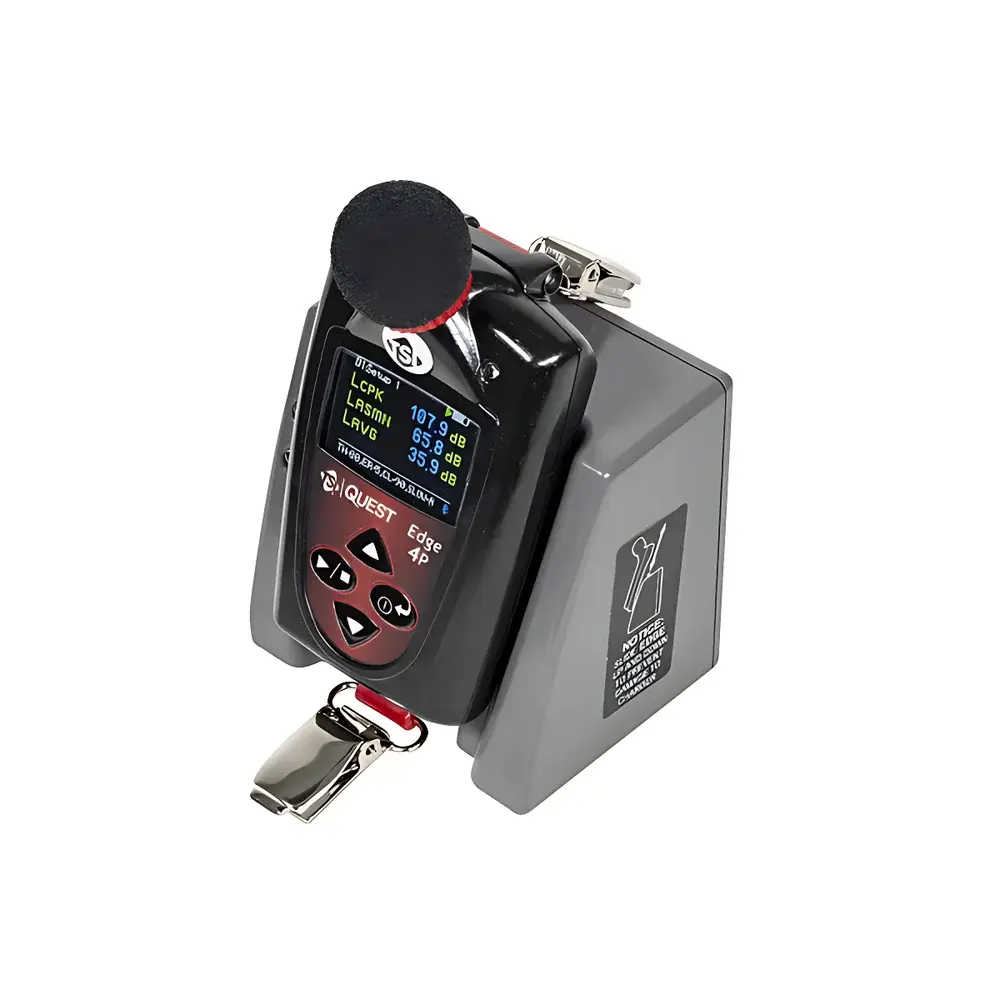
TSI Edge4+ Personal Noise Dosimeter
| Brand | TSI |
|---|---|
| Origin | USA |
| Model | Edge4+ |
| Weight | 85 g |
| Display | OLED color screen |
| Alarm | LED dose-exceedance indicator |
| Dose Groups | 2 independent configurable dose calculation sets |
| Power Management | Auto-display-off option for extended battery life |
| Compliance Standards Support | OSHA 1910.95, ISO 9612, ANSI S1.25, EU Directive 2003/10/EC |
| Data Storage | Internal logging with timestamped dose history |
Overview
The TSI Edge4+ Personal Noise Dosimeter is an occupational health instrumentation device engineered for accurate, real-time assessment of noise exposure in accordance with international regulatory frameworks governing hearing conservation programs. It operates on the principle of integrating sound pressure level (SPL) measurements over time—weighted by A-frequency weighting and exchange rate (typically 3-dB or 5-dB)—to compute time-weighted average (TWA) exposure and percentage noise dose relative to permissible exposure limits (PELs). Designed for continuous wear during full-shift monitoring, the Edge4+ captures acoustic data at user-defined intervals and applies standardized algorithms to quantify cumulative exposure risk. Its compact form factor and ergonomic shoulder-mount configuration ensure minimal interference with worker mobility while maintaining microphone positioning near the ear—critical for compliance with ISO 9612:2009 requirements for measurement geometry.
Key Features
- Ultra-lightweight construction (85 g) with low-profile shoulder strap mounting system for unobtrusive all-day wear
- High-contrast, sunlight-readable OLED color display providing immediate visual feedback on current dose, TWA, peak SPL, and elapsed measurement time
- Dual independent dose group configuration enabling simultaneous evaluation against multiple regulatory criteria—for example, concurrent OSHA 8-hour PEL (85 dBA, 5-dB exchange rate) and EU Directive 2003/10/EC action levels (80/85 dBA)
- LED-based visual alarm activated when preset dose thresholds (e.g., 85%, 100%, or 200% of daily limit) are exceeded—no audible alert to avoid workplace distraction or masking effects
- Configurable auto-display-off function to conserve battery life during extended deployments without compromising data integrity
- Internal non-volatile memory stores timestamped dose records, including start/stop times, dose percentages, TWAs, and calibration status flags
Sample Compatibility & Compliance
The Edge4+ is validated for use across diverse industrial environments—including manufacturing, construction, mining, transportation, and maintenance operations—where workers are exposed to intermittent, variable, or impulsive noise sources. Its microphone placement and directional response meet the spatial constraints defined in ISO 9612 for personal sampling. The instrument supports configuration for both legacy and modern exposure models, including OSHA 1910.95 (US), HSE L108 (UK), and ISO 1999:2013-based risk estimation. All internal calculations adhere to ANSI S1.25-1991 (R2021) for dosimetry accuracy and traceability. Device firmware is designed to maintain audit-ready data logs compliant with GLP-aligned recordkeeping practices, including immutable timestamps and operator ID tagging where integrated with TSI’s LogTrack software suite.
Software & Data Management
Data retrieval and analysis are performed via TSI’s LogTrack PC application (Windows-compatible), which imports binary log files through USB connection. LogTrack enables export of dose reports in CSV, PDF, and Excel formats—with customizable templates aligned to corporate EHS reporting standards. Each dataset includes metadata such as calibration date, microphone sensitivity, exchange rate selection, criterion level, and any manual annotations entered during download. The software supports batch processing of multi-user deployments and generates summary dashboards showing departmental exposure trends, high-risk task identification, and longitudinal comparison across shifts or weeks. All exported reports retain digital signatures and version-controlled metadata to satisfy internal quality audits and external regulatory inspections under ISO 45001 or OSHA recordkeeping requirements.
Applications
- Baseline noise exposure assessments prior to implementation of engineering controls
- Validation of hearing protection device (HPD) effectiveness through real-world attenuation verification
- Task-based exposure mapping to identify high-risk activities for administrative control prioritization
- Post-intervention monitoring following installation of noise-reduction measures (e.g., enclosures, damping, or mufflers)
- Compliance documentation for annual OSHA 300/301 logs and EU occupational health surveillance reporting
- Academic and industrial hygiene research requiring high-fidelity personal dosimetry datasets
FAQ
Does the Edge4+ support real-time wireless data streaming?
No—the Edge4+ operates as a standalone data logger. Real-time telemetry is not implemented to preserve battery longevity and measurement integrity in harsh industrial settings.
Can the device be calibrated in-field without returning to a service center?
Yes—users may perform acoustic verification using a compatible pistonphone (e.g., TSI 901A) to confirm microphone sensitivity drift; full recalibration requires NIST-traceable laboratory service.
Is the firmware upgradable, and how is version control managed?
Firmware updates are distributed via TSI’s secure customer portal and installed through LogTrack; each update includes SHA-256 checksum validation and revision history logging for regulatory traceability.
What battery type does the Edge4+ use, and what is its typical operational lifespan?
It uses a rechargeable lithium-ion battery rated for ≥24 hours of continuous logging at standard settings; battery health metrics are logged internally and visible in LogTrack post-download.
How does the dual-dose-group functionality handle conflicting exposure criteria?
Each group maintains independent integration parameters (criterion level, threshold, exchange rate, and averaging period); results are stored separately and never merged—ensuring unambiguous regulatory alignment per jurisdiction or internal policy.
Related Products







