TSI PresSura RPC30 Room Pressure Controller
| Brand | TSI |
|---|---|
| Origin | USA |
| Model | RPC30 |
| Sensor Technology | Thermal Mass Flow-Based Differential Pressure Sensing |
| Compliance | ANSI/ASHRAE/ASHE Standard 170-2008, FGI Guidelines 2010, CDC Environmental Infection Control Guidelines, USP <797> |
| Alarm System | Dual visual (LED) and audible (85 dB @ 1 m), user-configurable delay |
| Input Support | Differential pressure (±125 Pa), temperature (–10 to 60 °C), relative humidity (0–100 % RH), volumetric airflow (4–20 mA or 0–10 V analog inputs) |
| Control Output | 0–10 V DC or 4–20 mA for damper/valve actuation |
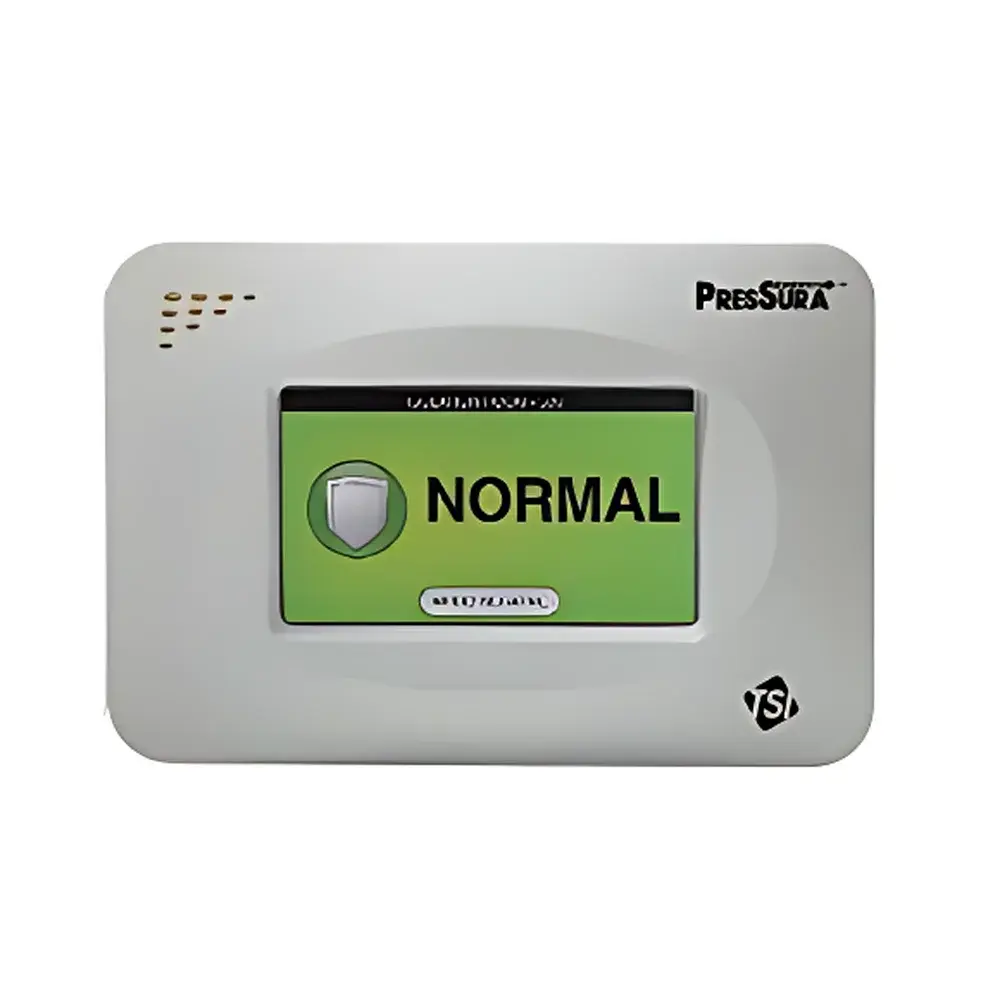
| Display | Color touchscreen (4.3″, capacitive), icon-driven UI with real-time status visualization |
| Communication | BACnet MS/TP, Modbus RTU, optional BACnet/IP via gateway |
| Security | Password-protected configuration access (admin/user levels) |
| Operating Mode | Isolation (AII/PE/OR) ↔ Neutral (non-isolation) toggle via physical key switch |
Overview
The TSI PresSura RPC30 Room Pressure Controller is an engineered solution for continuous, real-time differential pressure monitoring and active control in critical healthcare environments. It operates on the principle of thermal mass flow-based differential pressure measurement — a method inherently stable across varying temperature and humidity conditions, eliminating drift commonly observed in piezoresistive or capacitive sensors under transient HVAC loads. Designed specifically for compliance-critical spaces including Airborne Infection Isolation Rooms (AII), Protective Environment Rooms (PE), Operating Rooms (ORs), pharmacy cleanrooms, and biosafety laboratories, the RPC30 maintains prescribed pressure differentials (typically –2.5 Pa to +12.5 Pa) by dynamically modulating damper positions via analog output signals. Its architecture integrates pressure, temperature, and relative humidity sensing into a single validated platform — enabling environmental correlation analysis without external data fusion. The device functions as both a verification instrument and a closed-loop controller, satisfying functional safety requirements outlined in ASHRAE Standard 170-2008 Section 6.1.3 and FGI 2010 Guideline 2.1-2.
Key Features
- Thermal mass flow sensor core delivering long-term zero stability and immunity to particulate accumulation — validated per ISO 8573-1 Class 4 for medical air applications
- Configurable dual-stage alarm system: visual (high-contrast LED status ring + screen icon) and audible (85 dB at 1 m), with adjustable delay (0–300 s) to suppress nuisance alarms during routine door openings or HVAC transients
- Dedicated hardware key switch for immediate mode transition between isolation (AII/PE/OR) and neutral (non-isolation) operation — supporting decontamination protocols and maintenance workflows
- Embedded color touchscreen interface with intuitive iconography, real-time pressure trend graphing, and color-coded status zones (green/yellow/red) aligned with CDC and ASHE severity thresholds
- BACnet MS/TP and Modbus RTU native support for direct integration into hospital-wide BAS without protocol gateways; optional BACnet/IP expansion available
- Password-protected configuration hierarchy (admin/user) enforcing change control per FDA 21 CFR Part 11 Annex 11 principles for auditability and accountability
Sample Compatibility & Compliance
The RPC30 is validated for use in all ASHRAE 170-defined room types requiring controlled unidirectional airflow. It meets the performance criteria specified in ANSI/ASHRAE/ASHE Standard 170-2008 Table 6-1 (minimum pressure differential tolerances), FGI 2010 Guideline 2.1-2 (air barrier integrity verification), and CDC’s 2003 Environmental Infection Control Recommendations for AII rooms. For USP compliant pharmacy compounding areas, the unit supports continuous monitoring of positive-pressure differentials against adjacent corridors, with configurable alarm setpoints traceable to NIST-calibrated reference standards. All firmware revisions undergo formal verification against IEC 62304 Class B software lifecycle requirements. Device documentation includes IQ/OQ templates aligned with GMP Annex 15 for validation in regulated healthcare facilities.
Software & Data Management
The RPC30 operates autonomously without cloud dependency; all data logging, alarm history, and trend storage occur locally on internal non-volatile memory (retains ≥30 days of 1-minute interval data). Event logs include timestamp, pressure value, alarm state, mode change, and user ID (if authenticated). Configuration changes are recorded with operator ID, timestamp, and parameter before/after values — satisfying GLP/GMP audit trail requirements. Optional TSI Link™ software enables centralized fleet management across multiple RPC30 units, exporting CSV-formatted reports compatible with hospital CMMS platforms. Data export supports ISO/IEC 17025-compliant uncertainty reporting for pressure measurements (±0.25 Pa typical uncertainty at 25 °C, 50 % RH).
Applications
- Airborne Infection Isolation Rooms (AII): Maintains negative pressure differential (–2.5 Pa minimum) relative to anterooms and corridors to prevent pathogen escape
- Protective Environment Rooms (PE): Sustains positive pressure (+2.5 Pa minimum) to exclude ambient contaminants for immunocompromised patients
- Operating Rooms (ORs): Enforces directional airflow gradients per ASHRAE 170 Table 6-1, ensuring supply air exceeds exhaust by ≥12 air changes/hour
- USP Pharmacy Cleanrooms: Monitors ISO Class 5 buffer areas and segregated compounding areas for pressure cascade integrity
- Biosafety Level 2+ Laboratories & Animal Housing: Supports containment verification through differential pressure mapping and alarm-triggered HVAC interlocks
- Burn Units & Transplant Wards: Integrates with humidification systems to maintain combined pressure/humidity setpoints per clinical protocols
FAQ
What pressure range does the RPC30 measure and control?
The RPC30 measures differential pressure from –125 Pa to +125 Pa with a resolution of 0.1 Pa and full-scale accuracy of ±0.5 % of reading.
Can the RPC30 interface with existing building automation systems?
Yes — it natively supports BACnet MS/TP and Modbus RTU over RS-485; BACnet/IP is supported via optional communication gateway module.
How is calibration traceability maintained?
Each unit ships with a NIST-traceable calibration certificate; field recalibration is performed using TSI’s certified pressure calibrator (e.g., Model 4843) following ASTM E74 procedures.
Does the RPC30 support remote configuration or diagnostics?
Local configuration only via touchscreen or front-panel keys; remote read-only access is possible via BAS integration, but no remote write capability is enabled for security and regulatory compliance.
What happens during power loss or network interruption?
The device retains configuration and alarm history in non-volatile memory; upon recovery, it resumes control logic without manual reset and logs all outage events with timestamps.