
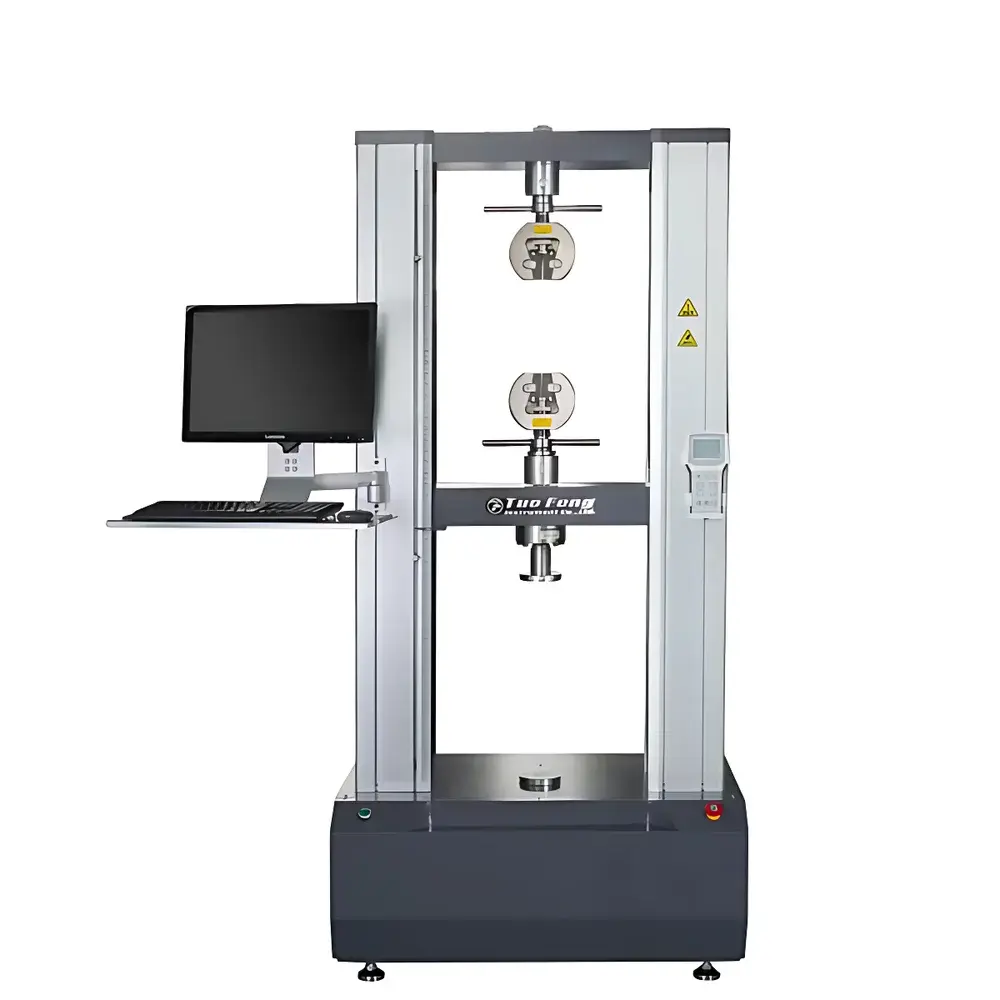
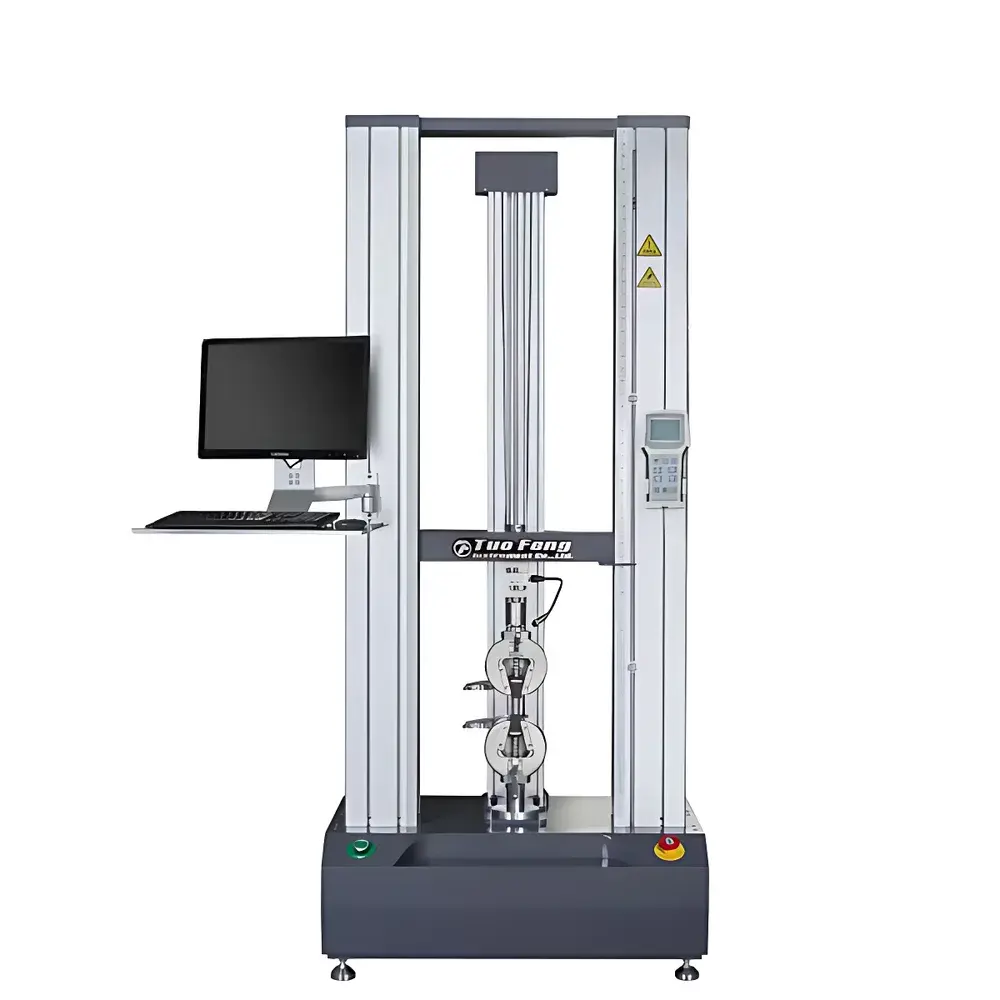
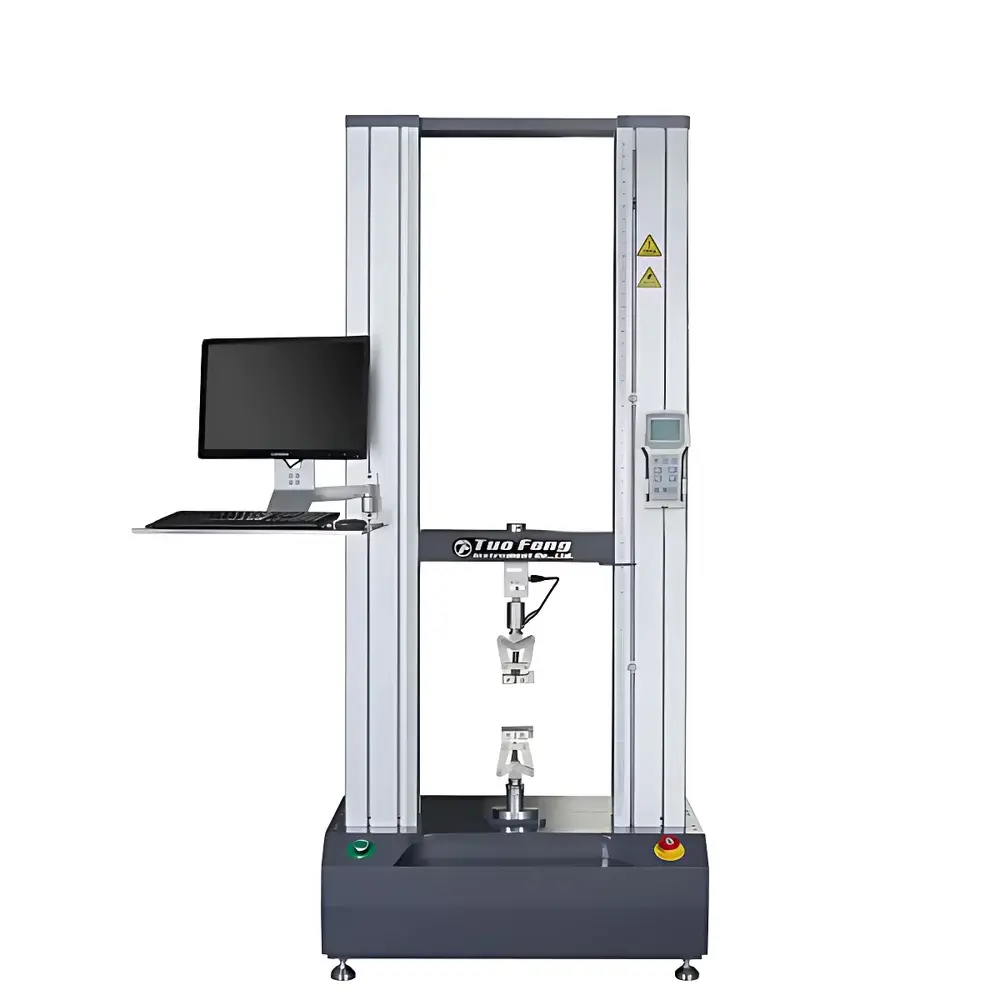
Tuofeng TFW-155 Advanced Microcomputer-Controlled Universal Testing Machine
| Brand | Tuofeng |
|---|---|
| Model | TFW-155 |
| Type | Electromechanical Universal Testing Machine |
| Max Test Load | 155 kN (customizable from 5–200 kN) |
| Accuracy Class | 0.5 |
| Effective Force Range | 0.2%–100% of full scale |
| Force Measurement Accuracy | ±0.005% of reading |
| Force Resolution | 1/±500,000 full-scale codes (single-range, no auto-ranging) |
| Drive System | Imported servo motor with precision worm-gear reducer |
| Lead Screw | High-precision preloaded ball screw |
| Effective Test Width | 600 mm (expandable) |
| Stroke | 800 mm (height-adjustable) |
| Speed Range | 0.001–500 mm/min (infinitely variable, closed-loop controlled) |
| Displacement Measurement | Optical encoder, accuracy ±0.005% of reading |
| Strain Measurement | Optional extensometer (clip-on or video-based) or large-deformation transducer, accuracy ±0.005% of reading |
| Safety Protection | Dual-limit electronic positioning, emergency stop, overload cutoff (>110% FS), automatic return after test |
| Control Mode | Load-controlled, displacement-controlled, strain-controlled, hold-mode (load/strain/displacement hold) |
| Software Compliance | Supports ASTM E4, E8/E8M, E9, E21, ISO 6892-1, ISO 7500-1, GB/T 228.1, GB/T 16491, JJG 475, DIN 51221, JIS Z 2241, BS EN 10002-1 |
Overview
The Tuofeng TFW-155 is a high-precision, microcomputer-controlled electromechanical universal testing machine engineered for static mechanical property characterization across metals, polymers, composites, elastomers, ceramics, and advanced engineering materials. Based on the fundamental principles of uniaxial force–displacement transduction via calibrated load cell feedback and closed-loop servo control, the system delivers traceable, repeatable, and standards-compliant mechanical data under tension, compression, bending, shear, peel, tear, and puncture configurations. Its rigid C-frame architecture, preloaded ball-screw actuation, and zero-backlash transmission ensure minimal compliance and high stiffness—critical for accurate modulus determination and low-force/high-resolution testing. Designed to meet the structural integrity and metrological requirements of ISO/IEC 17025-accredited laboratories, the TFW-155 serves as a primary reference instrument in R&D labs, QC/QA departments, and third-party certification bodies.
Key Features
- 0.5-class accuracy per ISO 7500-1 and GB/T 16491-2008, validated by national metrology institutes
- Single-range, high-resolution force measurement system (1/±500,000 FS) with no internal range switching—ensuring consistent resolution across the entire force span
- Closed-loop servo control enabling precise execution of complex test profiles: ramp-hold-ramp, cyclic loading, creep, stress relaxation, and multi-step displacement control
- Dual-speed automatic crosshead positioning (fast jog + fine adjustment) with programmable return-to-start functionality post-test
- Integrated safety architecture: hardware-based emergency stop, dual electronic limit switches, real-time overload detection (>110% FS), and mechanical torque-limiting clutch
- Modular fixture interface compatible with standardized wedge-action grips, compression platens, bend fixtures, peel jigs, and custom tooling per ASTM D638, ISO 527, ASTM D790, ISO 178, ASTM D1876, ISO 8510, and ASTM D624
Sample Compatibility & Compliance
The TFW-155 accommodates specimens ranging from miniature coupons (e.g., thin-film tensile bars per ASTM D882) to structural components (e.g., reinforced polymer rods or metallic weldments). Its expandable test width (up to 600 mm) and vertical stroke (800 mm) support both standard and non-standard geometries. The system is fully compliant with international mechanical testing standards including ASTM E4 (force verification), ASTM E8/E8M (tensile testing of metals), ASTM D638/D695/D790 (plastics), ISO 6892-1 (metallic materials), ISO 527-2 (polymer tensile), ISO 178 (flexural), and GB/T 228.1 (Chinese national standard for metallic tensile testing). Calibration certificates are traceable to NIM (National Institute of Metrology, China) and support GLP/GMP audit readiness per FDA 21 CFR Part 11 when paired with optional electronic signature and audit trail modules.
Software & Data Management
The embedded Windows-based testing software supports multilingual UI (English, Simplified/Traditional Chinese), customizable unit systems (N/kN/lbf, mm/in, MPa/psi), and real-time display of up to four synchronized curves: load–time, load–displacement, stress–strain, and displacement–time. All test parameters—including gauge length, cross-sectional area, hold duration, and control mode—are user-definable prior to execution. Raw data is stored in open ASCII format with timestamps, operator ID, environmental metadata (optional sensor integration), and full audit trail. The software enables batch statistical analysis (max/min/mean/std dev), curve overlay comparison across material batches or processing conditions, and automated report generation compliant with ISO/IEC 17025 documentation requirements. Firmware and application updates are delivered remotely; lifetime software maintenance is included.
Applications
The TFW-155 is deployed across industrial and academic domains requiring quantitative mechanical validation: tensile strength and elongation-at-break evaluation of aerospace-grade aluminum alloys (per AMS 4027); compressive yield behavior of cellular biomaterials; flexural modulus mapping of fiber-reinforced thermoplastics (ASTM D7264); peel adhesion quantification of pressure-sensitive tapes (ASTM D3330); tear resistance profiling of vulcanized rubber (ISO 34-1); and creep compliance assessment of high-performance polyimides under sustained thermal load. It is routinely used in supplier qualification programs (e.g., automotive PPAP), failure analysis investigations, and regulatory submissions supporting CE marking, FDA 510(k), or IEC 60601-1 mechanical safety claims.
FAQ
What standards does the TFW-155 comply with for calibration and verification?
It conforms to ISO 7500-1 (static calibration), ISO 376 (load cell verification), ASTM E4, GB/T 16491, and JJG 475, with optional NIST-traceable calibration certificate.
Can the system perform cyclic or fatigue testing?
The base configuration supports quasi-static and slow-cycle testing (≤5 Hz); high-frequency servo-hydraulic or electromagnetic fatigue add-ons require separate integration.
Is the software compliant with FDA 21 CFR Part 11?
Yes—when configured with role-based access control, electronic signatures, and immutable audit logs, it meets ALCOA+ data integrity principles.
What strain measurement options are available?
Standard optical encoder for gross displacement; optional clip-on axial extensometers (ASTM E83 Class B-1), video extensometry (for non-contact strain mapping), or large-deformation transducers for elastomers.
How is system maintenance and technical support provided?
Tuofeng offers remote diagnostics, on-site service contracts, annual performance verification, and lifetime software upgrades—no subscription fees.



