
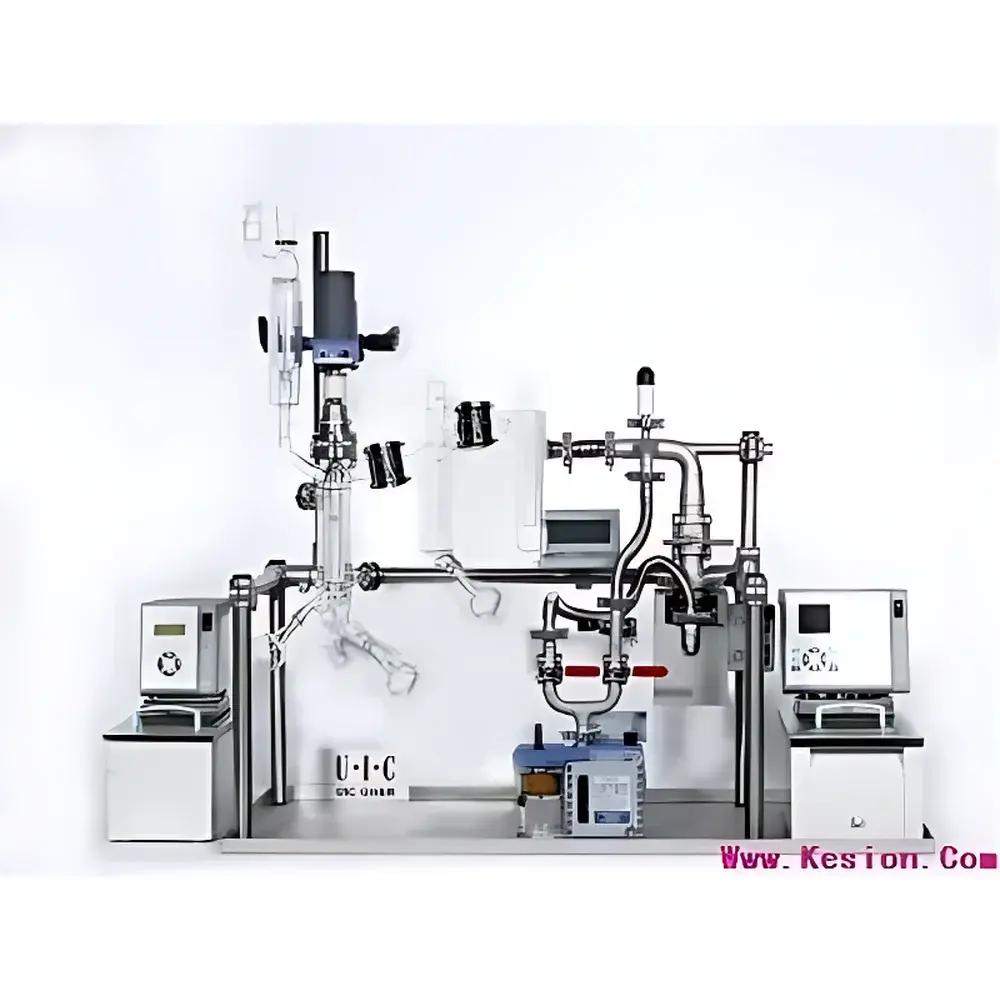
UIC KDL1 Benchtop Short-Path (Molecular) Distillation System
| Brand | UIC GmbH |
|---|---|
| Origin | Germany |
| Model | KDL1 |
| Feed Rate | 50–400 g/h |
| Effective Evaporation Area | 0.017 m² |
| Evaporator Internal Diameter | 120 mm |
| Condensation Area | 0.018 m² |
| Collecting Vials | 3-position rotatable receiver |
| Construction Material | Borosilicate Glass 3.3 |
| Max Evaporation Temperature | 250 °C |
| Ultimate Vacuum | ≤0.001 mbar |
| Heating Method | External Oil Bath |
| Film Formation | Self-Cleaning Roller-Type Wiper System |
Overview
The UIC KDL1 is a compact, benchtop short-path distillation system engineered for high-precision molecular distillation under ultra-high vacuum conditions. Based on the fundamental principle of molecular distillation—where separation occurs due to differences in mean free path rather than boiling point—the KDL1 enables thermal separation of thermally sensitive, high-boiling, or non-volatile compounds without significant thermal degradation. Its all-borosilicate glass 3.3 construction ensures full process visibility, chemical inertness, and compliance with laboratory-grade transparency requirements. Designed explicitly for R&D-scale purification, the system supports feed rates from 50 to 400 g/h and operates continuously at pressures as low as 0.001 mbar, making it suitable for isolating active pharmaceutical ingredients (APIs), natural extracts (e.g., tocopherols, fish oil concentrates), polymer stabilizers, and specialty fragrances.
Key Features
- Borosilicate glass 3.3 construction throughout—resistant to thermal shock, corrosion, and organic solvents; fully autoclavable components where applicable
- Self-cleaning roller-type wiper system ensuring uniform thin-film formation and minimal residence time (< 30 seconds typical)
- Integrated internal condenser (0.018 m² surface area) paired with an external condenser and cold trap for multi-stage vapor capture
- Three-position rotating receiver assembly enabling sequential collection of up to three distinct distillate fractions—and residual fraction—without interrupting vacuum or heating
- Dual-stage rotary vane vacuum system with real-time digital pressure monitoring (0.001–10 mbar range) compliant with ISO 27874 vacuum metrology standards
- Oil-bath heating with PID-controlled temperature regulation (ambient to 250 °C, ±1 °C stability) and direct visual observation of film dynamics and phase behavior
- Modular architecture: 12 functional subsystems—including feed control, residue discharge, dual distillate outlets, and vacuum measurement—are independently serviceable and configurable
Sample Compatibility & Compliance
The KDL1 accommodates viscous, heat-labile, and high-molecular-weight samples including polyphenols, phospholipids, squalene, CBD distillates, silicone oils, and synthetic intermediates. Its glass-wetted path eliminates metal contamination risks, satisfying USP and EP 3.2.1 material compatibility requirements. The system meets GLP documentation prerequisites when paired with validated vacuum logging software and audit-trail-enabled controllers. All vacuum components conform to DIN 28403 and ISO-KF flange standards; pressure sensors are NIST-traceable. No electrical components reside within the vacuum chamber, ensuring intrinsic safety per IEC 60079-0 for laboratory environments.
Software & Data Management
While the base KDL1 operates via analog controls and manual parameter adjustment, optional digital integration supports RS485/Modbus communication with third-party SCADA or LIMS platforms. Vacuum data, bath temperature, and feed rate (when using peristaltic feed pump add-on) can be logged at 1 Hz resolution. For regulated environments, the optional UIC DataLogger Pro module provides 21 CFR Part 11-compliant electronic records—including user authentication, change history, and immutable timestamps—required for FDA-submitted process validation dossiers. Raw vacuum and temperature logs export directly to CSV or ASTM E2500-17 compliant XML formats.
Applications
- Feasibility studies for scalable molecular distillation processes in API purification (e.g., removal of residual solvents or isomers)
- Isolation of omega-3 fatty acids (EPA/DHA) from fish oil hydrolysates while preserving cis-configuration integrity
- Refinement of botanical extracts—such as curcuminoids or gingerols—without decarboxylation or oxidation
- Recovery and concentration of catalyst residues from organometallic synthesis streams
- Characterization of thermal stability thresholds via controlled ramp-rate evaporation experiments
- Development of solvent-free purification routes aligned with ICH Q5C and Q5D guidelines for biologics manufacturing
FAQ
What vacuum level is required for optimal molecular distillation performance on the KDL1?
The system achieves full molecular regime operation below 0.01 mbar; for maximum separation efficiency with high-boiling-point compounds, sustained operation at ≤0.001 mbar is recommended using the included dual-stage rotary vane pump.
Can the KDL1 handle highly viscous feedstocks such as crude lanolin or polymer melts?
Yes—its self-cleaning roller wiper design maintains stable thin-film geometry across dynamic viscosities up to 50,000 cP at processing temperature, provided pre-heating and feed pre-conditioning are applied.
Is the borosilicate glass assembly compatible with aggressive solvents like chlorinated hydrocarbons or strong acids?
Borosilicate 3.3 exhibits excellent resistance to most organic solvents and diluted mineral acids (e.g., ≤30% HCl, ≤10% HNO₃); however, prolonged exposure to concentrated alkalis (e.g., >1 M NaOH) or hydrofluoric acid is not advised.
Does UIC provide IQ/OQ documentation packages for GMP-regulated laboratories?
Yes—UIC offers factory-verified Installation Qualification (IQ) and Operational Qualification (OQ) protocols, including calibration certificates for vacuum gauges and temperature sensors, traceable to DAkkS-accredited standards.



