
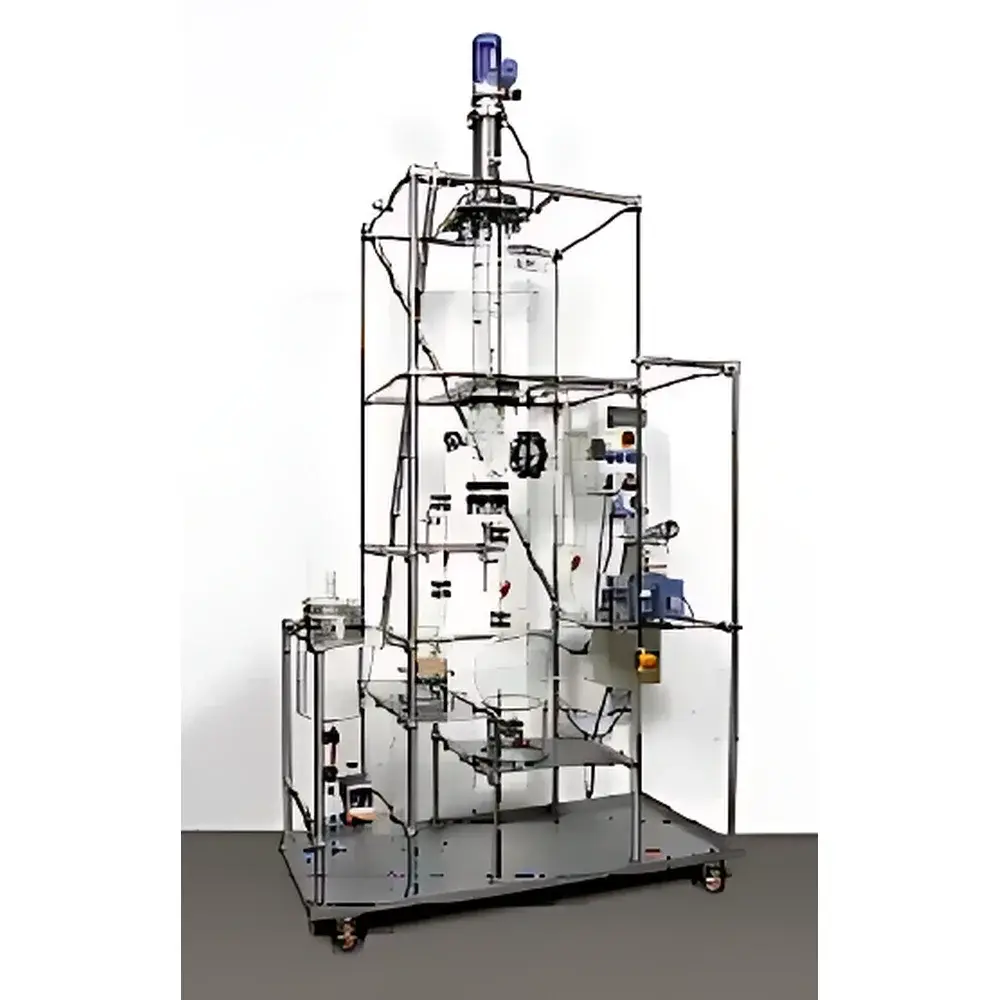
UIC KDL30 Pilot-Scale Glass Short-Path (Molecular) Distillation System
| Brand | UIC GmbH |
|---|---|
| Origin | Germany |
| Model | KDL30 |
| Feed Rate | 3–9 kg/h |
| Effective Evaporation Area | 0.15–0.3 m² |
| Evaporator Inner Diameter | 280 mm |
| Condenser Area | 0.58 m² |
| Collecting Flasks | 3 units |
| Construction Material | Borosilicate Glass 3.3, Nickel-Based Alloys, Tantalum Alloys |
| Max Evaporation Temperature | 250 °C |
| Min Operating Pressure | 0.001 mbar |
| Heating Method | Oil Bath |
| Film Formation | Self-Cleaning Roller-Type Wiper System |
Overview
The UIC KDL30 is a pilot-scale short-path molecular distillation system engineered for high-purity thermal separation of thermally sensitive, high-boiling, or metal-reactive compounds under ultra-high vacuum conditions. Unlike conventional fractional distillation, molecular distillation operates in the free-molecule regime—where mean free path exceeds evaporator-to-condenser distance—enabling separation based on differences in molecular volatility rather than boiling point alone. This principle allows effective purification of heat-labile substances such as polyunsaturated fatty acids (PUFAs), phospholipids, natural tocopherols, cannabinoids, and specialty polymers without significant thermal degradation. The KDL30 bridges the gap between laboratory benchtop units (e.g., KDL5) and full industrial plants, supporting flexible process development, GMP-aligned small-batch production, and regulatory-compliant impurity profiling.
Key Features
- Full borosilicate glass 3.3 construction for optical clarity, chemical inertness, and real-time process observation—critical for troubleshooting fouling or foaming behavior.
- Evaporator and condenser assemblies fabricated from corrosion-resistant nickel-based alloys and tantalum where metallic contact is unavoidable, ensuring compatibility with strongly acidic, halogenated, or oxidizing feedstocks.
- Self-cleaning roller-type wiper system ensures uniform thin-film formation across the entire evaporation surface, minimizing residence time (< 30 seconds typical) and maximizing thermal efficiency and reproducibility.
- Integrated oil bath heating with PID-controlled temperature regulation (range: ambient to 250 °C) and calibrated external thermocouple monitoring at multiple zones (evaporator wall, feed inlet, distillate outlet).
- Ultra-high vacuum capability down to 0.001 mbar, achieved via dual-stage vacuum system (mechanical pump + turbomolecular pump) with capacitance manometer pressure measurement and automated pressure stabilization.
- Modular three-flask collection train enables sequential fractionation, intermediate sampling, or parallel recovery of distillate and residue streams under continuous operation.
Sample Compatibility & Compliance
The KDL30 is validated for use with feed materials that exhibit strong reactivity toward stainless steel—including brominated flame retardants, chlorosilanes, organometallic precursors, and highly unsaturated lipids. Its all-glass fluid path eliminates catalytic side reactions (e.g., cis-trans isomerization, oxidation, or polymerization) commonly induced by metal surfaces. The system complies with ISO 9001 manufacturing standards and supports GLP/GMP documentation requirements through traceable calibration records, material certificates (EN 1744-1 for glass, ASTM B564 for nickel alloys), and optional audit-ready log files. Vacuum and temperature control systems meet IEC 61000-6-2/6-4 electromagnetic compatibility specifications.
Software & Data Management
The KDL30 integrates with UIC’s proprietary DISTRO software suite for real-time acquisition and visualization of process parameters—including vacuum level, evaporator wall temperature, feed flow rate (via optional mass flow controller), condenser temperature, and distillate collection timing. All data are timestamped, stored in CSV/Excel-compatible format, and support 21 CFR Part 11 compliance when configured with user authentication, electronic signatures, and audit trail logging. Optional OPC UA connectivity enables integration into centralized MES or LIMS platforms for batch record generation and quality attribute mapping.
Applications
- Purification of omega-3 concentrates (EPA/DHA ethyl esters) from fish oil hydrolysates.
- Deacidification and deodorization of crude tall oil and bio-based fatty acid mixtures.
- Isolation of vitamin A acetate and natural carotenoids from botanical extracts.
- Recovery and purification of heat-sensitive pharmaceutical intermediates (e.g., prostaglandins, lactones, terpenes).
- Removal of residual monomers and catalysts from silicone prepolymers and specialty polyesters.
- Process validation studies supporting regulatory filings (EMA, FDA) requiring demonstration of impurity clearance under defined thermal-vacuum stress conditions.
FAQ
What is the difference between short-path and conventional vacuum distillation?
Short-path distillation relies on molecular mean free path physics and operates at pressures below 0.01 mbar, enabling separation of compounds with minimal thermal exposure. Conventional vacuum distillation operates at higher pressures (1–100 mbar) and depends on relative vapor pressure differences; it typically requires higher temperatures and longer residence times.
Can the KDL30 be used for continuous operation?
Yes—the system supports semi-continuous mode using programmable peristaltic or diaphragm feed pumps, with automatic level control in the feed vessel and synchronized distillate collection triggers.
Is the glass body resistant to hydrofluoric acid or molten alkali?
No—borosilicate glass 3.3 is incompatible with HF, hot concentrated phosphoric acid, and fused alkalis. For such applications, custom tantalum-lined configurations may be evaluated on a case-by-case basis.
Does UIC provide validation documentation (IQ/OQ/PQ protocols)?
Yes—UIC offers factory-verified Installation Qualification (IQ) and Operational Qualification (OQ) packages, including sensor calibration certificates, vacuum leak test reports, and temperature uniformity mapping across the evaporator surface.
What maintenance intervals are recommended for the roller wiper mechanism?
The PTFE-coated stainless-steel wiper blades require inspection every 200 operating hours and replacement every 1,000 hours under standard operating conditions; wear rate increases significantly with abrasive or crystallizing feedstocks.



