
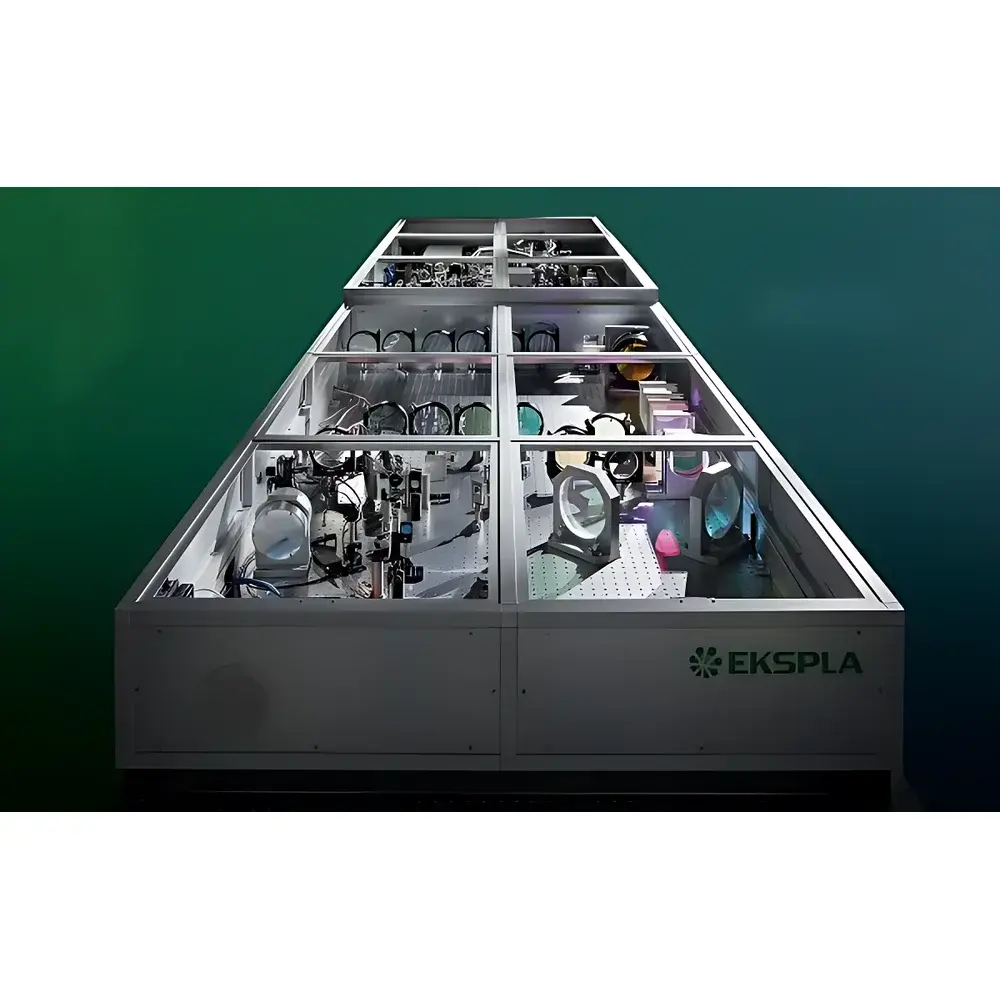
UltraFlux FF/FT 5000 High-Energy Tunable Femtosecond Laser System
| Brand | Ekspla |
|---|---|
| Technology | OPCPA (Optical Parametric Chirped Pulse Amplification) |
| Repetition Rate | Up to 1 kHz |
| Pulse Energy | Up to 50 mJ |
| Pulse Energy Stability | <1.5% RMS |
| Average Power Stability | <1.5% RMS over >12 h |
| Wavelength Tuning | Motorized, Hands-Free |
| Patents | EP2827461, EP2924500 |
| Laser Type | Solid-State OPCPA System |
Overview
The UltraFlux FF/FT 5000 is a high-energy, broadly tunable femtosecond laser system engineered for advanced ultrafast science applications requiring exceptional pulse energy, temporal contrast, and operational stability. Built upon Optical Parametric Chirped Pulse Amplification (OPCPA) architecture, it delivers superior performance compared to conventional Ti:sapphire or regenerative amplifier-based systems—particularly in the 240–2600 nm spectral range—without reliance on complex cryogenic cooling or high-maintenance pump lasers. Its front-end design integrates a diode-pumped solid-state oscillator, broadband parametric amplification stages, and chirped-pulse compression optics optimized for minimal dispersion and high fidelity. The system operates at repetition rates up to 1 kHz, enabling statistically robust data acquisition in time-resolved spectroscopy, attosecond pulse generation, and strong-field physics experiments. Designed and manufactured by Ekspla—a globally recognized developer of ultrafast laser sources—the UltraFlux FF/FT 5000 meets stringent requirements for laboratory-grade reproducibility, long-term reliability, and integration readiness with vacuum beamlines, delay stages, and detection electronics.
Key Features
- OPCPA architecture enables high peak power (>1013 W) with excellent temporal contrast (>1010), eliminating the need for external cross-polarized wave (XPW) or saturable absorber contrast enhancement
- Patented front-end design (EP2827461, EP2924500) ensures robust carrier-envelope phase (CEP) stability and low-amplitude noise across full tuning range
- Motorized, hands-free wavelength tuning via precision optical parametric amplifier (OPA) stage—no manual alignment required for spectral adjustment
- Pulse energy stability <1.5% RMS over continuous operation; average power stability 12-hour periods—validated under ambient lab conditions (22 ± 1°C, <50% RH)
- Integrated diagnostics: real-time pulse energy monitoring, beam pointing stability feedback, and automated compressor alignment verification
- Modular architecture supports optional add-ons including CEP stabilization, second-harmonic generation (SHG) modules, and vacuum-compatible output couplers
Sample Compatibility & Compliance
The UltraFlux FF/FT 5000 is compatible with standard ultrafast experimental configurations—including gas-phase molecular beams, solid-state thin-film samples, liquid-jet targets, and plasma-generating targets. Its near-transform-limited pulses (typically <35 fs FWHM after compression) ensure minimal temporal broadening when coupled into vacuum chambers or multipass cells. The system complies with IEC 60825-1:2014 Class 4 laser safety standards and includes interlocked enclosures, beam shutter control, and emergency stop circuitry meeting EN 61511 functional safety requirements. All firmware and control logic are designed to support GLP/GMP-aligned environments: audit trails for parameter changes, user-access logging, and timestamped event records are available via the embedded controller interface. While not FDA-certified as a medical device, its optical output specifications conform to ISO 11146-1 for beam propagation characterization and ASTM F2793 for ultrafast laser calibration traceability.
Software & Data Management
Control is managed through Ekspla’s proprietary UltraFlux Control Suite—a Windows-based application offering both graphical workflow configuration and Python API (PyUltraFlux) for custom automation. The software provides synchronized parameter logging (pulse energy, wavelength, repetition rate, compressor grating position) at 10 Hz sampling, exportable in HDF5 and CSV formats for post-processing in MATLAB, Python (NumPy/SciPy), or OriginLab. All configuration files are digitally signed to prevent unauthorized modification. Audit-trail functionality records user login/logout events, parameter adjustments, and system error states—fully compliant with 21 CFR Part 11 requirements when deployed with validated domain authentication and electronic signature workflows. Remote monitoring via Ethernet (TCP/IP) or optional fiber-optic link enables integration into centralized lab management systems without compromising local security policies.
Applications
- Time-resolved photoelectron spectroscopy (TR-PES) and angle-resolved measurements in surface science and quantum materials
- High-harmonic generation (HHG) for coherent soft X-ray sources and attosecond pulse metrology
- Nonlinear optical spectroscopy: transient absorption, 2D electronic spectroscopy, and pump-probe anisotropy studies
- Laser-induced breakdown spectroscopy (LIBS) with enhanced signal-to-noise ratio due to high pulse energy and contrast
- Multi-photon microscopy in thick-tissue imaging where deep penetration and reduced photodamage are critical
- Femtosecond laser micromachining of transparent dielectrics and semiconductor substrates requiring precise ablation thresholds
FAQ
What is the typical pulse duration after compression?
Pulse duration is typically <35 fs (FWHM) across the 240–2600 nm tuning range, verified using frequency-resolved optical gating (FROG) or spectral phase interferometry for direct electric-field reconstruction (SPIDER).
Is CEP stabilization included as standard equipment?
CEP stabilization is available as an optional upgrade module (UltraFlux CEP-LOCK); the base system maintains passive CEP drift <100 mrad over 1 hour without active feedback.
Can the system be integrated with existing vacuum beamlines?
Yes—the output port is equipped with CF-63 or KF-40 flange options, and all optical paths are designed for UHV compatibility (<1×10⁻⁹ mbar) with bake-out capability up to 150°C.
What maintenance schedule is recommended?
Ekspla recommends biannual inspection of OPA crystal alignment, compressor grating cleanliness, and pump laser diode calibration—documented in the provided Maintenance Logbook per ISO/IEC 17025 guidelines.
Does the system support third-party synchronization protocols?
Yes—TTL and LVDS trigger outputs are provided for synchronization with delay generators, CCD cameras, and lock-in amplifiers; IEEE-1588 PTP timing is supported via optional network interface card.






