
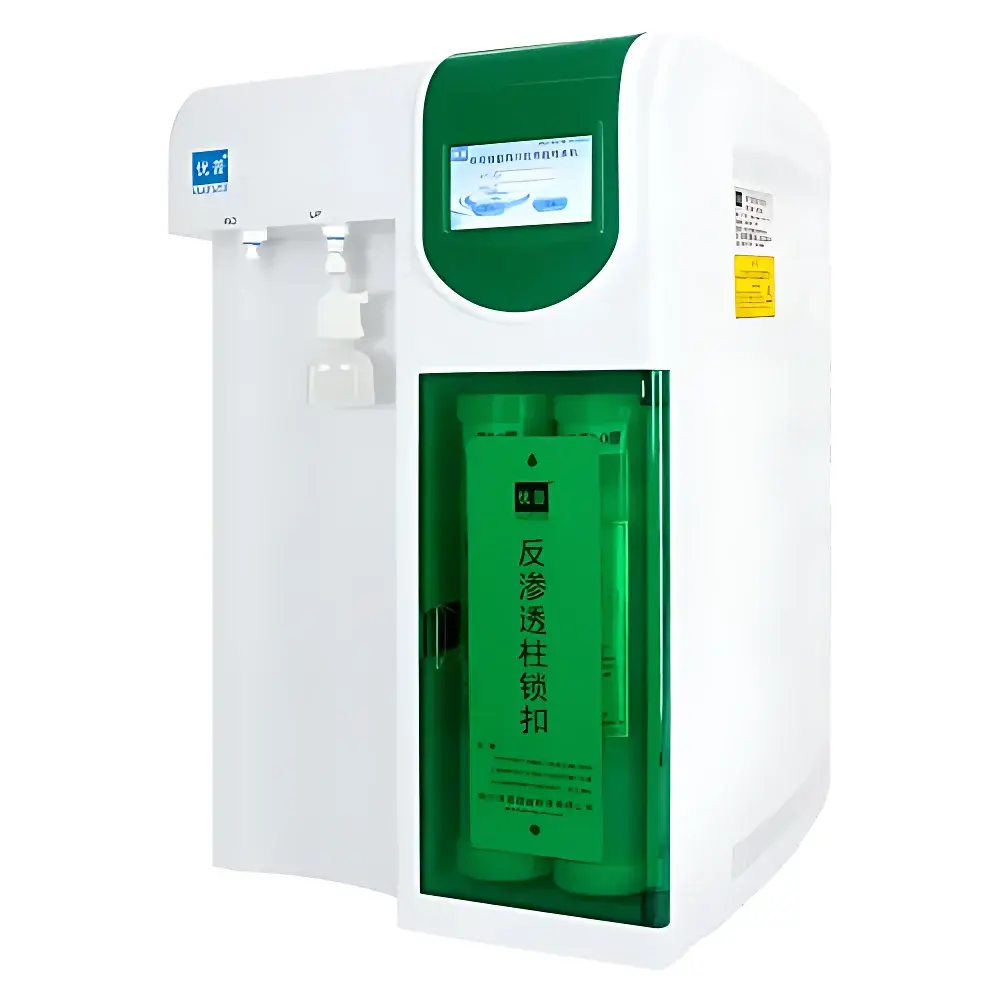
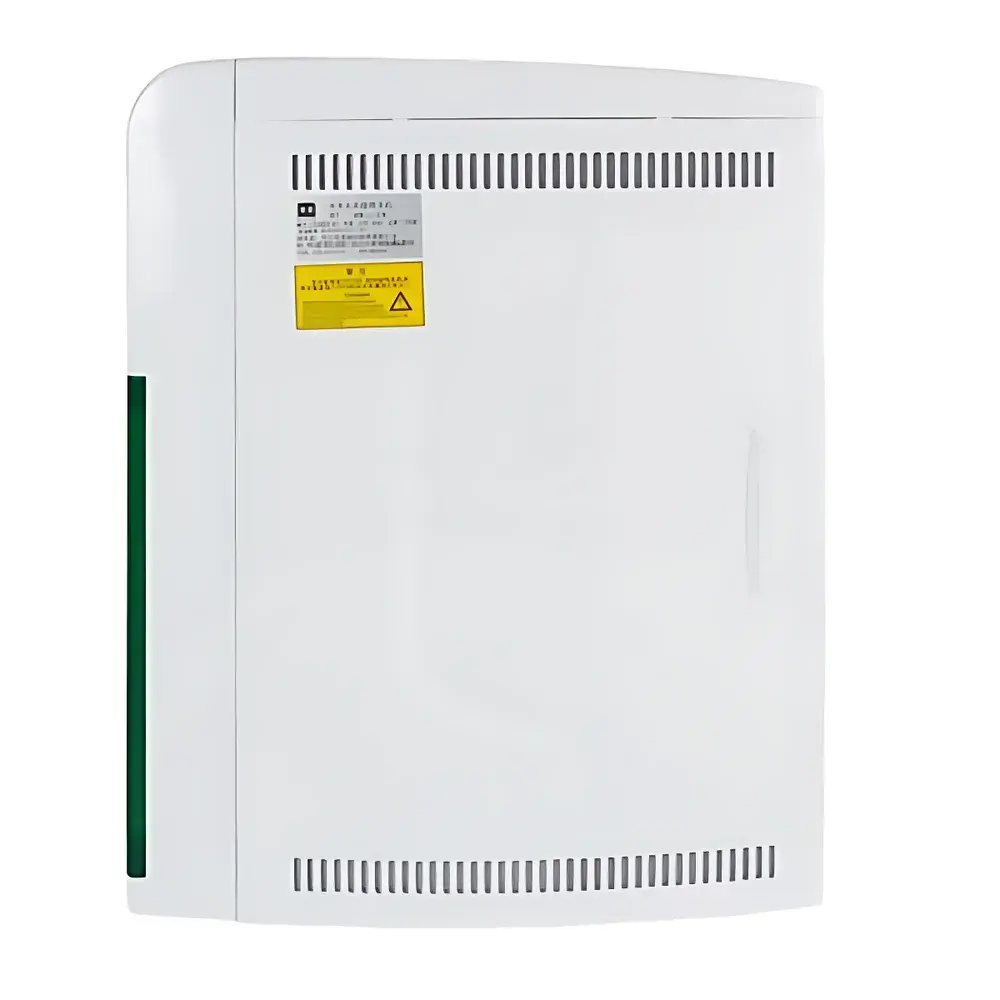
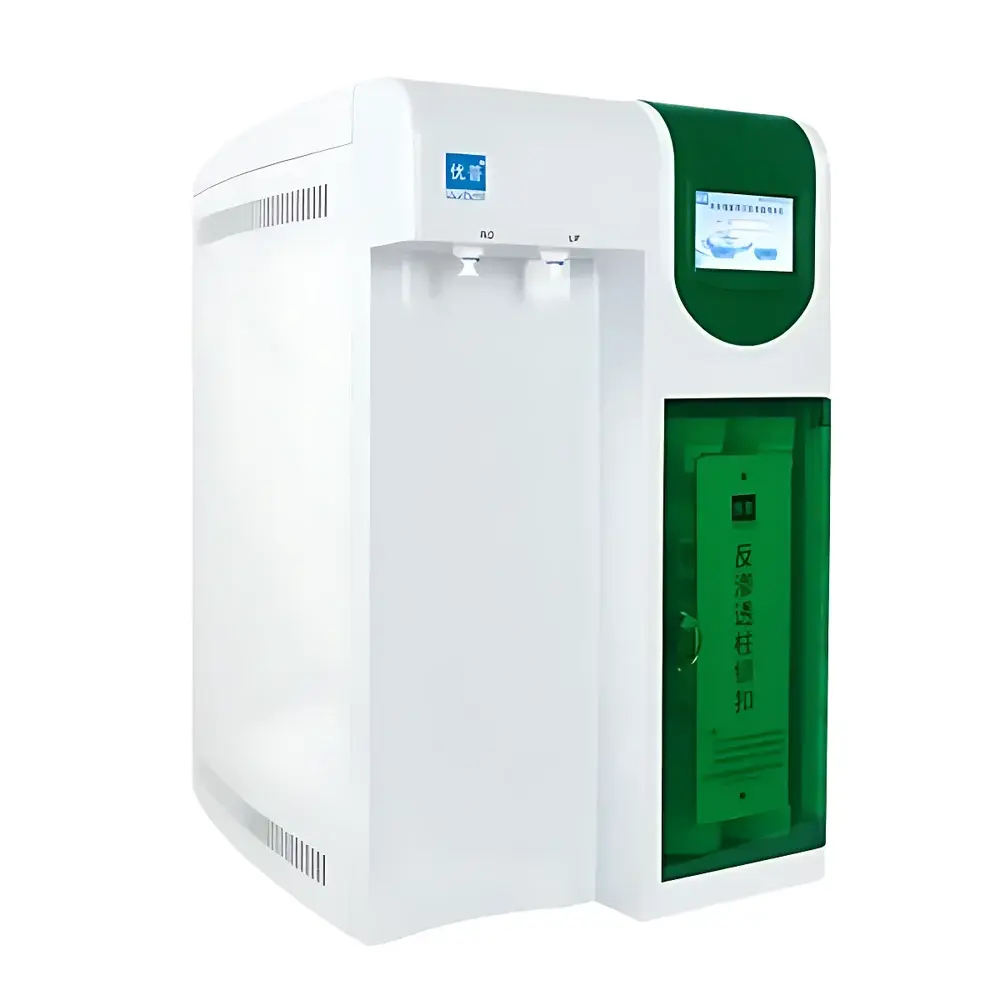
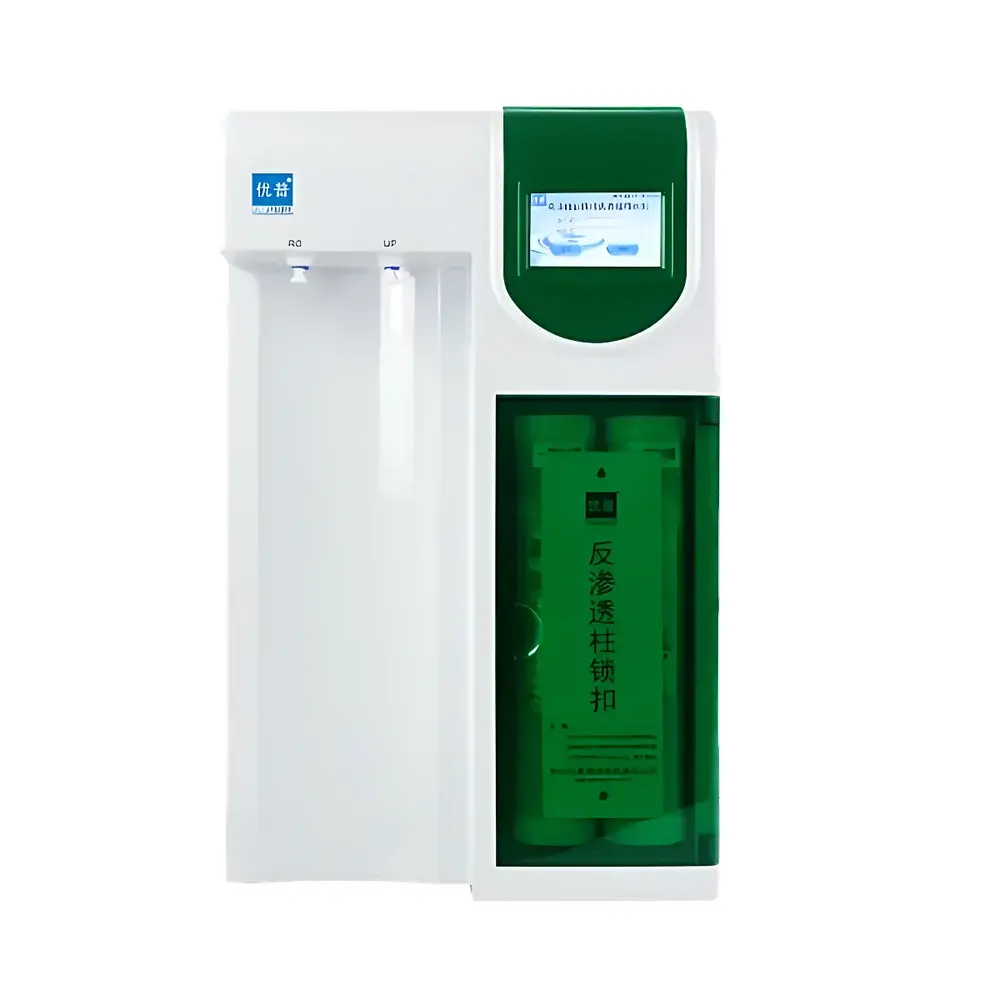
ULUPURE UPR-I/II/III Series Benchtop Ultra-Pure Water System
| Brand | ULUPURE |
|---|---|
| Origin | Sichuan, China |
| Manufacturer Type | Direct Manufacturer |
| Regional Classification | Domestic (China) |
| Model | UPR-I/II/III-10/20T |
| Pure Water Grade | GB/T 6682–2008 Grade III (RO) & Grade I (UP) |
| Resistivity | 18.2 MΩ·cm @ 25 °C |
| Heavy Metals & Soluble Silica | ≤0.1 ppb |
| Total Organic Carbon (TOC) | ≤8 ppb |
| Microbial Count | <1 CFU/mL |
| Endotoxin | <0.01 EU/mL |
| Particles (>0.1 µm) | <1 particle/mL |
| UV Wavelengths | 185 nm & 254 nm (dual-band photooxidation), 270 nm (germicidal) |
| UF Membrane Cutoff | 3000 Da |
| Final Filtration | 0.2 µm hydrophilic PES membrane |
| Dimensions (W×D×H) | 375 × 505 × 615 mm |
| Weight | ~30 kg |
| Power Supply | AC 220 V, 50 Hz (170–200 W) |
| Feed Water Requirements | TDS < 1000 ppm, Pressure 0.10–0.40 MPa, Temperature 5–45 °C |
| RO Output Conductivity | 1–5 µS/cm |
| Flow Rate | 10 or 20 L/h (at 25 °C) |
Overview
The ULUPURE UPR-I/II/III Series is a benchtop ultra-pure water system engineered for laboratories requiring consistent, high-fidelity Type I water per GB/T 6682–2008 and GB/T 33087–2016 standards. It integrates dual-stage reverse osmosis (RO) pretreatment with multi-stage polishing—comprising UV photooxidation (185/254 nm), ultrafiltration (3000 Da), and terminal 0.2 µm microfiltration—to achieve resistivity ≥18.2 MΩ·cm at 25 °C, TOC ≤8 ppb, endotoxin <0.01 EU/mL, and microbial load <1 CFU/mL. Designed for operational resilience in regions with variable feed water quality (TDS up to 1000 ppm), the system employs pressure-stabilized RO membranes and temperature-compensated resistivity monitoring to ensure reproducible output across seasonal fluctuations. Its compact footprint and ABS engineering plastic housing—chemically resistant to acids, alkalis, and common solvents—support integration into analytical labs, cell culture suites, and QC environments where space and material compatibility are critical.
Key Features
- Dual-wavelength UV system: 185 nm for organic oxidation and 254 nm for disinfection, supplemented by a dedicated 270 nm cold-light germicidal lamp for continuous loop sterilization
- Patented double-layer medical-grade PE ultrapure water storage tank (ZL201610787560.5), equipped with a hydrophobic 0.2 µm vent filter (breather) and integrated dispensing faucet
- 4.3-inch capacitive touchscreen interface with real-time display of resistivity, TOC (optional), flow rate, system pressure, and consumable life indicators
- Quantitative and rapid dispensing modes with programmable volume delivery (1 mL–99.9 L), reducing operator variability and contamination risk
- Intelligent recirculation loop (optional) with continuous UV exposure and ultrafiltration to suppress biofilm formation and maintain endotoxin levels below 0.01 EU/mL during storage
- Comprehensive data logging: onboard memory stores >10,000 timestamped entries (resistivity, temperature, pressure, alarms); exportable via USB to support GLP-compliant audit trails
Sample Compatibility & Compliance
The UPR series delivers water suitable for applications demanding strict chemical and biological purity. RO permeate meets GB/T 6682–2008 Grade III specifications (conductivity ≤5 µS/cm), appropriate for glassware rinsing, buffer preparation, and general lab use. UP-grade output satisfies ISO 3696:1987 Class 1, ASTM D1193–06 Type I, and USP purified water requirements—validated for use in HPLC mobile phase preparation, ICP-MS calibration, PCR master mix formulation, and mammalian cell culture media. Optional 3000 Da ultrafiltration reduces endotoxin to <0.001 EU/mL, enabling compliance with IVF and primary neuronal culture protocols. All wetted materials—including tubing, tanks, and filters—are USP Class VI-certified and extractables-tested per ISO 10993-12. The system architecture supports 21 CFR Part 11–ready software upgrades for electronic signature and audit trail functionality.
Software & Data Management
Embedded firmware enables continuous monitoring of critical parameters with automatic alarm thresholds (e.g., resistivity drop >0.1 MΩ·cm/min, TOC rise >1 ppb/min). Historical data—resistivity, temperature, flow pulses, UV lamp intensity, and filter saturation status—is stored with UTC timestamps and accessible via USB mass storage mode. No proprietary drivers are required; exported CSV files are compatible with LIMS platforms and Excel-based trending analysis. Optional Ethernet/Wi-Fi modules (ULUPURE Connect) allow remote diagnostics, predictive maintenance alerts, and integration into centralized facility monitoring systems. Firmware updates are delivered via signed binary packages to ensure integrity and traceability.
Applications
- HPLC, LC-MS, and GC-MS mobile phase and standard diluent preparation
- Cell culture media, transfection reagents, and electrophysiology buffers for primary neurons and stem cells
- PCR, qRT-PCR, and next-generation sequencing library prep where nuclease-free conditions are essential
- Atomic absorption spectroscopy (AAS), inductively coupled plasma (ICP-OES/MS), and trace metal analysis
- Pharmaceutical stability testing, dissolution media, and excipient dilution per USP
- Electrochemical studies requiring low ionic background and minimal organic interference
FAQ
What feed water quality is required for optimal RO membrane lifespan?
RO performance and membrane longevity depend on feed TDS, hardness, and chlorine content. For TDS >200 ppm, we recommend pairing the UPR with a pre-installed softener and activated carbon cartridge to reduce scaling and oxidant damage.
How does ambient temperature affect production rate?
RO output declines ~3% per °C below 25 °C. At 5 °C, flux drops to near zero. Units installed in unheated labs should be sized with winter minimums in mind—or paired with a thermostatically controlled feed water preheater.
Is TOC monitoring mandatory for my application?
TOC quantification is critical for LC-MS, electrochemical sensors, and semiconductor rinse validation. The optional online TOC sensor provides real-time, non-destructive measurement traceable to NIST SRM 990b.
Can the system be validated per GMP/GLP requirements?
Yes. IQ/OQ documentation templates, calibration certificates for conductivity and temperature sensors, and filter integrity test records are provided. Full 21 CFR Part 11 compliance requires ULUPURE Connect software and external PKI infrastructure.
What maintenance intervals apply to consumables?
Pre-filters: 3–6 months (dependent on feed quality); RO membranes: 2–3 years; UP polishing cartridges: 6–12 months; UV lamps: 12 months (intensity monitored continuously); UF membranes: 18–24 months (with recirculation enabled).



