
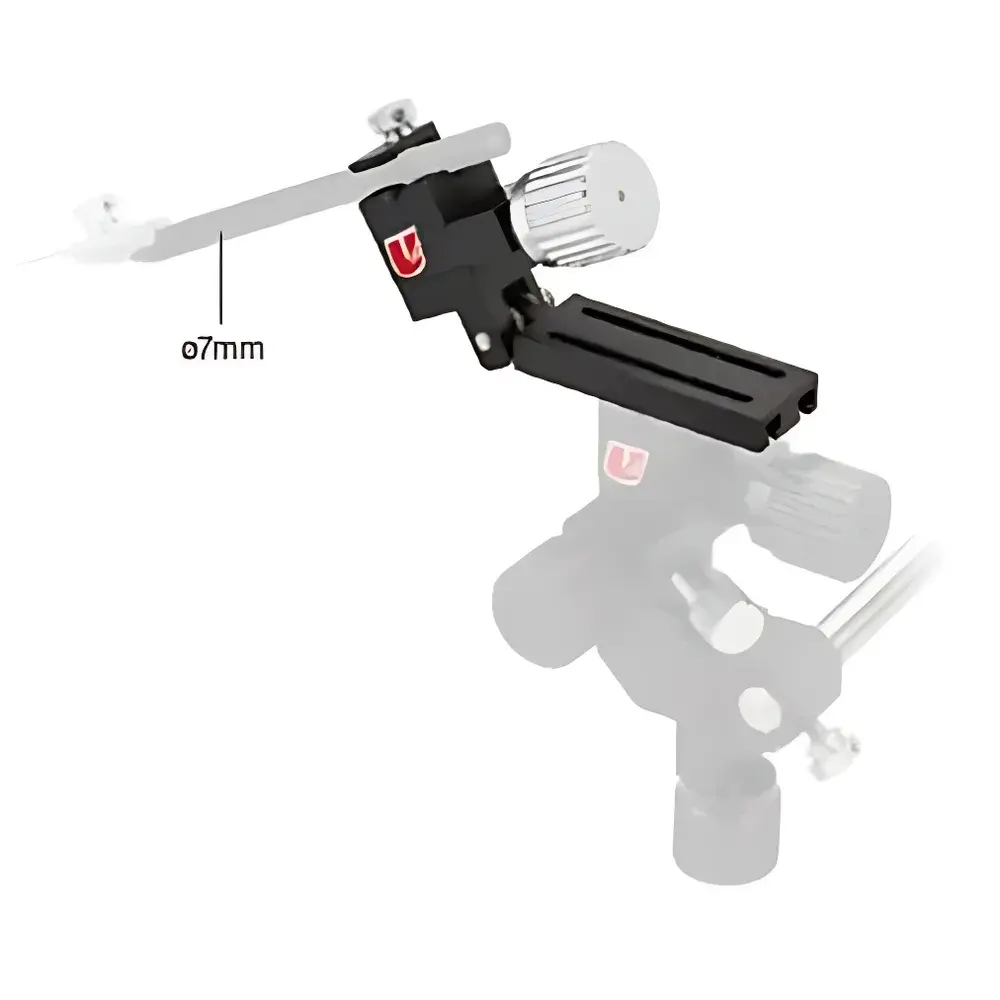
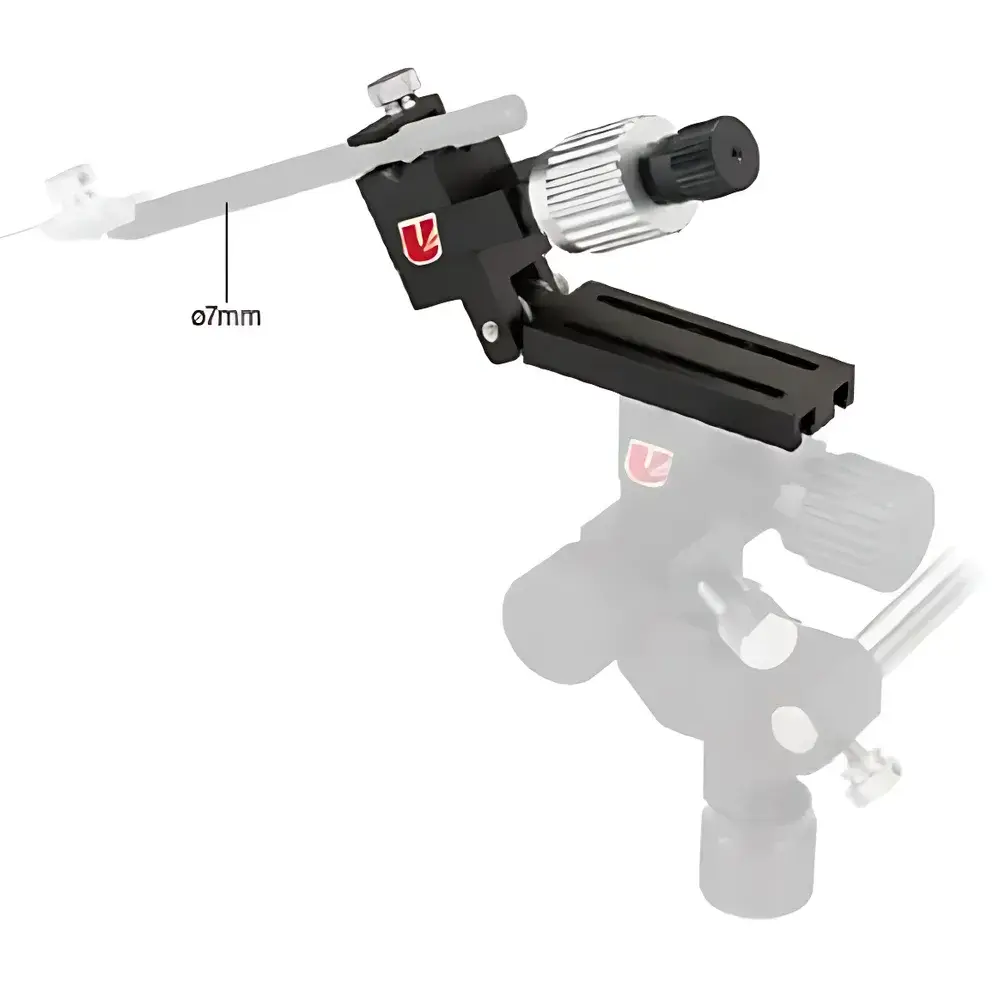
UM-1PF & UM-1PFC Micro Manipulators by NARISHIGE
| Brand | NARISHIGE |
|---|---|
| Origin | Japan |
| Model | UM-1PF, UM-1PFC |
| Fine Adjustment Range (UM-1PF) | 20 mm (X-axis) |
| Fine Adjustment Range (UM-1PFC) | 6 mm (X-axis) |
| Coarse Adjustment Range (UM-1PFC) | 14 mm (X-axis) |
| Micrometer Resolution | 250 µm |
| Dimensions (W×D×H) | 85 × 23 × 53 mm |
| Weight | 102 g (UM-1PF), 106 g (UM-1PFC) |
Overview
The UM-1PF and UM-1PFC micro manipulators are precision mechanical positioning devices engineered by NARISHIGE—a Japanese manufacturer with over five decades of specialization in micromanipulation systems for electrophysiology, patch-clamp recording, microinjection, and single-cell manipulation. These compact, manually operated manipulators employ a dual-stage mechanical translation architecture to deliver stable, backlash-free linear displacement along the X-axis. Unlike motorized or piezoelectric alternatives, the UM-1 series relies on high-tolerance brass-on-brass micrometer drives and precision-machined stainless steel guide rails—ensuring long-term dimensional stability, thermal consistency, and immunity to electromagnetic interference. The instruments operate on pure mechanical principles without electronic components, making them suitable for integration into Faraday cages, shielded electrophysiology rigs, and low-noise voltage-clamp setups where signal integrity is paramount. Their miniature footprint and lightweight construction enable secure mounting on vibration-isolated optical tables, microscope stages, or custom-built experimental platforms.
Key Features
- Compact ergonomic design: 85 mm width × 23 mm depth × 53 mm height; weighs only 102–106 g for minimal stage load and easy repositioning.
- Dual-resolution control: UM-1PF provides continuous fine adjustment over 20 mm; UM-1PFC combines 14 mm coarse travel with 6 mm fine travel—optimized for rapid initial positioning followed by sub-millimeter refinement.
- 250 µm per revolution micrometer drive: Precision-machined brass thimble with engraved scale enables repeatable, tactile feedback during manual adjustment—critical for iterative electrode approach protocols.
- Full 360° rotatable base mount: Allows angular reorientation of the manipulator head without loosening fasteners, facilitating alignment with pipette puller axes or multi-electrode arrays.
- Corrosion-resistant stainless steel body and hardened brass lead screws: Designed for sustained operation in humid laboratory environments and compatibility with ethanol or isopropanol cleaning protocols.
- No power supply or software required: Fully passive operation eliminates grounding loops, RF noise coupling, and firmware dependency—ideal for GLP-compliant electrophysiology labs.
Sample Compatibility & Compliance
The UM-1PF and UM-1PFC are compatible with standard 1.2 mm OD glass micropipettes, tungsten microelectrodes, and insulated stainless-steel probes used in intracellular and extracellular recording. Their mechanical interface accepts NARISHIGE’s proprietary MP-1 or MP-2 pipette holders (sold separately) via M3.5 × 0.6 threaded ports. While not certified as medical devices, both models conform to JIS B 7451:2015 (Japanese Industrial Standard for micromanipulator performance testing) and exhibit positional repeatability within ±1 µm under controlled ambient conditions (23 ± 1 °C, 45–55% RH). Units are supplied with RoHS-compliant materials documentation and CE marking for laboratory equipment (2014/30/EU EMC Directive, 2014/35/EU LVD Directive).
Software & Data Management
These are purely mechanical instruments with no embedded electronics, sensors, or digital interfaces. Consequently, they do not require drivers, firmware updates, or software integration. Position data is recorded manually in lab notebooks or imported into experiment logs via user-defined annotation fields in acquisition platforms such as pCLAMP, Signal, or Spike2. For audit-trail compliance under FDA 21 CFR Part 11 or ISO/IEC 17025, laboratories may document manipulator settings alongside timestamped electrophysiological traces using validated electronic lab notebook (ELN) systems. No calibration certificate is shipped by default; however, users may perform in-house verification using certified gauge blocks traceable to NIST or JCSS standards.
Applications
- Manual patch-clamp electrode positioning in acute brain slice or cultured neuron preparations.
- Controlled insertion of sharp microelectrodes during intracellular recording in invertebrate or amphibian preparations.
- Alignment of dual-pipette configurations for voltage-clamp or current-clamp dual recordings.
- Microinjection of dyes, tracers, or CRISPR-Cas9 ribonucleoprotein complexes into zebrafish embryos or Xenopus oocytes.
- Positioning of stimulating electrodes in in vitro hippocampal slice field potential experiments.
- Integration into custom-built optogenetic rigs requiring synchronized mechanical actuation and optical stimulation.
FAQ
Are the UM-1PF and UM-1PFC compatible with inverted microscopes?
Yes—both models feature a low-profile base and optional adapter plates (e.g., NARISHIGE MA-1) for direct attachment to standard microscope stage dovetails or custom mounting brackets.
What is the maximum load capacity for mounted electrodes?
Rated for static loads up to 50 g; dynamic loading (e.g., pipette penetration) should remain below 20 g to preserve micrometer thread longevity and positional fidelity.
Can these manipulators be sterilized for use in sterile tissue culture work?
The stainless steel and brass components tolerate autoclaving at 121 °C for 15 minutes; however, repeated cycles may accelerate wear on the micrometer threads—ethanol wipe-down is recommended for routine decontamination.
Is there a version with Y- or Z-axis adjustment?
No—the UM-1 series is strictly X-axis oriented; for multi-axis control, NARISHIGE recommends the MO-202 or MN-401 series, which integrate orthogonal motion stages with independent micrometer controls.
Do replacement micrometer knobs or mounting screws ship with traceable calibration records?
Standard spare parts are supplied without calibration documentation; users requiring metrological traceability must engage an accredited calibration laboratory (e.g., A2LA-accredited) for post-installation verification.
Related Products




