
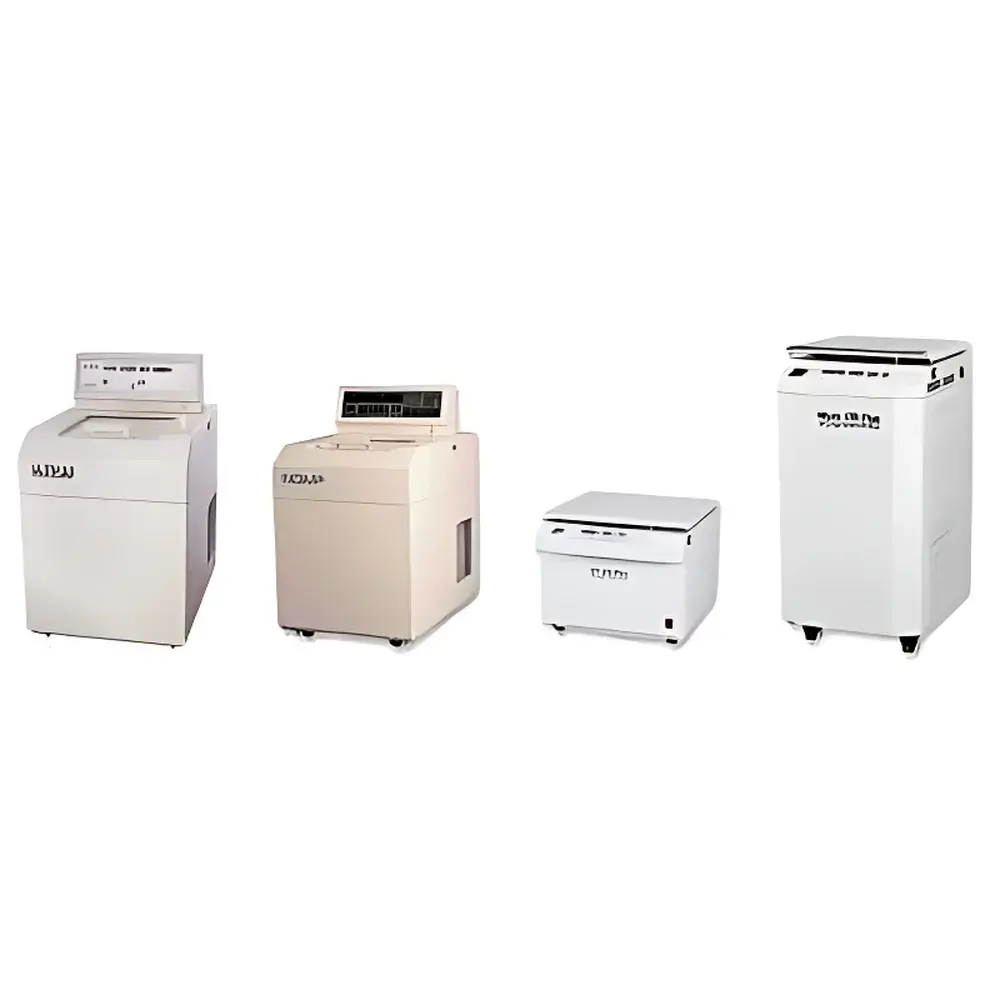
Union 32R Plus / Union 32R and MF 600 Plus / MF 600 Low-Speed Refrigerated Centrifuges
| Origin | Imported |
|---|---|
| Manufacturer Type | Authorized Distributor |
| Model Series | Ultra / Supra / MF / Micro / Union |
| Max Speed | 10,000 rpm (Union 32R Plus), 6,000 rpm (MF 600 Plus) |
| Max RCF | 12,857 × g (Union 32R Plus), 4,910 × g (MF 600 Plus) |
| Max Capacity | 4 × 750 mL |
| Temperature Range | −20 °C to +40 °C (Union), Ambient Air-Cooled (MF) |
| Timer Range | 9 h 59 min 59 s (Union), 99 min 59 s (MF) |
| Drive Motor | Brushless AC Magnetic Induction Motor |
| Power Supply | 220 VAC, 60 Hz, Single Phase, 2.5 kW (Union), 2 kW (MF) |
| Weight | 116 kg (Union 32R Plus), 75 kg (MF 600 Plus) |
Overview
The Union 32R Plus and MF 600 Plus are precision-engineered low-speed refrigerated centrifuges designed for routine separation tasks in clinical, pharmaceutical, and life science laboratories. These instruments operate on the principle of sedimentation under controlled gravitational force (RCF), enabling reliable pelleting of cells, organelles, precipitates, and macromolecular complexes without thermal degradation. The Union 32R Plus integrates active refrigeration with a wide temperature control range (−20 °C to +40 °C), making it suitable for temperature-sensitive samples such as plasma, serum, whole blood, and tissue homogenates. In contrast, the MF 600 Plus employs passive air-cooling architecture—ideal for ambient-temperature applications where refrigeration is not required but consistent thermal stability during extended runs remains critical. Both models feature brushless AC magnetic induction motors, eliminating carbon brush wear and ensuring long-term operational reliability, low acoustic emission (<58 dB(A)), and minimal vibration transmission to the lab environment.
Key Features
- Microprocessor-based control system with intuitive digital interface displaying RPM, RCF, elapsed time, program number, rotor ID, and real-time temperature (Union series only)
- Automatic rotor recognition via embedded RFID or mechanical coding—ensures correct RCF calculation and prevents overspeed operation
- 10 programmable methods stored internally; each includes speed, time, acceleration/deceleration profile, temperature setpoint (Union), and braking mode
- Dynamic 3-step braking system (MF 600 Plus) and programmable deceleration profiles (10 selectable ramps for Union 32R Plus) to protect sample integrity during stop cycles
- Safety interlock mechanism preventing lid opening during rotation and automatic emergency shutdown upon detection of imbalance, overtemperature, overspeed, or door breach
- Patented aerodynamic swing-out rotors (e.g., WS750-4B) reduce air resistance and enable higher sustainable speeds at lower power consumption
Sample Compatibility & Compliance
These centrifuges support a broad spectrum of primary and secondary containment formats—including conical-bottom tubes (5–500 mL), microtiter plates (96-well), and custom adapters for specialized vessels. All standard and optional rotors comply with ISO 15189 and CLSI EP05-A3 guidelines for analytical performance verification. The Union 32R Plus meets IEC 61010-1:2010 safety requirements for laboratory equipment and supports GLP/GMP workflows through audit-trail-capable software integration (via optional RS-232/USB interface). While not certified for sterile processing, the stainless-steel chamber and rotor housings are autoclavable (excluding electronic components), facilitating decontamination between batches in regulated environments.
Software & Data Management
Both systems support external data logging via serial communication protocols compatible with LIMS and ELN platforms. Optional PC-based software enables remote configuration, method validation documentation, and export of run logs in CSV or PDF format—including timestamps, operator ID, rotor calibration history, and deviation alerts. For facilities operating under FDA 21 CFR Part 11 requirements, validated software modules provide electronic signatures, role-based access control, and immutable audit trails—fully traceable to individual centrifugation events. Firmware updates are delivered via secure USB key with cryptographic signature verification to maintain regulatory compliance integrity.
Applications
- Clinical diagnostics: Separation of serum/plasma from whole blood (e.g., ISO 15189-compliant CBC preparation)
- Biopharmaceutical QC: Clarification of cell lysates prior to chromatography or filtration steps
- Food & beverage testing: Fat separation in milk homogenates per AOAC 989.10 methodology
- Environmental analysis: Sedimentation of suspended solids in wastewater samples (EPA Method 160.1)
- Academic research: Isolation of mitochondria, nuclei, or synaptosomes using differential centrifugation protocols
- Veterinary labs: Processing of equine synovial fluid or bovine colostrum for IgG quantification
FAQ
What is the difference between RCF and RPM, and why does the instrument display both?
RCF (Relative Centrifugal Force, expressed in × g) represents the actual gravitational force experienced by the sample and is dependent on rotor radius and rotational speed. RPM (revolutions per minute) is a mechanical parameter independent of geometry. Dual display allows users to replicate protocols across different rotors while maintaining consistent sedimentation kinetics.
Can these centrifuges be used for continuous operation (e.g., overnight runs)?
Yes—the Union 32R Plus supports free-running mode with no time limit, provided ambient temperature remains within specified limits and cooling capacity is sufficient. The MF 600 Plus is rated for maximum 99-minute cycles but may be restarted manually after cooldown intervals.
Are rotor calibrations traceable to national standards?
All factory-installed rotors include NIST-traceable calibration certificates verifying radius tolerance (±0.1 mm) and balance specifications (≤1 g·cm imbalance at max speed). Field recalibration services are available through authorized service centers.
Does the system meet electromagnetic compatibility (EMC) requirements for shared lab environments?
Both models conform to EN 61326-1:2013 for laboratory equipment immunity and emissions, minimizing interference with adjacent instrumentation such as mass spectrometers or electrophoresis units.
How is rotor lifetime managed and monitored?
Each rotor contains an embedded usage counter tracking cumulative hours and max-speed exposures. The control system displays remaining service life based on manufacturer-recommended fatigue thresholds (e.g., 10,000 hours for aluminum rotors, 25,000 for titanium variants).



