
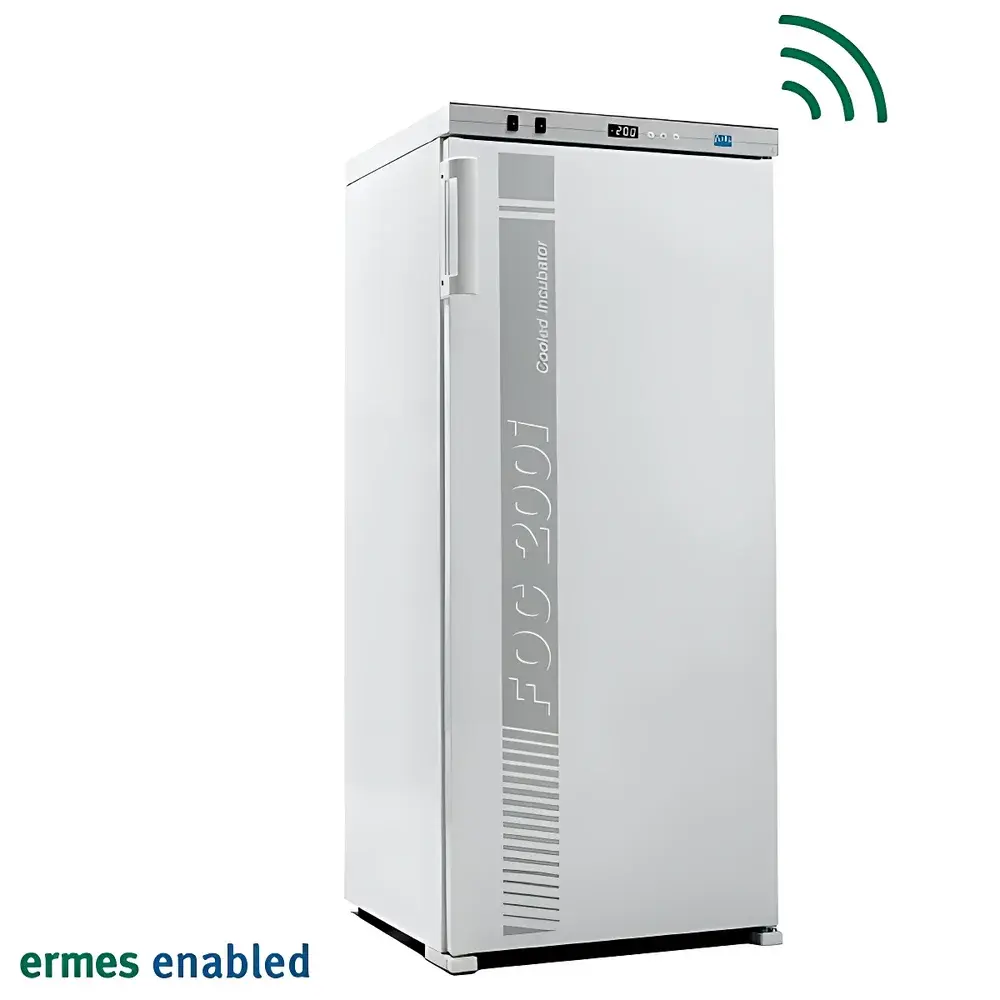
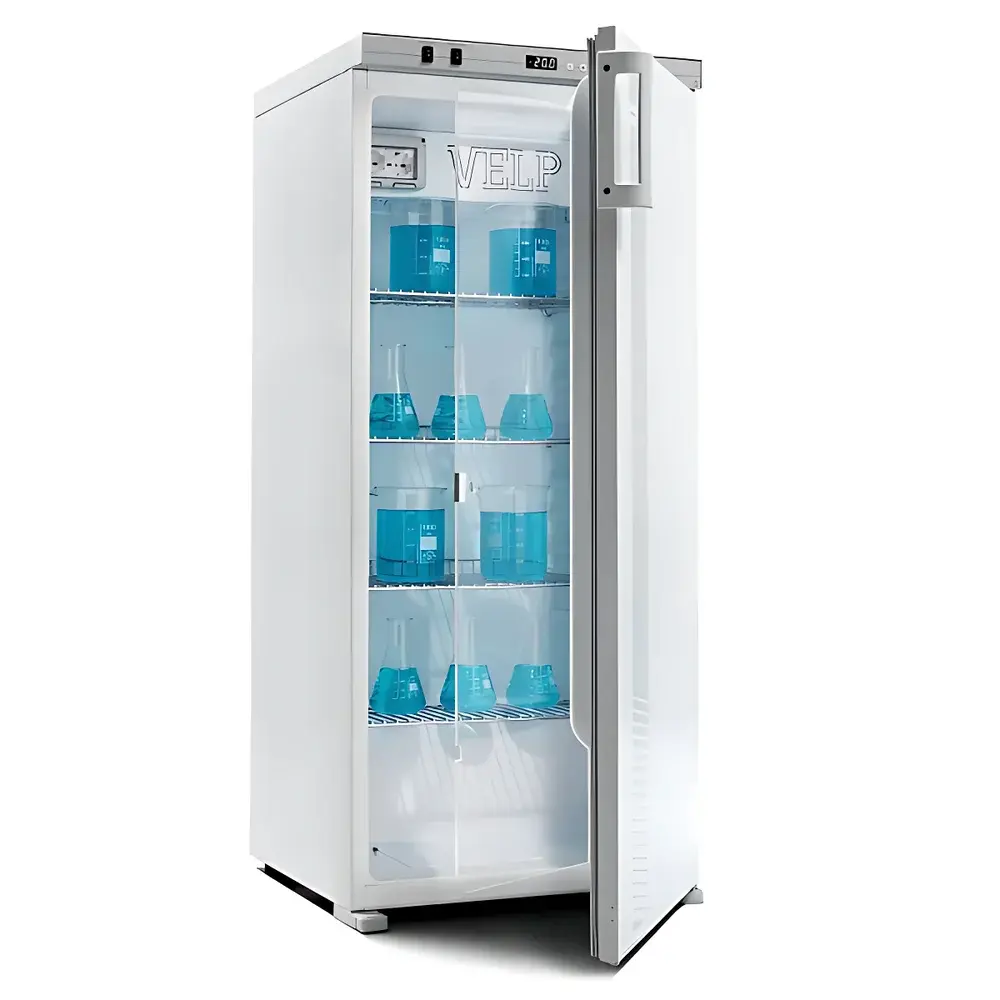
VELP FOC 200I Connect Refrigerated Incubator
| Brand | VELP |
|---|---|
| Origin | Italy |
| Model | FOC 200I Connect |
| Temperature Range | 3–50 °C |
| Temperature Uniformity | ±0.5 °C |
| Total Capacity | 200 L |
| Energy Efficiency Class | A+ |
| Compliance | GLP, MODBUS RTU Protocol |
| Optional Software | TEMPSoft™, Ermes Cloud Platform |
| Max. External Sensor Integration | 4 × BODSensor System 6 or 1 × BODSensor System 10 |
Overview
The VELP FOC 200I Connect is a microprocessor-controlled refrigerated incubator engineered for precise, stable, and energy-efficient environmental conditioning of biological, microbiological, and biochemical samples. It operates on a forced-air convection principle with VELP’s proprietary ventilation technology to ensure uniform thermal distribution across the entire 200 L chamber. The unit maintains temperature setpoints from 3 °C to 50 °C—enabling both ambient-temperature incubation and active cooling below room temperature—while delivering ±0.5 °C stability under standard operating conditions. Its A+-rated refrigeration system utilizes eco-friendly refrigerants and optimized heat exchange architecture to minimize power consumption without compromising thermal performance. Designed for continuous operation in regulated laboratory environments, the FOC 200I Connect supports Good Laboratory Practice (GLP) compliance through traceable, time-stamped temperature logging, audit-ready data export, and secure remote monitoring capabilities.
Key Features
- Intelligent auto-tuning temperature control system for rapid stabilization and long-term drift compensation
- Transparent double-glazed inner door minimizes thermal disturbance during visual sample inspection
- Digital interface with three tactile keys for intuitive navigation and parameter configuration
- Integrated internal power socket (230 V AC, 10 A) for powering auxiliary devices such as shakers or sensors inside the chamber
- Modular sensor expansion: supports up to four VELP BODSensor Systems (e.g., four BODSensor System 6 units or one BODSensor System 10) for dissolved oxygen, pH, or CO₂ monitoring
- MODBUS RTU communication protocol for seamless integration into centralized building management or LIMS systems
- Low-maintenance design with accessible condenser and self-diagnostic firmware alerts
Sample Compatibility & Compliance
The FOC 200I Connect accommodates standard laboratory vessels—including Petri dishes, multi-well plates, flasks, and culture bottles—across its full working volume. Its interior is constructed from corrosion-resistant stainless steel (AISI 304), and the chamber floor features non-slip, removable trays for easy cleaning and sterilization. All operational parameters—including real-time temperature, setpoint history, alarm events, and calibration logs—are recorded in accordance with GLP requirements. Data integrity is preserved via timestamped entries, user-access controls, and electronic signature support when used with TEMPSoft™ and Ermes. The system meets essential electrical safety standards (IEC 61010-1) and electromagnetic compatibility (EN 61326-1). While not certified for medical device use under ISO 13485, it fulfills environmental control criteria referenced in ISO 17025, ASTM D5210, and USP for microbiological testing environments.
Software & Data Management
The FOC 200I Connect is fully compatible with two complementary software platforms: TEMPSoft™ and Ermes. TEMPSoft™ enables local PC-based supervision of up to ten connected FOC units, supporting programmable temperature ramps, multi-point alarm thresholds, graphical trend visualization, and GLP-compliant data export in CSV, PDF, and XML formats. Ermes—a cloud-hosted platform—provides secure remote access via web browser or mobile application, enabling real-time status monitoring, push notifications for deviations or maintenance alerts, and over-the-air firmware updates. Both platforms enforce role-based user permissions, audit trail generation (including operator ID, action type, and timestamp), and encrypted data transmission (TLS 1.2+). When paired with VELP’s Ermes Gateway, the incubator supports 21 CFR Part 11–aligned electronic records, including electronic signatures and immutable log archiving.
Applications
This incubator is routinely deployed in quality control laboratories for BOD (Biochemical Oxygen Demand) analysis per ISO 5815-1 and EPA Method 405.1; microbial growth studies compliant with ISO 4833-1 and AOAC 977.27; stability testing of pharmaceutical intermediates under ICH Q1A(R2); and environmental simulation for material biodegradability assessments (OECD 301 series). Its extended low-temperature capability (down to 3 °C) also supports cold-adapted organism cultivation, enzymatic activity profiling at sub-ambient conditions, and controlled storage of temperature-sensitive reagents. Academic research groups utilize its modularity for multi-parameter bioprocess monitoring, while industrial labs rely on its MODBUS interface for integration into automated QC workflows.
FAQ
Does the FOC 200I Connect support validation documentation (IQ/OQ/PQ)?
Yes—VELP provides configurable validation templates and test protocols aligned with ISO/IEC 17025 and GMP Annex 15 upon request. Calibration certificates traceable to national standards are available.
Can temperature data be exported in machine-readable format for LIMS integration?
Yes—via TEMPSoft™ or Ermes, users can schedule automatic exports in CSV or XML with customizable metadata fields and time stamps.
Is the internal lighting UV-safe for photosensitive cultures?
The optional LED illumination module emits no UV radiation and operates at low heat output to prevent photoinhibition or thermal artifacts.
What is the recommended calibration frequency for GLP compliance?
Annual calibration is advised; however, the built-in self-test and reference probe port allow for intermediate verification using NIST-traceable thermistors.
How does the A+ energy rating translate to operational cost savings?
Compared to conventional Class B incubators, the FOC 200I Connect reduces annual electricity consumption by approximately 35–40% under continuous 37 °C operation, based on EN 60068-3-5 test cycles.



