
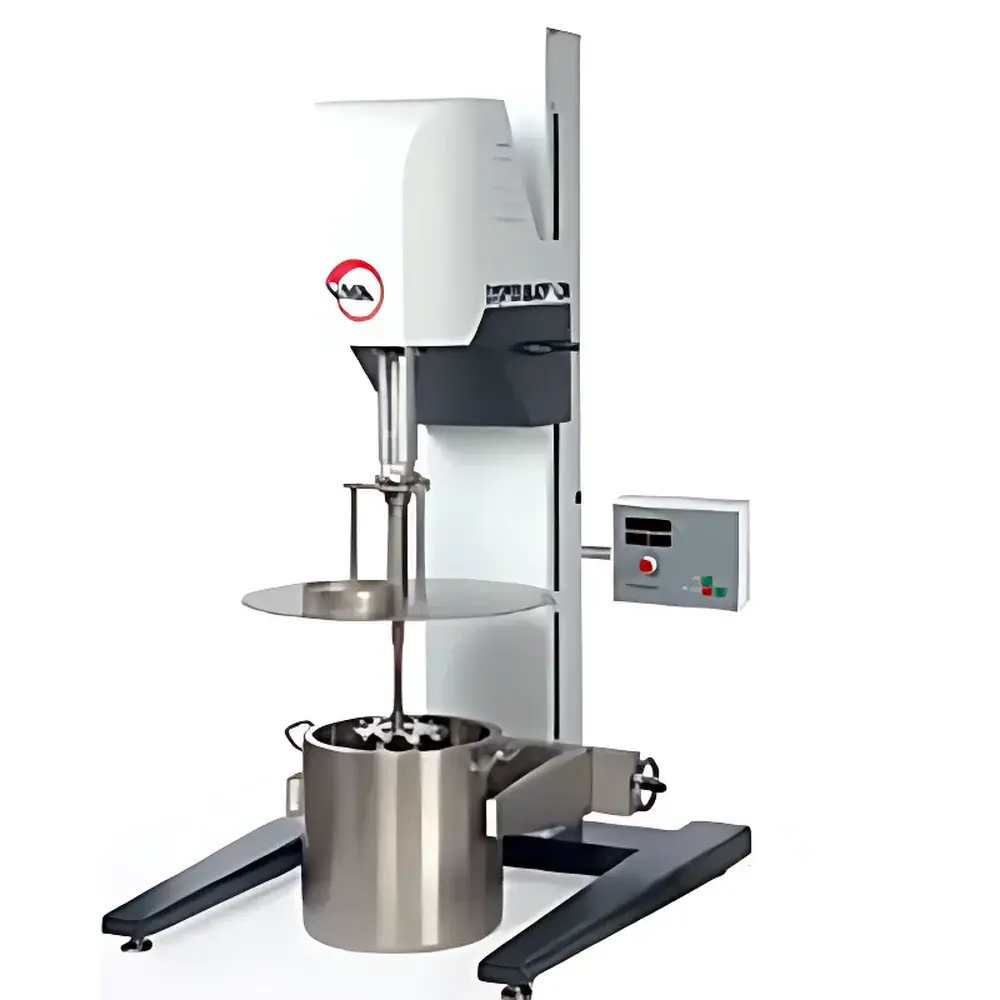
VMA DISPERMAT CN80 High-Torque Laboratory Homogenizer & Dispersion System
| Brand | VMA |
|---|---|
| Origin | Germany |
| Model | CN80 |
| Power | 7.5 kW |
| Max Speed | 3000 rpm |
| Max Torque | 50 N·m |
| Volume Range | 10–120 L |
| Drive Type | Electromechanical, Height-Adjustable Stand |
| Compliance | Machinery Directive 2006/42/EC |
| Optional Milling Systems | Five interchangeable dispersion systems (CN10–CN100) |
| Viscosity Capability | Up to non-flowing, high-viscosity pastes (with ASC scraper system) |
Overview
The VMA DISPERMAT CN80 is a high-performance, electromechanical laboratory homogenizer and dispersion system engineered for rigorous R&D, pilot-scale formulation development, and quality control in advanced materials, coatings, adhesives, battery slurries, pharmaceutical suspensions, and ceramic pastes. It operates on the principle of high-shear mechanical dispersion—utilizing precisely controlled rotor-stator geometry to generate intense hydrodynamic forces that break down agglomerates, deagglomerate nanoparticles, and achieve uniform particle distribution within viscous or thixotropic matrices. Unlike conventional stirrers or low-torque mixers, the CN80 delivers consistent energy input across variable viscosities—from low-viscosity liquids to non-flowing pastes—via its patented CN drive architecture and optional ASC (Automatic Scraper Control) system, which actively clears material buildup from vessel walls during operation. Its modular design centers on reproducibility, mechanical stability, and operator safety, making it suitable for GLP-compliant environments and pre-production validation workflows.
Key Features
- Electromechanically driven, height-adjustable stand with precision vertical positioning—enabling optimal immersion depth and torque transmission across diverse vessel geometries.
- 7.5 kW continuous-duty motor delivering up to 50 N·m peak torque at speeds ranging from 0–3000 rpm, ensuring stable performance under load without thermal derating.
- Five standardized CN dispersion systems (CN10–CN100) with interchangeable rotor-stator configurations—each optimized for specific shear intensity, throughput, and particle size reduction targets.
- ASC (Automatic Scraper Control) option for high-viscosity applications: integrated scraper blades synchronized with shaft rotation prevent wall adhesion and ensure complete batch homogenization in pastes, gels, and filled composites.
- Robust cast-iron frame with vibration-damped mounting and IP54-rated electrical enclosure; fully compliant with EU Machinery Directive 2006/42/EC, including integrated emergency stop, guarded drive coupling, and interlocked lid sensing.
- Centralized clamping system secures vessels (standard DIN 28121 flange interface) without external fixtures—reducing setup time and enhancing repeatability between runs.
Sample Compatibility & Compliance
The CN80 accommodates sample volumes from 10 L to 120 L in standard jacketed or non-jacketed stainless-steel vessels (DIN 28121, ISO 2858). It processes Newtonian and non-Newtonian fluids—including shear-thinning polymers, yield-stress pastes, and highly filled suspensions—with validated consistency across batches. Material contact parts are constructed from AISI 316L stainless steel, electropolished to Ra ≤ 0.4 µm where required. The system meets structural and operational requirements of ISO 13849-1 (PL e), EN 60204-1, and supports audit-ready documentation for GMP/GLP environments. While not intrinsically rated for ATEX zones, optional purge-compatible variants are available upon request for solvent-based formulations.
Software & Data Management
The CN80 operates via an integrated touch-panel HMI with real-time display of speed, torque, elapsed time, and motor temperature. All operational parameters are logged internally with timestamping and stored in CSV format for traceability. Optional Ethernet or RS485 connectivity enables integration into centralized LIMS or MES platforms. When configured with VMA’s DISPERMATIC® software suite (v4.2+), users gain access to programmable multi-step protocols, torque-limiting profiles, automatic viscosity compensation, and FDA 21 CFR Part 11–compliant electronic signatures, audit trails, and user-level access control—fully supporting regulated pharmaceutical and medical device development.
Applications
- Development and scale-up of electrode slurries for lithium-ion and solid-state batteries (NMC, LFP, Si-anode formulations).
- Dispersion of nanomaterials (carbon nanotubes, graphene oxide, metal oxides) in polymer matrices and coating resins.
- Stabilization of pigment dispersions in architectural, automotive, and industrial coatings.
- Homogenization of ceramic and refractory slurries prior to spray drying or tape casting.
- Preparation of uniform suspensions for oral solid dosage forms and topical semisolids under pharmaceutical QbD frameworks.
- Rheological conditioning of sealants, adhesives, and construction mortars to meet ASTM D1847 (viscosity of latex) and ISO 2555 standards.
FAQ
What is the maximum viscosity range the CN80 can process with the ASC system?
The ASC-equipped CN80 handles materials up to ~500,000 mPa·s (Brookfield LVT, spindle #7, 0.5 rpm), including non-flowing pastes and dough-like compounds.
Can the CN80 be used for wet milling or only dispersion?
It is primarily a high-shear dispersion system; however, when paired with VMA’s optional bead-mill modules (e.g., NETZSCH-compatible adapters), it supports integrated wet grinding for sub-micron particle size reduction.
Is calibration traceable to national standards?
Torque and speed sensors are factory-calibrated with NIST-traceable references; full calibration certificates (ISO/IEC 17025) are available upon request.
Does the CN80 support automated cleaning-in-place (CIP)?
While not CIP-integrated by default, the modular vessel interface and smooth internal surfaces permit manual or semi-automated cleaning per ISO 14644 cleanroom protocols.
What safety certifications does the base configuration include?
CE marking per Machinery Directive 2006/42/EC, Low Voltage Directive 2014/35/EU, and EMC Directive 2014/30/EU—verified by TÜV Rheinland.



