
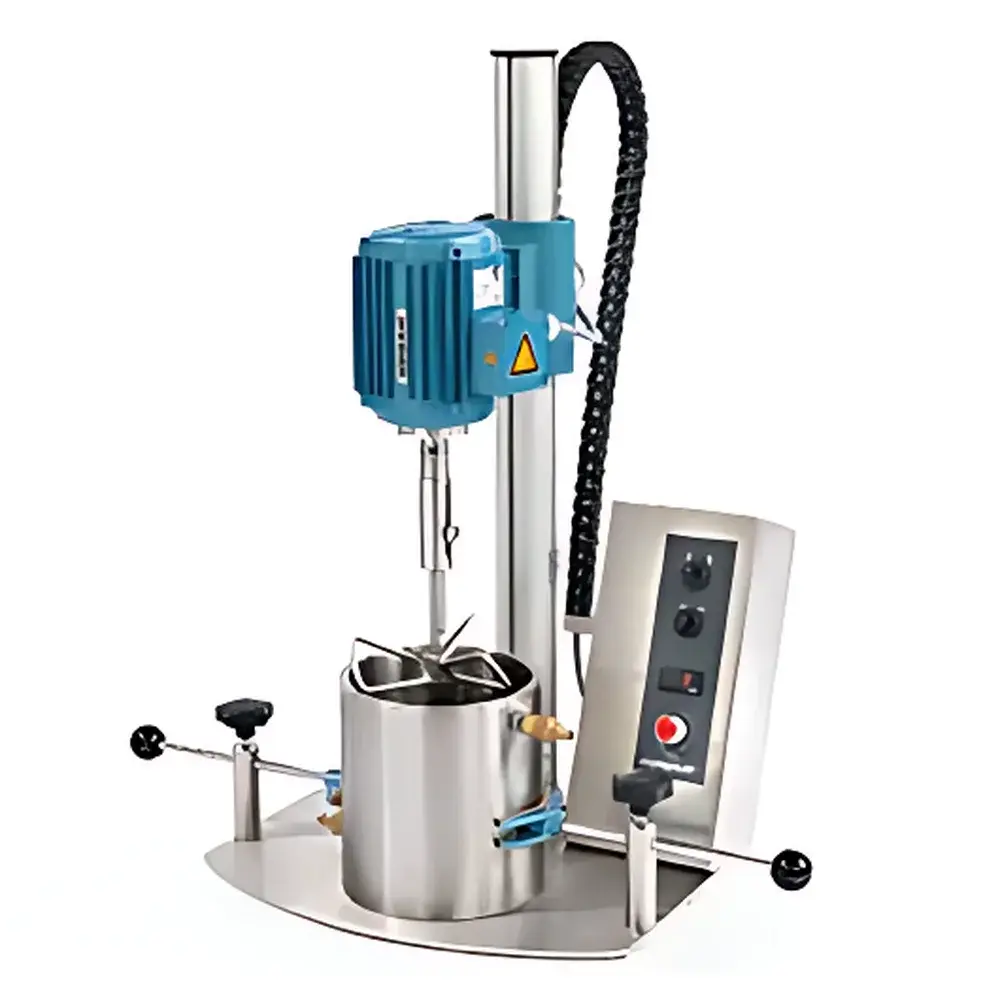
VMA R30 High-Torque Laboratory Disperser
| Brand | VMA |
|---|---|
| Origin | Germany |
| Model | R30 |
| Drive Type | AC Motor |
| Speed Range | 0–4000 rpm |
| Power | 0.3 kW |
| Torque | 2 N·m |
| Max. Working Volume | 0.5–7 L |
| Base Material | Stainless Steel |
| Control Panel | Stainless Steel |
| Height Adjustment | Electric |
| Speed Display | Digital |
| Mixing Tools | Propeller Blades, Butterfly Impellers, Dispersing Discs, Triple-Arm Impellers |
| Compliance | CE, ISO 9001 (Manufacturer) |
Overview
The VMA R30 High-Torque Laboratory Disperser is an engineered solution for reproducible wet milling, deagglomeration, homogenization, and suspension stabilization in research and quality control laboratories. Based on the principle of high-shear rotor-stator dispersion, the R30 generates intense hydrodynamic forces through controlled rotational motion of interchangeable impellers within a defined gap between rotor tip and vessel wall or bottom. Its robust 0.3 kW AC motor delivers consistent 2 N·m torque across the full 0–4000 rpm speed range—enabling stable operation even with viscosities up to 50,000 mPa·s when paired with appropriate impeller geometry. Designed for benchtop use, the unit accommodates working volumes from 0.5 L to 7 L in standard cylindrical glass or stainless-steel vessels, making it suitable for formulation development, pigment dispersion, nanoparticle suspension, and polymer emulsion preparation.
Key Features
- Electrically actuated vertical height adjustment for precise impeller immersion depth control—critical for shear rate consistency and avoiding vortex formation.
- Digital RPM display with analog potentiometer speed regulation, providing real-time feedback and fine-grained speed resolution (±10 rpm).
- Stainless-steel base and control panel ensure corrosion resistance, mechanical rigidity, and compliance with laboratory hygiene standards.
- Interchangeable impeller system: includes propeller blades for low-viscosity blending, butterfly impellers for gentle suspension, dispersing discs for high-shear particle breakdown, and triple-arm impellers for viscous pastes and gels.
- Maintenance-free AC motor with thermal overload protection and integrated speed feedback circuitry for long-term operational stability.
- CE-marked design conforming to EN 61000-6-2 (EMC immunity) and EN 61000-6-4 (EMC emission) standards.
Sample Compatibility & Compliance
The R30 supports a broad range of sample types including aqueous and organic suspensions, solvent-based coatings, ceramic slurries, pharmaceutical suspensions, and battery electrode slurries. Its modular tooling allows optimization for both Newtonian and non-Newtonian fluids. All contact parts are constructed from electropolished 316 stainless steel or chemically resistant PTFE-coated components (optional), ensuring compatibility with aggressive solvents such as acetone, THF, and NMP. While the instrument itself does not carry FDA 21 CFR Part 11 certification, its digital speed logging capability (via optional RS-232/USB interface) supports GLP-compliant data traceability when integrated into validated laboratory information management systems (LIMS). The unit meets ISO 9001 manufacturing requirements per VMA’s quality management system documentation.
Software & Data Management
The R30 operates as a standalone hardware platform with no embedded operating system. Speed setpoints and real-time RPM values are displayed locally via a 4-digit LED readout. For integration into automated workflows, an optional serial interface (RS-232 or USB-to-serial adapter) enables remote speed command (ASCII protocol) and RPM telemetry. Third-party software—including LabVIEW, MATLAB, and Python-based control scripts—can log timestamped speed data for audit trails. When used in regulated environments, users may implement external electronic lab notebooks (ELNs) to capture operator ID, batch number, impeller type, vessel geometry, and environmental conditions alongside dispersion parameters—fulfilling core ALCOA+ (Attributable, Legible, Contemporaneous, Original, Accurate, Complete, Consistent, Enduring, Available) data integrity expectations.
Applications
- Dispersion of pigments, carbon black, and metal oxides in paint, ink, and cosmetic formulations.
- Deagglomeration of nanomaterials (e.g., graphene oxide, TiO₂, SiO₂) in aqueous and non-aqueous media.
- Preparation of homogeneous electrode slurries for lithium-ion battery R&D.
- Stabilization of oil-in-water and water-in-oil emulsions under controlled shear history.
- Homogenization of biological suspensions (e.g., cell lysates, microcapsule dispersions) prior to filtration or centrifugation.
- QC testing of viscosity-dependent dispersion efficiency using standardized reference materials (e.g., NIST-traceable glycerol/water mixtures).
FAQ
What impeller configurations are included with the R30 as standard?
The base configuration includes one dispersing disc (Ø 30 mm) and one triple-arm impeller (Ø 40 mm). Propeller and butterfly impellers are available as optional accessories.
Can the R30 be used under inert atmosphere or in glovebox environments?
Yes—the unit has no internal electronics requiring ventilation; only the motor housing requires ambient airflow. Optional explosion-proof motor variants (ATEX Zone 2) are available upon request.
Is calibration required for speed accuracy?
VMA certifies speed accuracy at ±1% of setpoint across the 0–4000 rpm range. Annual verification using an external optical tachometer is recommended for GLP/GMP applications.
What vessel geometries are recommended for optimal dispersion performance?
Cylindrical vessels with d/D = 0.3–0.5 (impeller diameter/vessel diameter) and H/D = 1.0–1.5 (liquid height/vessel diameter) yield highest energy transfer efficiency. Flat-bottomed glass jars and stainless-steel beakers are preferred over conical or tapered containers.
Does the R30 support continuous operation at maximum speed and torque?
Continuous operation at 4000 rpm is rated for ≤30 minutes per cycle. For extended runs (>1 h), sustained operation at ≤3000 rpm is recommended to maintain thermal stability and bearing longevity.
Related Products



