
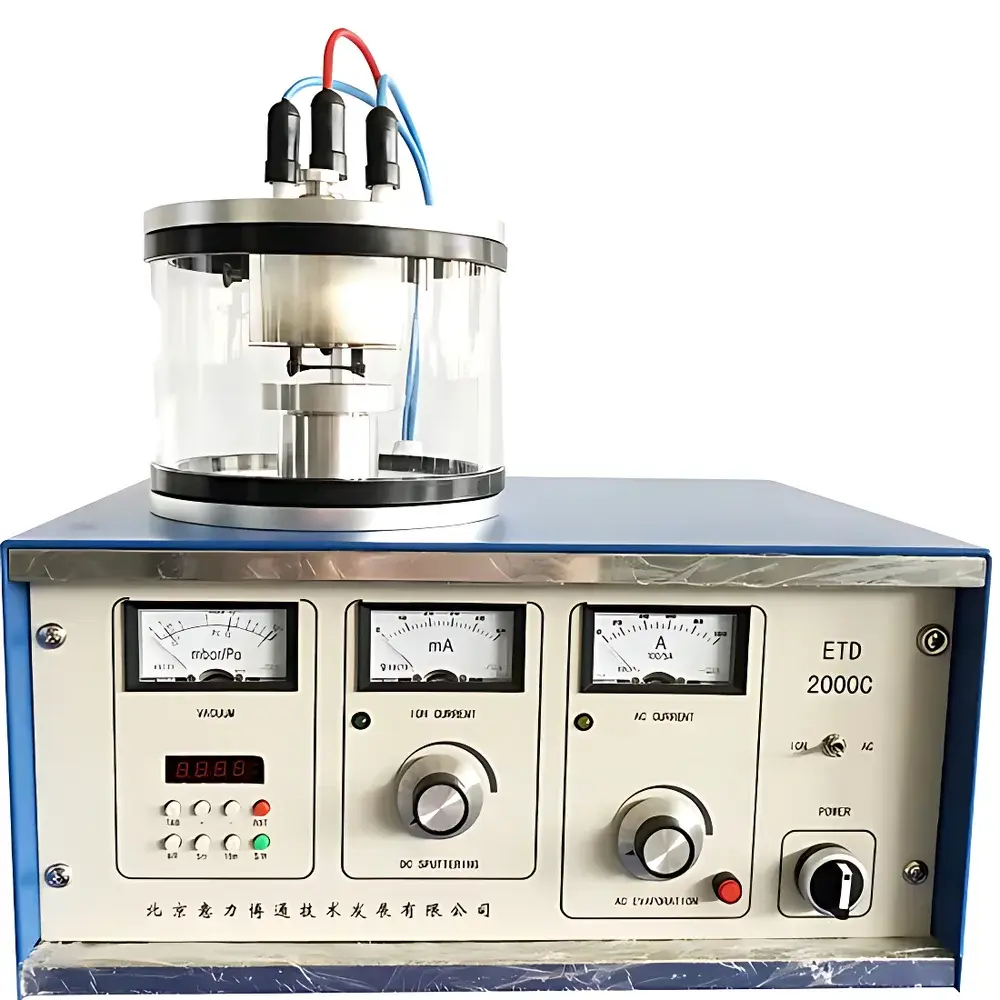
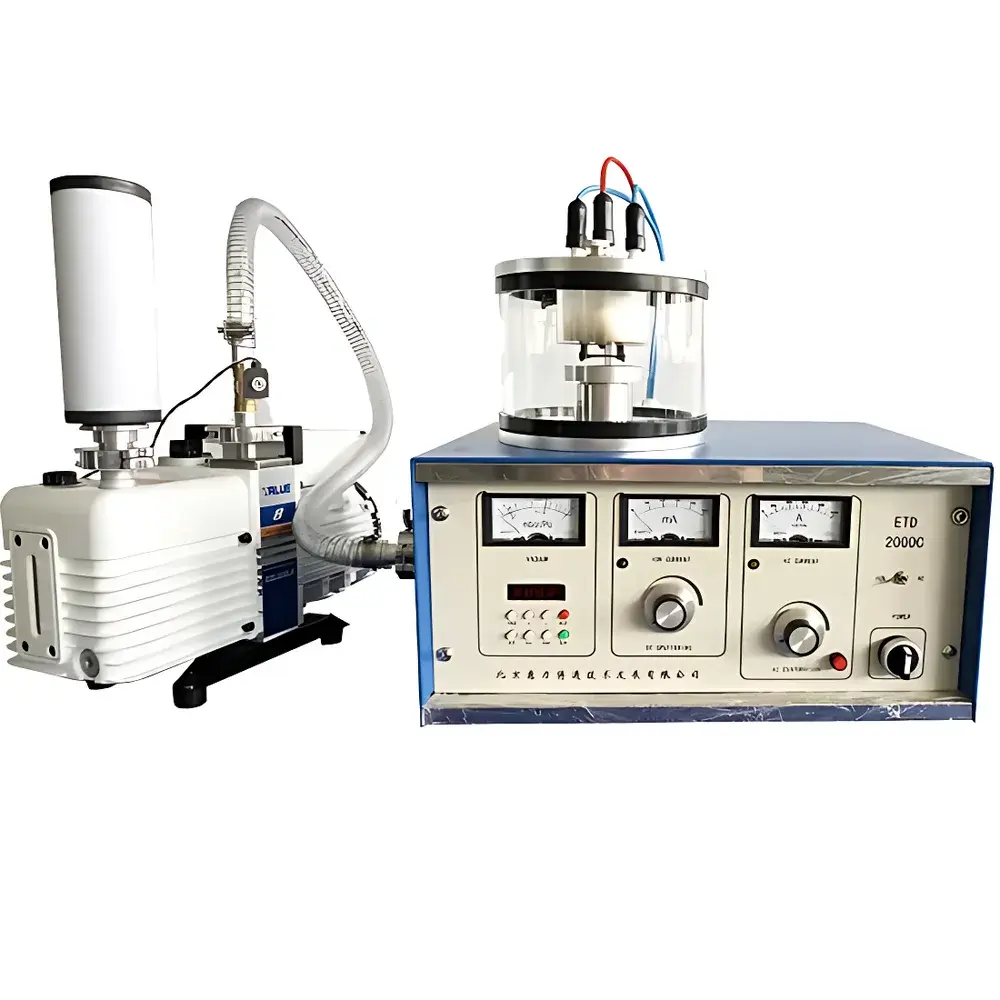
VPI ETD-2000C Dual-Mode Ion Sputter Coater with Carbon Thermal Evaporation
| Brand | VPI |
|---|---|
| Model | ETD-2000C |
| Target Material | Au or Pt |
| Target Diameter | 50 mm |
| Control Mode | Manual |
| Chamber Dimensions | Ø160 mm × 120 mm (H) |
| Sample Stage Diameter | 50–70 mm |
| Sputtering Gas | Multiple inert gases (Ar, N₂, etc.) |
| Sputtering Voltage | 0–1600 V DC |
| Sputtering Current | 0–50 mA |
| Sputtering Timer | 0–360 s |
| Carbon Evaporation Current | 0–100 A AC |
| Carbon Evaporation Voltage | 0–30 V AC |
| Evaporation Time | 0–1 s |
| Chamber Material | Borosilicate glass |
| Vacuum Pump | VRD-8 rotary vane pump (2 L/min) |
| Input Power | 220 V / 50 Hz (optional 110 V) |
Overview
The VPI ETD-2000C is a compact, dual-function thin-film deposition system engineered for high-reproducibility sample preparation in electron microscopy laboratories. It integrates two complementary physical vapor deposition (PVD) techniques—DC magnetron ion sputtering and resistive thermal evaporation—within a single vacuum chamber. This hybrid architecture enables users to select the optimal coating method based on sample composition, analytical requirements, and imaging modality. Ion sputtering relies on glow discharge plasma generation between a conductive target (anode) and grounded sample stage (cathode) under controlled low-pressure inert gas (typically argon), resulting in energetic metal atom ejection and directional condensation onto non-conductive substrates. Thermal carbon evaporation employs resistive heating of ultra-pure carbon fiber filaments to produce sub-nanometer-scale, amorphous carbon films ideal for high-resolution SEM, TEM, EBSD, and microprobe analysis where minimal beam-induced artifacts and atomic-level uniformity are critical.
Key Features
- Dual-mode operation: Independent yet co-located sputtering and carbon evaporation modules eliminate cross-contamination risks and reduce instrument footprint.
- Manual precision control: Adjustable DC sputtering voltage (0–1600 V) and current (0–50 mA) enable fine-tuning of film nucleation density and grain size; AC-powered carbon evaporation (0–100 A) delivers rapid, low-thermal-load deposition.
- Optimized vacuum architecture: Borosilicate glass chamber (Ø160 mm × 120 mm H) with integrated miniature pneumatic valve (φ3 mm port) supports flexible gas introduction (Ar, N₂, O₂) and stable pressure regulation during both processes.
- Modular target and stage design: Standard 50 mm diameter gold target (replacable with Pt, Cr, Al, Cu, Ag); interchangeable sample stages accommodate Ø50 mm and Ø70 mm specimens; custom stage configurations available upon request.
- Integrated safety and stability systems: Automatic vacuum interlock prevents arcing at sub-optimal pressures; digital timer (0–360 s sputtering / 0–1 s evaporation) ensures process repeatability and operator consistency.
Sample Compatibility & Compliance
The ETD-2000C addresses fundamental challenges in electron-beam characterization workflows. For beam-sensitive specimens—including biological tissues, polymers, and hydrated gels—the ultra-thin, low-Z carbon film provides mechanical stabilization without introducing topographic distortion or charging artifacts. For insulating materials (ceramics, oxides, geological samples), metallic coatings (Au, Pt) establish a continuous conductive path, suppressing surface charge accumulation and enabling stable secondary electron emission. The system supports ASTM E1558 (Standard Guide for Preparation of Specimens for X-ray Photoelectron Spectroscopy) and ISO 27409:2015 (Electron microscopy — Preparation of specimens for scanning electron microscopy) compliance when operated within validated parameter ranges. While not inherently 21 CFR Part 11 compliant due to manual control architecture, full audit trails and SOP documentation can be maintained externally per GLP/GMP laboratory requirements.
Software & Data Management
The ETD-2000C operates via front-panel analog controls and digital timing interface—designed for simplicity, reliability, and minimal maintenance in core facility environments. No embedded firmware or proprietary software is required; all operational parameters (voltage, current, time, gas flow if externally regulated) are manually recorded in lab notebooks or integrated into institutional LIMS platforms. For traceability, users are advised to log batch-specific settings alongside sample IDs, target lot numbers, and vacuum pump oil change history. Optional external pressure gauges and current meters with analog outputs (0–10 V) may be interfaced for analog data logging in regulated settings.
Applications
- High-resolution SEM imaging of non-conductive or beam-sensitive specimens requiring sub-2 nm carbon films for charge dissipation and structural integrity.
- TEM grid coating for electron-transparent support films, particularly in cryo-EM specimen preparation where carbon homogeneity directly impacts ice-layer quality.
- EBSD pattern acquisition on ceramic or mineral phases where conductive metal layers would obscure crystallographic contrast.
- Routine QC/QA in materials science labs preparing failure analysis samples from semiconductor wafers, composite laminates, or additive-manufactured alloys.
- Teaching laboratories requiring robust, low-cost instrumentation for hands-on PVD principles instruction—covering plasma physics, mean free path effects, and nucleation kinetics.
FAQ
Can the ETD-2000C deposit chromium or aluminum films?
Yes—any electrically conductive sputtering target with Ø50 mm diameter and standard backing plate compatibility may be installed, including Cr, Al, Ni, and Ir, subject to appropriate gas selection (e.g., Ar for Cr, Ar/O₂ mixture for oxide formation).
Is the carbon evaporation module compatible with tungsten or molybdenum filaments?
No—the system is specifically engineered for carbon fiber rope (resistivity ~1.5–2.0 Ω/m), which ensures uniform thermal distribution and avoids filament sagging or localized hot spots common with refractory metals.
What vacuum level is required for stable sputtering?
Optimal DC sputtering occurs between 5 × 10⁻² and 2 × 10⁻¹ mbar. The VRD-8 rotary vane pump achieves base pressures ≤5 × 10⁻² mbar after 15 minutes of pump-down, sufficient for routine Au/Pt coating.
How often should the vacuum pump oil be changed?
Under typical usage (≤10 coating cycles/day), oil replacement is recommended every 200 operating hours or quarterly—whichever occurs first—to maintain consistent chamber evacuation performance and minimize hydrocarbon backstreaming.
Does the unit include a vacuum gauge?
The standard configuration includes an analog Pirani-type vacuum gauge with 10⁻³–10⁰ mbar range, calibrated for air equivalence. Digital upgrades with capacitance manometers are available as optional accessories.
Related Products



