
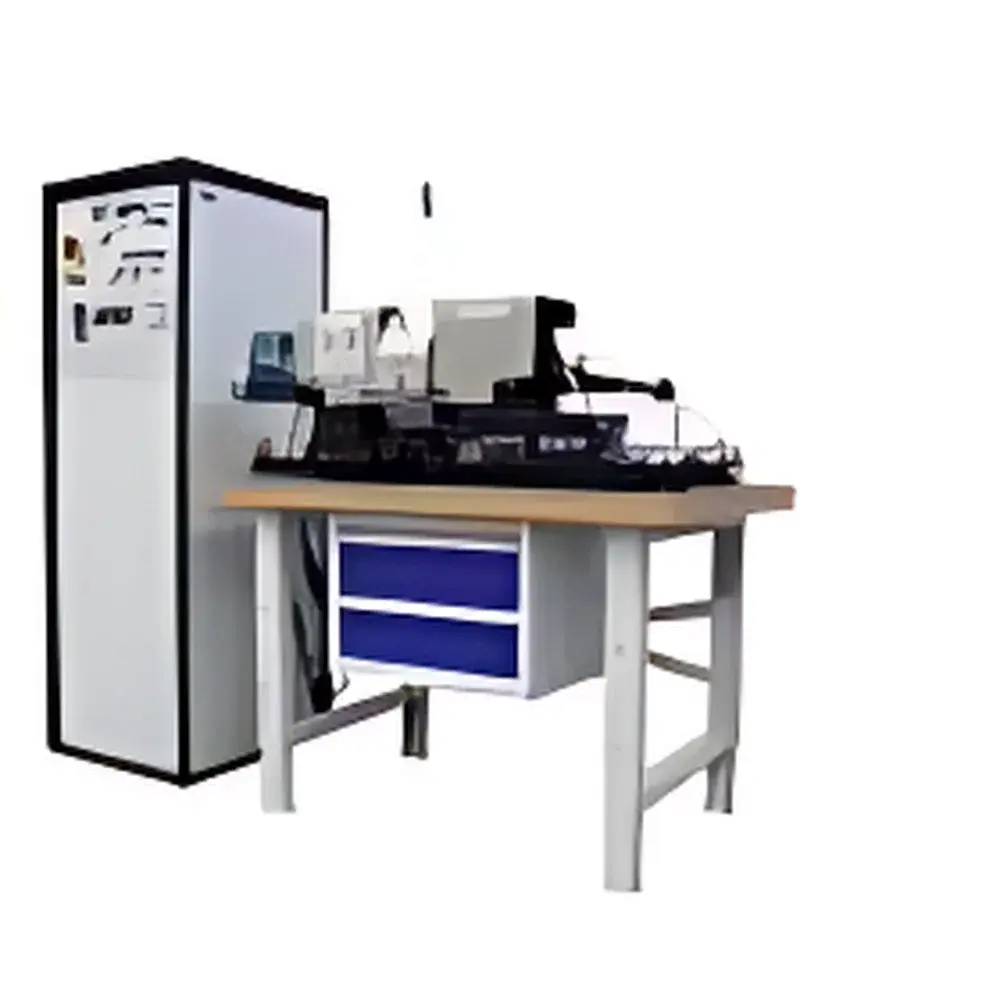
W+B UBM Series Rotational Bending Testing Machine
| Brand | W+B |
|---|---|
| Origin | Switzerland |
| Model | UBM Series |
| Torque Range | 0.5–500 N·m |
| Test Temperature | Ambient to 1000 °C (with optional high-temperature furnace) |
| Compliance | DIN 50113 |
| Configuration | Compact desktop design |
| Load Type | Constant bending moment (static load applied, cyclic strain induced by rotation) |
Overview
The W+B UBM Series Rotational Bending Testing Machine is a precision-engineered instrument designed for fatigue evaluation of metallic and advanced alloy specimens under controlled cyclic bending stress. Operating on the principle of rotational bending—where a static bending moment is applied while the specimen rotates continuously at 360° per cycle—the system induces fully reversed surface strain (tension-compression alternation) at the outer fiber. This method replicates service conditions encountered in rotating shafts, turbine blades, and aerospace fasteners. Unlike axial or torsional fatigue testers, the UBM configuration eliminates axial misalignment sensitivity and ensures uniform stress distribution across the gauge section. The machine conforms strictly to DIN 50113, the German standard governing rotational bending fatigue testing of metallic materials, and supports both ambient-temperature qualification and high-temperature endurance assessment up to 1000 °C when integrated with a certified high-temperature furnace assembly.
Key Features
- Compact desktop architecture engineered for laboratory space efficiency without compromising mechanical rigidity or thermal stability
- Adjustable torque application range from 0.5 N·m to 500 N·m, calibrated traceably to national metrology standards
- High-precision rotational drive system with speed regulation (typically 50–300 rpm), ensuring consistent cycle timing and minimal angular drift
- Modular furnace integration interface enabling seamless coupling with ISO/IEC 17025-accredited high-temperature chambers (up to 1000 °C)
- Specimen support geometry optimized for standardized DIN 50113 cylindrical test pieces (e.g., Ø3–10 mm, gauge length 40–60 mm)
- Integrated overload protection, emergency stop circuitry, and real-time torque monitoring via strain-gauge-based transducers
- Robust cast-iron base and hardened steel bearing housings ensure long-term dimensional stability and repeatability
Sample Compatibility & Compliance
The UBM series accommodates standard cylindrical specimens as defined in DIN 50113, including polished smooth-bar samples and notched variants for notch-sensitivity analysis. Specimen mounting utilizes precision-machined collets and adjustable support arms to minimize bending moment eccentricity (< ±0.15 mm alignment tolerance). The system supports compliance with multiple international fatigue testing frameworks, including ASTM E466 (standard practice for conducting force-controlled constant amplitude axial fatigue tests) by analogy where applicable, and serves as a foundational tool for material qualification under EN 10002-5 and ISO 1099. When operated within validated furnace configurations, data generated meets GLP requirements for high-temperature mechanical property reporting and supports submissions aligned with ASME Section II Part D and ASTM E21 for elevated-temperature fatigue behavior.
Software & Data Management
Control and acquisition are managed via W+B’s proprietary WinTest-Bending software suite, compliant with FDA 21 CFR Part 11 for electronic records and signatures. The software provides real-time visualization of rotational cycles, cumulative cycle count, torque deviation trends, and automatic termination upon specimen fracture detection (via torque drop thresholding). All raw data—including time-stamped cycle count, motor current, temperature profile (when furnace-equipped), and event logs—are stored in encrypted .csv and .tdms formats. Audit trails record user actions, parameter changes, and calibration events with immutable timestamps. Export modules support direct integration into LIMS environments and statistical analysis platforms such as Minitab or JMP for S–N curve generation and Weibull life modeling.
Applications
- Rotating-bending fatigue life assessment of bearing steels (e.g., 100Cr6, M50), titanium alloys (Ti-6Al-4V), and nickel-based superalloys (Inconel 718)
- Notch sensitivity quantification and surface finish effect studies (e.g., grinding vs. EDM vs. shot-peened surfaces)
- High-temperature fatigue behavior characterization for gas turbine component materials
- Quality control and lot acceptance testing per OEM specifications (e.g., Rolls-Royce RRES 90010, GEK 105904)
- Research into crack initiation mechanisms under multiaxial surface strain states
- Validation of predictive fatigue models (e.g., Findley, Wang-Brown) using experimentally derived surface strain histories
FAQ
Does the UBM system support automated specimen loading?
No—specimen mounting is manual to ensure precise alignment and surface condition verification; however, quick-change collet kits reduce setup time between tests.
Can the UBM be used for push-pull (axial) fatigue testing?
No—it is mechanically configured exclusively for rotational bending; axial or torsional testing requires dedicated systems (e.g., W+B TTM or ZWICK/ROELL servo-hydraulic frames).
Is third-party calibration documentation provided with delivery?
Yes—each unit ships with a factory calibration certificate traceable to METAS (Swiss Federal Institute of Metrology) and includes torque transducer and angular encoder verification reports.
What safety certifications does the UBM series hold?
The system complies with CE marking requirements under Machinery Directive 2006/42/EC and EMCD 2014/30/EU; furnace-integrated configurations additionally meet IEC 60519-1 for industrial electroheating equipment.
How is thermal expansion compensated during high-temperature testing?
The furnace mount incorporates low-CTE ceramic spacers and differential thermal expansion compensation in the support arm linkage, maintaining nominal bending moment accuracy within ±1.5% over the full 20–1000 °C range.



