
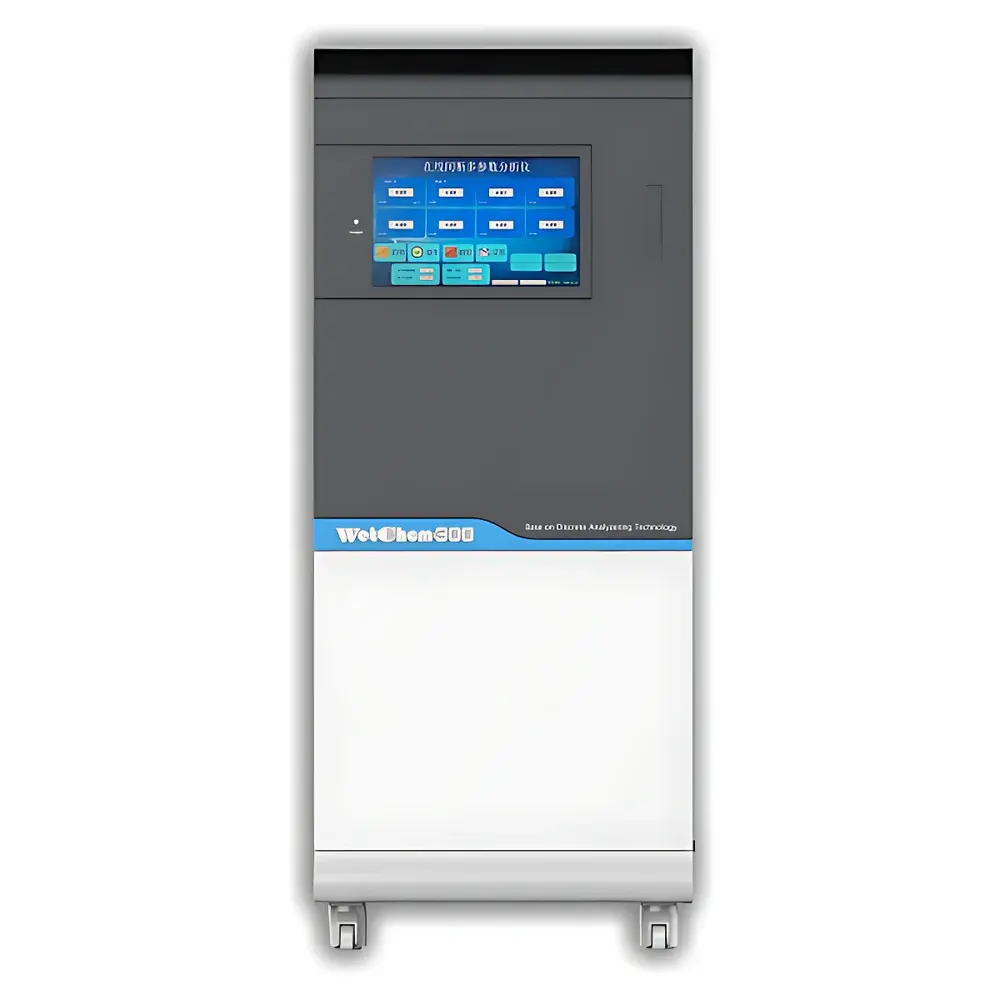
WetChem300 Automated Online Discrete Chemical Analyzer
| Origin | Shenzhen, China |
|---|---|
| Manufacturer Type | Authorized Distributor |
| Model | WetChem300 |
| Price Range | USD 70,000–98,000 (FOB) |
| Instrument Category | Online Water Quality Analyzer |
| Measurable Parameters | Ammonia-N, Nitrate, Nitrite, Orthophosphate, Silicate, Sulfate, Sulfide, Alkalinity, Hexavalent Chromium, Fluoride, Iron, Copper, Zinc, Cadmium, Boron, Hydrazine, Chloride |
Overview
The WetChem300 Automated Online Discrete Chemical Analyzer is an engineered solution for high-fidelity, multi-parameter water quality monitoring in continuous operational environments. Unlike conventional flow-injection or segmented-flow analyzers, the WetChem300 implements discrete (batch-mode) chemical analysis—where each sample is processed individually in a dedicated cuvette using precise liquid handling, controlled reaction timing, and direct photometric detection. This architecture eliminates carryover between samples, minimizes reagent consumption, and enables simultaneous quantification of up to 18 analytes per sampling cycle without hardware modification. The system operates on standardized colorimetric, spectrophotometric, and ion-selective electrode-based methods aligned with EPA Methods 350.1, 353.2, 365.4, ISO 15681-1/2, and ASTM D3370, supporting regulatory compliance for environmental monitoring programs under national and regional water quality directives.
Key Features
- True discrete analysis architecture: Each sample is aspirated, dispensed into a single-use or rigorously cleaned optical cuvette, reacted with method-specific reagents, and measured via high-stability LED-based photometry (420–880 nm range, ±1 nm wavelength accuracy).
- Multi-parameter capability: Simultaneous analysis of ≥18 water quality parameters—including ammonia-N, nitrate, orthophosphate, silicate, sulfate, sulfide, alkalinity, hexavalent chromium, fluoride, Fe, Cu, Zn, Cd, B, hydrazine, and chloride—within one automated sequence.
- Background subtraction algorithm: Integrated sample matrix compensation for salinity-variable environments (e.g., estuarine, tidal, brackish waters), enabling stable calibration across conductivity ranges from 0.05 to 50 mS/cm.
- Low-volume chemistry: Micro-dosing precision (<0.45 mL total reagent volume per test) achieved via dual-piston syringe pumps with ≤0.5% volumetric repeatability (CV), reducing operational costs and hazardous waste generation.
- Intelligent cuvette management: Automated cleaning station with sequential rinse (deionized water, acid wash, air purge), optical integrity verification, and thermal stabilization (±0.1°C) prior to measurement.
- Remote operation & diagnostics: Embedded Linux-based controller with Modbus TCP, OPC UA, and MQTT protocol support; real-time status monitoring, error logging, and predictive maintenance alerts via web interface or SCADA integration.
Sample Compatibility & Compliance
The WetChem300 accepts raw, filtered (≤80 µm), or centrifuged aqueous matrices including surface water, drinking water, wastewater effluent, groundwater, and coastal seawater. It complies with ISO/IEC 17025:2017 requirements for analytical competence when operated under documented SOPs. Data integrity adheres to ALCOA+ principles (Attributable, Legible, Contemporaneous, Original, Accurate, Complete, Consistent, Enduring, Available), with optional audit trail functionality meeting FDA 21 CFR Part 11 and EU Annex 11 expectations for regulated laboratories. All method validations follow ICH Q2(R2) guidelines for specificity, linearity (R² ≥ 0.999), LOD/LOQ determination, and intermediate precision assessment.
Software & Data Management
The instrument is controlled by ChemControl v4.2 software—a Windows-based application offering method editor, calibration manager, QC tracking (Levey-Jennings, Westgard rules), and report generation (PDF/CSV/XLSX). Raw absorbance data, temperature logs, pump actuation timestamps, and cuvette ID records are stored locally with automatic backup to network drives or cloud repositories (AWS S3, Azure Blob). Role-based user access (Administrator, Technician, Viewer) ensures separation of duties. Data export supports LIMS integration via HL7 v2.5 or ASTM E1384-compliant formats. Firmware updates are delivered over secure HTTPS with SHA-256 signature verification.
Applications
- Real-time compliance monitoring at municipal wastewater treatment plants (WWTPs) for discharge permit reporting (e.g., NPDES, EU Urban Wastewater Treatment Directive).
- Source water surveillance for drinking water utilities—early detection of nutrient spikes, industrial contamination events, or seasonal algal bloom precursors.
- Environmental impact assessment (EIA) studies requiring high-temporal-resolution data across river basins, reservoirs, or estuarine transects.
- Research-grade process monitoring in pilot-scale water reuse facilities, desalination pretreatment units, or aquaculture systems.
- Long-term ecological observatories where low-maintenance, field-deployable instrumentation must operate unattended for >30 days between service intervals.
FAQ
What sample throughput can be expected per hour?
Typical cycle time is 4–6 minutes per sample for full 18-parameter analysis; throughput ranges from 10–15 samples/hour depending on method complexity and reaction kinetics.
Is the system compatible with existing SCADA infrastructure?
Yes—native Modbus TCP and OPC UA server implementation allows seamless integration with Siemens Desigo, Schneider EcoStruxure, or Honeywell Experion DCS platforms.
How is calibration maintained during extended unattended operation?
Automatic daily recalibration using certified reference standards (NIST-traceable), with drift correction applied via internal reference cuvettes and photometric stability checks before each batch.
Can custom methods be developed and validated on-site?
Yes—the open method editor supports user-defined reagent sequences, incubation times, wavelength selection, and curve-fitting algorithms (linear, quadratic, log-log, 4PL), subject to validation per ISO 17025 Clause 7.2.2.
What maintenance intervals are recommended?
Preventive maintenance every 90 days includes pump valve inspection, cuvette optical path verification, and fluidic path pressure testing; consumables (tubing, filters, cuvettes) are tracked automatically and flagged at 85% usage.







