
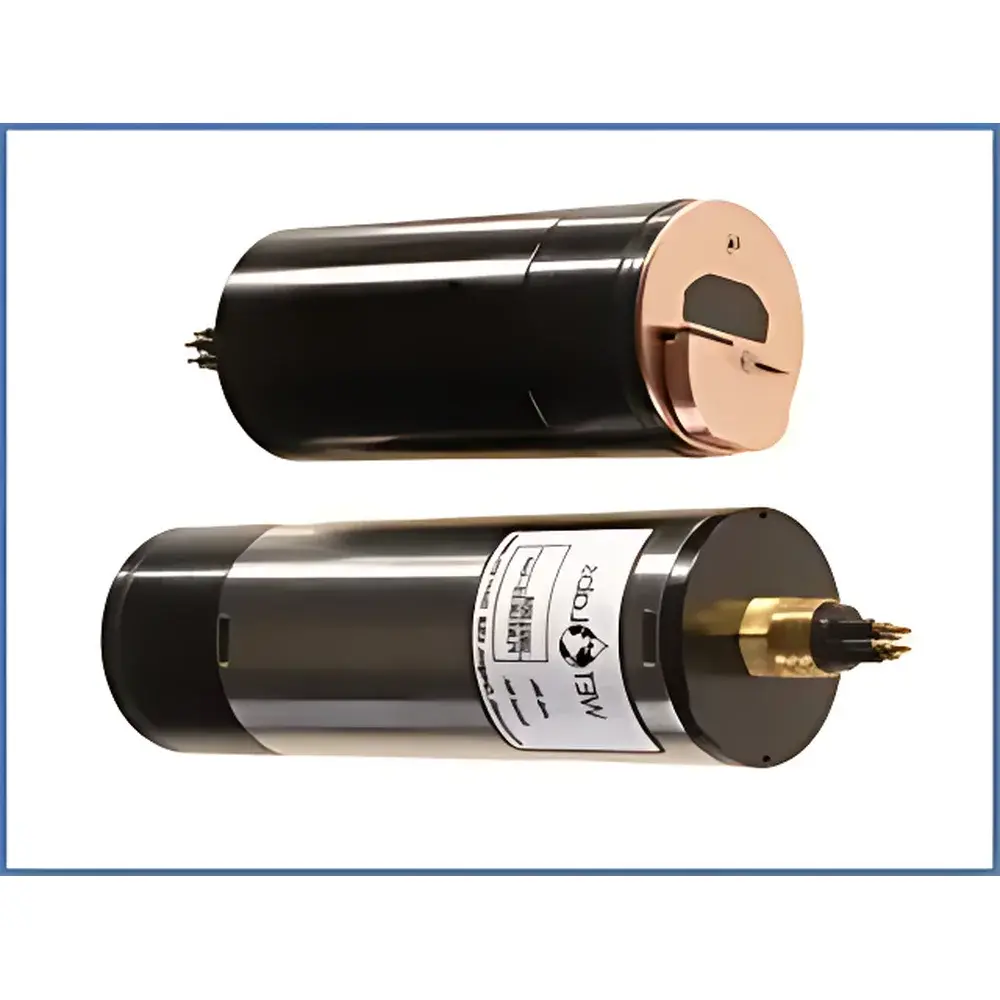
Wetlabs ECO-NTU Submersible Turbidimeter
| Brand | Wetlabs |
|---|---|
| Origin | USA |
| Model | ECO-NTU |
| Type | Submersible Online Turbidimeter |
| Measurement Ranges | 0–70 NTU, 0–200 NTU, or 0–1000 µg/L (selectable) |
| Resolution | 0.01 NTU |
| Accuracy | ±0.01 NTU |
| Wavelength | 700 nm |
| Housing Material | Polyoxymethylene (POM), seawater-corrosion-resistant |
| Dimensions | Ø63 × 127 mm |
| Weight | 0.4 kg (air), 0.02 kg (water) |
| Depth Rating | Standard 600 m, optional 6000 m |
| Output | RS-232 (19200 baud), 0–5 V analog |
| Digital Resolution | 12-bit |
| Sampling Rate | 8 Hz |
| Internal Data Logging | Optional, up to 65,000 samples |
| Power Input | 7–15 VDC |
| Current Draw | 80 mA (active), 85 µA (sleep mode) |
| Connector | SUB-CONN Micro 5-pin male |
| Optional Features | Internal Li-ion battery, anti-fouling copper brush (programmable cycle), biofouling guard, handheld terminal interface |
Overview
The Wetlabs ECO-NTU Submersible Turbidimeter is a high-stability, field-deployable optical sensor engineered for continuous in-situ turbidity measurement in aquatic environments. It operates on the principle of near-infrared (700 nm) nephelometry—measuring the intensity of light scattered at 90° from a collimated beam as it passes through a water column. This wavelength minimizes interference from colored dissolved organic matter (CDOM) and chlorophyll-a fluorescence, enhancing specificity for suspended particulate matter. Designed for long-term unattended operation, the ECO-NTU integrates robust mechanical architecture with low-power electronics, enabling deployment on moorings, AUVs, ROVs, CTD frames, and fixed-platform monitoring systems. Its compact cylindrical form factor (Ø63 × 127 mm), titanium-compatible housing material (polyoxymethylene), and pressure-rated seal design support reliable operation down to 600 m standard depth—with an optional ultra-deep variant rated to 6000 m. The sensor conforms to ISO 7027:2016 principles for turbidity measurement and is calibrated traceably to NIST-traceable formazin standards.
Key Features
- Triple-range turbidity measurement: user-selectable full-scale options of 0–70 NTU, 0–200 NTU, or 0–1000 µg/L (as suspended solids equivalent), optimized for diverse environmental matrices—from oligotrophic open ocean to eutrophic estuaries and wastewater outfalls.
- High-resolution detection: 0.01 NTU resolution and ±0.01 NTU accuracy across all ranges, validated under controlled laboratory conditions per ASTM D6508 and EPA Method 180.1 protocols.
- Low-power embedded architecture: draws only 80 mA during active sampling and reduces to 85 µA in sleep mode—enabling multi-month deployments when paired with optional internal rechargeable Li-ion battery.
- Programmable anti-fouling system: optional copper-brush wiper mechanism with configurable cleaning intervals (e.g., every 1–24 hours), mitigating biofilm accumulation without compromising optical path integrity.
- Dual-output capability: simultaneous digital (RS-232, 19200 baud, 12-bit resolution) and analog (0–5 V) outputs simplify integration with third-party data loggers, CTD systems (e.g., Sea-Bird Electronics SBE 19/25/16plus), and SCADA platforms.
- Modular expandability: compatible with Wetlabs’ ECO family’s multi-parameter configuration—allowing co-mounting with CDOM, chlorophyll-a, and phycocyanin sensors on shared power/data buses using standardized Micro-5pin SUB-CONN interfaces.
Sample Compatibility & Compliance
The ECO-NTU is validated for use in natural waters—including seawater, brackish estuaries, freshwater lakes, groundwater wells, and secondary-treated effluent streams. Its POM housing exhibits negligible leaching and high resistance to chloride-induced stress cracking, satisfying ASTM D5232 and ISO 11348 requirements for marine sensor materials. The 700 nm optical path avoids spectral overlap with common fluorophores, ensuring minimal cross-sensitivity in CDOM-rich coastal zones. Calibration stability is maintained over temperature ranges of −2 °C to +35 °C, with built-in thermal compensation algorithms referenced to ITS-90. The device supports GLP-compliant data acquisition when used with Wetlabs’ ECO Host Software, including timestamped metadata, instrument ID, firmware version, and environmental pressure/temperature (when interfaced with auxiliary sensors). All factory calibrations are documented per ISO/IEC 17025-accredited procedures.
Software & Data Management
Data acquisition is supported via Wetlabs’ ECO Host PC software (Windows-based), which enables real-time telemetry, configuration parameter adjustment (e.g., sampling interval, wiper schedule, range selection), and binary-to-ASCII conversion of raw 12-bit output. Logged data include turbidity value, timestamp (UTC), internal temperature, battery voltage, and diagnostic flags (e.g., “wiper activated”, “signal saturation”). Internal memory stores up to 65,000 time-stamped samples with millisecond precision; data retrieval occurs via serial command protocol or automated FTP push upon surface recovery. For integration into enterprise monitoring networks, the sensor complies with Modbus RTU mapping conventions (custom register map available) and supports CSV export compatible with EPA STORET, WQX, and ISO 19156 (Observations & Measurements) schema structures. Audit trails and electronic signatures can be implemented via external middleware compliant with FDA 21 CFR Part 11 when deployed in regulated wastewater compliance contexts.
Applications
- Long-term coastal observatories: tracking sediment resuspension events during storm surges or tidal forcing.
- Drinking water intake monitoring: early detection of turbidity spikes preceding filter breakthrough.
- Wastewater treatment plant effluent compliance: continuous reporting against local discharge limits (e.g., <2 NTU per US EPA NPDES permits).
- Groundwater–surface water interaction studies: quantifying turbid interflow along hyporheic zones using shallow-buried deployments.
- Autonomous platform payloads: integration on gliders (e.g., Slocum, SeaExplorer) and profiling floats for synoptic vertical turbidity profiling.
- Regulatory environmental monitoring: supporting ISO 5667-22 (water quality sampling) and EU Water Framework Directive (WFD) physicochemical assessment elements.
FAQ
What calibration standards are used for factory calibration?
All ECO-NTU units are calibrated using NIST-traceable formazin suspensions prepared in accordance with ISO 7027:2016, with verification against primary reference standards at Wetlabs’ ISO/IEC 17025-accredited calibration lab.
Can the ECO-NTU be deployed with a CTD without external power?
Yes—the sensor accepts 7–15 VDC input and draws ≤80 mA, making it compatible with standard Sea-Bird CTD power budgets when connected via the optional MCBH6M pigtail cable.
Is pressure compensation applied to turbidity readings?
No—turbidity is an optical property independent of hydrostatic pressure; however, the housing’s pressure rating ensures dimensional stability of the optical path up to 6000 m depth.
How often does the copper brush require maintenance?
Under typical coastal biofouling conditions, brush wear is negligible over 6–12 months; replacement brushes are field-serviceable using standard 1.5 mm hex tools.
Does the internal data logger retain timestamps during power loss?
Yes—the real-time clock (RTC) is backed by a supercapacitor, preserving timekeeping for ≥72 hours without main power, ensuring continuity of time-series integrity.



