
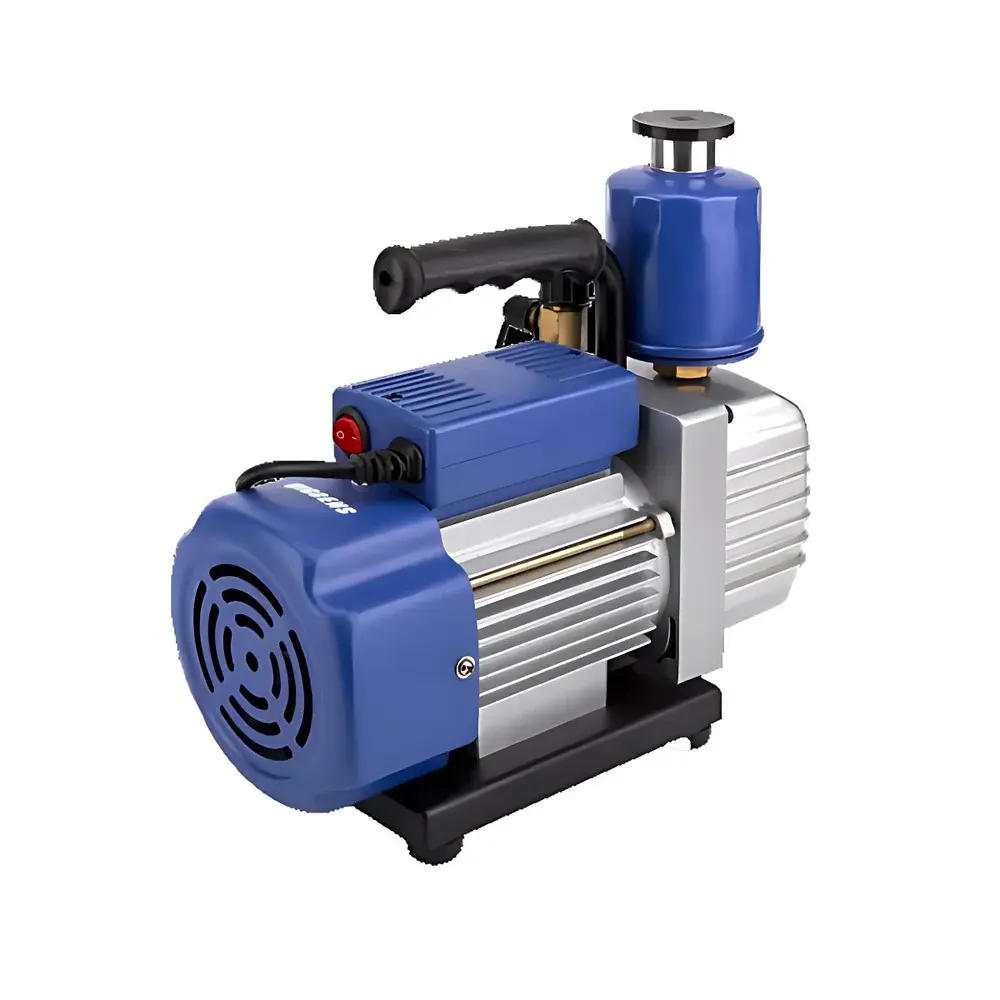
WIGGENS R-4SN Rotary Vane Oil-Sealed Vacuum Pump
| Brand | WIGGENS |
|---|---|
| Origin | Germany |
| Model | R-4SN |
| Pump Type | Single-Stage Rotary Vane |
| Operating Fluid | Mineral Oil |
| Ultimate Vacuum | 2.5 × 10⁻² mbar |
| Pumping Speed | 50 L/min |
| Motor Power | 180 W |
| Motor Speed | 1400 rpm |
| Weight | 9 kg |
| Noise Level (Gas Ballast Closed) | < 54 dB(A) |
| Inlet/Outlet Port | SAE 3/8" & UNF 7/16"-20 |
| Oil Capacity | 0.25 L |
| Protection Rating | IP54 |
| Gas Ballast Valve | Integrated |
| Power Supply | 220 V / 50 Hz |
Overview
The WIGGENS R-4SN is a compact, single-stage rotary vane oil-sealed vacuum pump engineered for reliable performance in general laboratory vacuum applications. Based on the classic Couette-type positive displacement principle, it achieves vacuum by rotating vanes within an eccentrically mounted rotor, creating variable-volume chambers that compress and expel gas through the exhaust port. Its ultimate vacuum of 2.5 × 10⁻² mbar and nominal pumping speed of 50 L/min make it suitable for primary vacuum generation in processes such as rotary evaporation, vacuum filtration, freeze drying, vacuum degassing, and vacuum impregnation. Designed and assembled to German engineering standards, the R-4SN serves both as a standalone vacuum source and as a robust forepump for high-vacuum systems—including turbomolecular pumps and diffusion pumps—ensuring stable backing pressure under dynamic load conditions.
Key Features
- Integrated gas ballast valve enables continuous removal of condensable vapors (e.g., water, solvents), minimizing oil contamination and extending service intervals.
- IP54-rated sealed motor provides dust resistance and protection against low-pressure water ingress—critical for shared lab environments with variable humidity or incidental spills.
- Optimized oil circulation path and anti-backflow check design prevent oil migration into vacuum lines upon shutdown, eliminating post-shutdown contamination risks.
- Low-noise operation (<54 dB(A) with gas ballast closed) supports placement in open-plan laboratories without acoustic shielding.
- High tolerance to water vapor and moderate chemical exposure due to corrosion-resistant internal coatings and chemically stable mineral oil formulation.
- Circular sight glass with calibrated scale allows real-time oil level verification without disassembly or measurement tools.
- Thermal overload protection safeguards motor windings during extended duty cycles or inlet overpressure events.
- Compact footprint (240 × 140 × 220 mm) and lightweight construction (9 kg) facilitate benchtop integration and mobility between workstations.
Sample Compatibility & Compliance
The R-4SN is compatible with non-reactive, non-polymerizing gases and vapors commonly encountered in analytical and preparative workflows—including aqueous, alcoholic, and chlorinated solvent vapors—when used with appropriate cold traps or scrubbers. It is not rated for explosive, highly corrosive (e.g., HF, Cl₂, Br₂), or polymerizable process streams. The pump conforms to IEC 61000-6-3 (EMC emission limits) and IEC 61000-6-2 (immunity requirements). While not intrinsically safe, its design supports compliance with GLP and ISO/IEC 17025 laboratory quality systems when operated per documented SOPs—including scheduled oil analysis, leak verification, and gas ballast calibration checks. Routine maintenance logs satisfy audit requirements for FDA 21 CFR Part 11–aligned data integrity frameworks where electronic records are maintained.
Software & Data Management
The R-4SN operates as a stand-alone mechanical device with no embedded digital control or connectivity. However, its analog operational stability—evidenced by consistent pumping speed and vacuum decay profiles—enables seamless integration into automated vacuum systems via external pressure transducers (e.g., capacitance manometers) and programmable logic controllers (PLCs). When paired with third-party vacuum controllers (e.g., Pfeiffer Vacuum DuoSelect or Agilent Vacuubrand VACUU·SELECT), users can log time-stamped pressure curves, trigger gas ballast activation based on vapor load thresholds, and generate CSV-exportable reports compliant with 21 CFR Part 11 audit trails. Pump runtime and oil change intervals may be tracked manually or via laboratory information management systems (LIMS) using standardized equipment ID tagging.
Applications
- Vacuum distillation and concentration of heat-sensitive compounds in organic synthesis and natural product isolation.
- Membrane and gravity-assisted vacuum filtration for cell culture harvest, particulate removal, and HPLC sample preparation.
- Freeze-drying cycle support—providing primary vacuum during sublimation and desorption phases in pharmaceutical and biotech lyophilization protocols.
- Leak detection via helium mass spectrometry (as forepump for turbo-molecular analyzers).
- Vacuum packaging validation studies for medical device sterility assurance (ISO 11607).
- Thin-film deposition pre-evacuation and chamber conditioning in materials science labs.
- Adsorption/desorption characterization of porous media using gravimetric or volumetric gas sorption analyzers.
FAQ
What is the recommended oil change interval for the R-4SN under continuous operation?
Under typical laboratory use (≤4 hrs/day, non-aggressive vapors), oil should be replaced every 500 operating hours or semiannually—whichever occurs first. Oil analysis (acid number, viscosity, particulate count) is advised before extending intervals.
Can the R-4SN be used with aggressive solvents like acetone or ethyl acetate?
Yes—with proper gas ballast activation and upstream cold trapping. Prolonged exposure without vapor mitigation accelerates oil degradation and reduces ultimate vacuum; oil changes become necessary after each high-solvent batch.
Is the pump suitable for GMP-regulated environments?
It meets baseline mechanical reliability and documentation requirements for GMP Annex 15 and EU GMP Chapter 3 when integrated into validated vacuum processes, including defined preventive maintenance, calibration of connected gauges, and traceable oil lot records.
Does the R-4SN require cooling water or forced ventilation?
No—its thermally optimized cast-aluminum housing and low-power motor (180 W) enable passive convection cooling. Maintain ≥10 cm clearance around exhaust and ventilation slots for sustained performance.
How does the gas ballast function affect ultimate vacuum specification?
With gas ballast open, ultimate vacuum degrades to ~1–5 mbar due to intentional air admixture; this trade-off enables condensable vapor removal while preserving oil integrity. Always close the gas ballast once vapor load subsides to restore optimal base pressure.



