
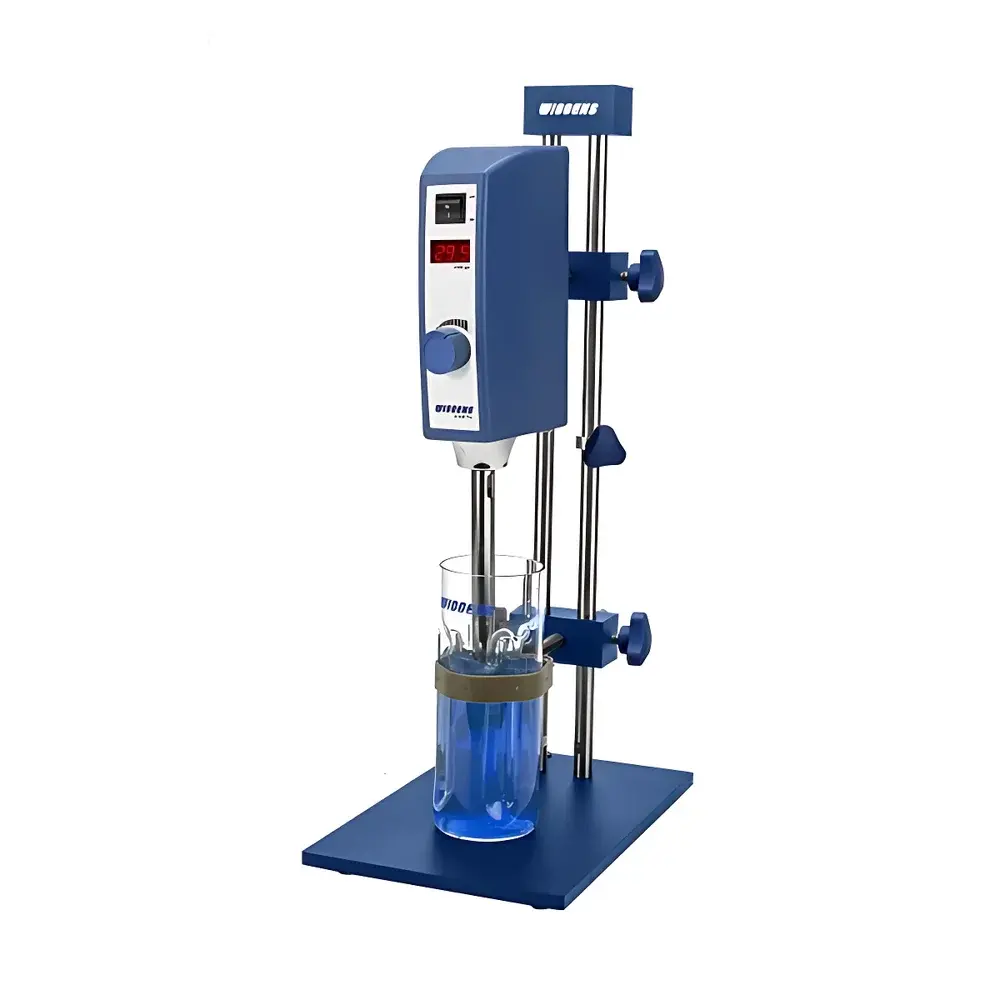
WIGGENS D-500D Digital Display Homogenizer
| Brand | WIGGENS |
|---|---|
| Origin | Germany |
| Model | D-500D |
| Instrument Type | Probe-type Rotor-Stator Homogenizer |
| Dimensions (W×D×H) | 157 × 76 × 236 mm (host unit only) |
| Weight | 2.0 kg (host unit only) |
| Processing Volume | 0.05–2000 mL |
| Speed Range | 500–30,000 rpm (digital display & precise setting) |
| Power Output | 500 W |
| Noise Level | 66 dB(A) at 25,000 rpm |
| Rotor Diameter | 3–25 mm |
| IP Rating | IP20 |
| Operating Voltage | 220 V / 50 Hz |
| Ambient Temperature | 0–40 °C |
| Relative Humidity | ≤80 % RH |
| Construction Material | 316L stainless steel housing with electrogalvanized finish |
Overview
The WIGGENS D-500D Digital Display Homogenizer is a high-performance, probe-type rotor-stator homogenization system engineered for precision sample disruption, emulsification, and dispersion in research, quality control, and production environments. Based on the Couette flow principle, it generates intense shear forces through high-speed rotation of a precisely fitted rotor within a concentric stator—enabling efficient cell lysis, particle size reduction, and uniform phase integration across diverse viscosities. Designed and manufactured under German engineering standards, the D-500D delivers reproducible mechanical energy input while maintaining thermal stability and operational safety. Its compact footprint and modular architecture make it suitable for benchtop use in analytical laboratories, pharmaceutical development labs, food R&D facilities, and academic research settings where consistent sample preparation is critical to downstream analysis.
Key Features
- 500 W brushless motor with smooth start-up and stable torque delivery across the full speed range (500–30,000 rpm), minimizing mechanical shock to sensitive samples
- Digital LED speed display and rotary encoder control for real-time, stepless speed adjustment with ±50 rpm repeatability
- Intelligent speed regulation system that dynamically adjusts output power in response to load viscosity changes—ensuring constant rotational speed during processing
- Acoustically optimized housing constructed from noise-dampening composite materials; measured sound pressure levels of 66 dB(A) at 25,000 rpm and 72 dB(A) at maximum speed
- One-hand quick-connect/disconnect rotor-stator assembly—full disassembly into three core components (stator, rotor, shaft) achievable in under 10 seconds without tools
- Serrated rotor geometry optimized for rapid particle breakdown and homogeneous dispersion of suspensions, emulsions, and viscous matrices
- Full compatibility with autoclaving (121 °C, 2 bar, 20 min); all wetted parts fabricated from medical-grade 316L stainless steel with electrogalvanized corrosion resistance and PTFE-coated bearings for chemical inertness and wear resistance
Sample Compatibility & Compliance
The D-500D supports a broad spectrum of sample types—including biological tissues (plant, animal, human), polymer dispersions, pigment suspensions, pharmaceutical excipients, cosmetic emulsions, and food matrices—within a volumetric range of 0.05 to 2000 mL. Its rotor-stator configuration enables scalable processing from micro-volume lysates to larger batch preparations. All materials comply with EU Directive 2011/65/EU (RoHS) and meet ISO 10993-5 biocompatibility requirements for indirect contact applications. The device conforms to IEC 61010-1:2010 for laboratory electrical equipment safety and carries CE marking. While not intrinsically rated for hazardous area use, its IP20 enclosure provides basic protection against solid ingress and is suitable for controlled indoor laboratory environments operating within specified ambient conditions (0–40 °C, ≤80 % RH).
Software & Data Management
The D-500D operates as a standalone instrument with no embedded software or network interface. However, its digital speed readout and stable setpoint retention support GLP-compliant documentation when integrated into validated workflows. Users may record operational parameters—including speed, duration, rotor type, and batch ID—in laboratory notebooks or LIMS-compatible electronic records. For regulated environments requiring audit trails, the device can be operated under SOPs referencing its fixed calibration points and maintenance log entries. Optional third-party data acquisition modules (e.g., USB-based analog output adapters) may interface with external PCs for time-stamped speed logging, though native firmware does not store historical run data or support FDA 21 CFR Part 11 electronic signatures.
Applications
- Cell disruption and subcellular fractionation in molecular biology and proteomics
- Preparation of homogenized tissue extracts for HPLC, ELISA, or PCR analysis
- Formulation development of oil-in-water and water-in-oil emulsions in cosmetics and food science
- Dispersion of pigments, resins, and nanomaterials into polymer matrices or solvents
- Extraction of active pharmaceutical ingredients (APIs) from solid dosage forms (tablets, capsules)
- Homogenization of environmental samples (soil slurries, wastewater suspensions) prior to elemental or microbial analysis
- Routine QC sample prep for viscosity, particle size, or concentration assays across GMP-regulated manufacturing lines
FAQ
Is the D-500D compatible with sterile processing workflows?
Yes—its 316L stainless steel probe assembly and PTFE bearings withstand standard autoclave cycles (121 °C, 20 min, saturated steam), enabling reuse in aseptic applications.
Can the D-500D be used for temperature-sensitive samples?
It lacks integrated cooling but supports external jacketed vessels and intermittent pulsing protocols to limit thermal buildup; users should validate temperature rise empirically for each sample type and volume.
What rotor sizes are supported out of the box?
The standard configuration includes interchangeable rotors with diameters ranging from 3 mm to 25 mm, allowing optimization for low-volume micro-homogenization or high-throughput macro-processing.
Does the unit include validation documentation?
No factory-issued IQ/OQ/PQ protocols are supplied; however, technical specifications, material certifications, and CE declaration of conformity are provided upon request for internal validation planning.
How often does the bearing require replacement?
Under typical usage (≤2 hrs/day, aqueous non-abrasive media), PTFE-coated bearings maintain performance for ≥12 months; visual inspection and rotational smoothness testing are recommended quarterly.



