
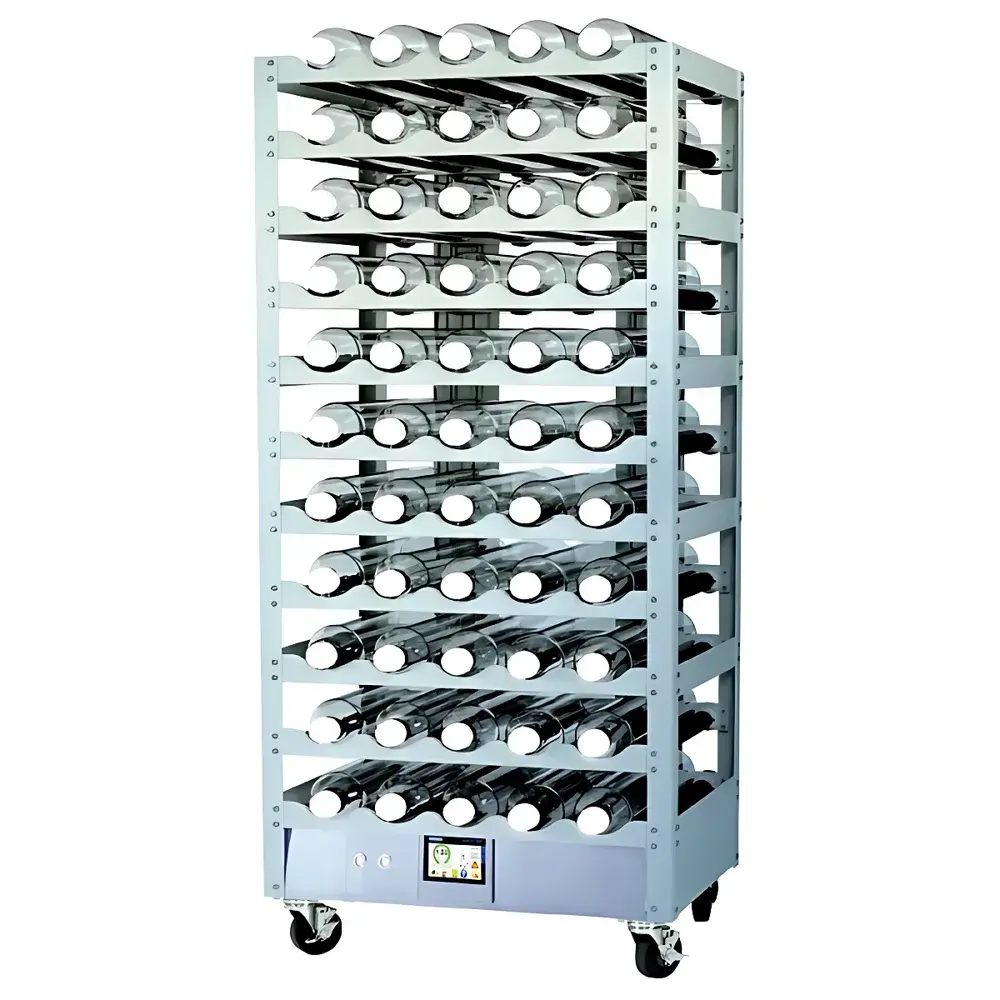
WIGGENS Celrol Elite (GMP Version) Roller Bottle Culture System
| Brand | WIGGENS |
|---|---|
| Origin | Germany |
| Model | Celrol Elite (GMP Version) |
| Rotation Speed Range | 0.08–2.5 rpm (for 110 mm diameter bottles) |
| Speed Accuracy | ±0.01 rpm |
| Bottle Capacity | 8–88 positions (configurable in 5- or 8-bottle layers) |
| Bottle Dimensions | Ø108–121 mm × up to 550 mm length |
| Drive System | Brushless DC motor with synchronous polyurethane timing belt |
| Control Interface | Siemens PLC-based touchscreen HMI |
| Communication Protocols | RS-422 Modbus RTU, RS-485 Modbus RTU, Modbus TCP/IP, TCP/IP |
| Compliance | Fully stainless steel construction compliant with GMP design principles for pharmaceutical bioprocessing |
| Operating Temperature Range | 10–40 °C |
| Humidity Tolerance | Up to 80% RH at 31 °C |
| Power Supply | 100–240 VAC, 50/60 Hz |
| Certifications | Designed to support GLP/GMP audit readiness, compatible with 21 CFR Part 11-compliant data management workflows when integrated with validated SCADA systems |
Overview
The WIGGENS Celrol Elite (GMP Version) Roller Bottle Culture System is an engineered solution for scalable, adherent cell culture under controlled, regulatory-compliant conditions. Based on the proven principle of continuous rotational motion—where cylindrical culture vessels rotate slowly around their longitudinal axis—the system maintains uniform cell monolayer formation across the internal surface of borosilicate glass roller bottles. This hydrodynamic environment minimizes shear stress while maximizing nutrient exchange and gas transfer, making it particularly suitable for production-scale expansion of anchorage-dependent mammalian cells—including CHO, Vero, MRC-5, and hybridoma lines—in biopharmaceutical process development, vaccine manufacturing, and therapeutic protein expression workflows. Unlike orbital shakers or spinner flasks, roller bottle systems provide laminar, non-turbulent flow essential for delicate primary cultures and high-density monolayers. The Celrol Elite’s architecture integrates GMP-aligned materials, traceable control logic, and deterministic mechanical performance to meet stringent requirements for clinical-grade biomanufacturing environments.
Key Features
- Fully stainless steel frame and housing, electropolished where applicable, meeting ISO 14644-1 Class 7 cleanroom compatibility and corrosion resistance per ASTM A967 for repeated autoclave and VHP cycles
- Siemens SIMATIC S7-1200 PLC with 7-inch resistive touchscreen HMI, supporting intuitive icon-driven operation, multi-language UI, and configurable alarm thresholds (e.g., speed deviation >±0.02 rpm, motor stall, temperature excursion)
- Precision brushless DC motor with closed-loop PID feedback, delivering stable rotation from 0.08 to 2.5 rpm at ±0.01 rpm accuracy—critical for reproducible attachment kinetics and confluence timing
- Modular layer configuration: 5-bottle or 8-bottle tiers; total capacity scalable from 8 to 88 bottles (e.g., 110 × 550 mm format), enabling parallel process qualification and lot-size flexibility
- Integrated safety and continuity functions: auto-restart after power interruption with position memory, real-time RPM monitoring via optical encoder, and dual-channel emergency stop circuitry
- Industrial-grade communication suite: native support for RS-422/RS-485 Modbus RTU and Ethernet-based Modbus TCP/IP, facilitating seamless integration into MES, SCADA, and DCS platforms for centralized monitoring and electronic batch record (EBR) linkage
- Low-vibration drive train utilizing tension-controlled polyurethane timing belts and precision-machined aluminum rollers—acoustic noise <45 dB(A) at 1 m distance, compatible with quiet-room installations
Sample Compatibility & Compliance
The Celrol Elite accommodates standard USP Type I borosilicate glass roller bottles (ASTM E438 Type I, Class A), including formats with integral sealing rings, polypropylene screw caps, and breathable closures (e.g., Wheaton 45 mm vented caps). Bottles ranging from Ø108–121 mm in diameter and up to 550 mm in length are supported, with verified surface area utilization across all configurations (e.g., 110 × 240 mm = 550 cm² usable growth area). All wetted surfaces are non-leaching and extractables-tested per USP . The system is designed to operate inside CO₂ incubators (with optional temperature/humidity monitoring add-ons) or standalone cleanrooms. Its construction and documentation package align with EU Annex 1 (2022), FDA Guidance for Industry: Process Validation (2011), and ICH Q5D for cell substrate characterization. Full traceability of firmware revisions, calibration logs, and maintenance history supports 21 CFR Part 11 compliance when deployed with validated electronic signature and audit trail modules.
Software & Data Management
The embedded Siemens HMI stores operational logs—including start/stop timestamps, cumulative runtime, average RPM, and alarm events—for ≥30 days onboard. Data export is supported via USB flash drive (CSV format) or network transfer using Modbus TCP/IP queries. When connected to a validated SCADA platform (e.g., Ignition, Siemens WinCC), the system enables real-time dashboarding, automated report generation, and electronic signature–enabled deviation handling. Optional data acquisition modules provide synchronized temperature and humidity logging (±0.5 °C, ±3% RH) with time-stamped metadata. All firmware updates undergo version-controlled release testing and include rollback capability. Audit trails capture user login/logout, parameter changes, and manual override actions—meeting ALCOA+ principles (Attributable, Legible, Contemporaneous, Original, Accurate, Complete, Consistent, Enduring, Available).
Applications
- Upstream bioprocess development: scaling adherent cell cultures from R&D to pilot-scale production batches (e.g., viral vector manufacturing, monoclonal antibody seed train expansion)
- Vaccine production: propagation of human diploid cell lines (e.g., MRC-5) and avian embryonic fibroblasts under cGMP-aligned conditions
- Cell therapy workflows: expansion of mesenchymal stromal cells (MSCs) and induced pluripotent stem cell (iPSC)-derived lineages requiring low-shear, high-surface-area substrates
- Regulatory filing support: generation of comparability data across manufacturing scales using identical roller bottle geometry and rotation profiles
- Stability and longevity studies: long-term culture maintenance (>30 passages) with minimal phenotypic drift due to consistent mechanical stimulation
FAQ
Is the Celrol Elite certified for use in Grade A/B cleanrooms?
It is constructed to meet material and surface finish requirements for ISO Class 7 environments; however, final cleanroom classification requires site-specific qualification (e.g., particle counting, microbial monitoring) per ISO 14644-2.
Can the system be validated per IQ/OQ/PQ protocols?
Yes—WIGGENS provides URS templates, FAT/SAT documentation packages, and validation support files (including test scripts for speed accuracy, temperature stability, and alarm response verification).
Does it support integration with LIMS or ERP systems?
Via Modbus TCP/IP or OPC UA (with optional gateway), enabling bidirectional data exchange for sample tracking, equipment utilization analytics, and preventive maintenance scheduling.
What maintenance is required for the brushless DC motor?
None—sealed-for-life design with no brushes, lubrication points, or consumable wear parts; only periodic visual inspection and belt tension verification recommended annually.
How is speed calibration performed and documented?
Using a NIST-traceable handheld tachometer; calibration certificates include as-found/as-left data, uncertainty budget, and technician signature—retained in the device’s electronic logbook.
Related Products




