
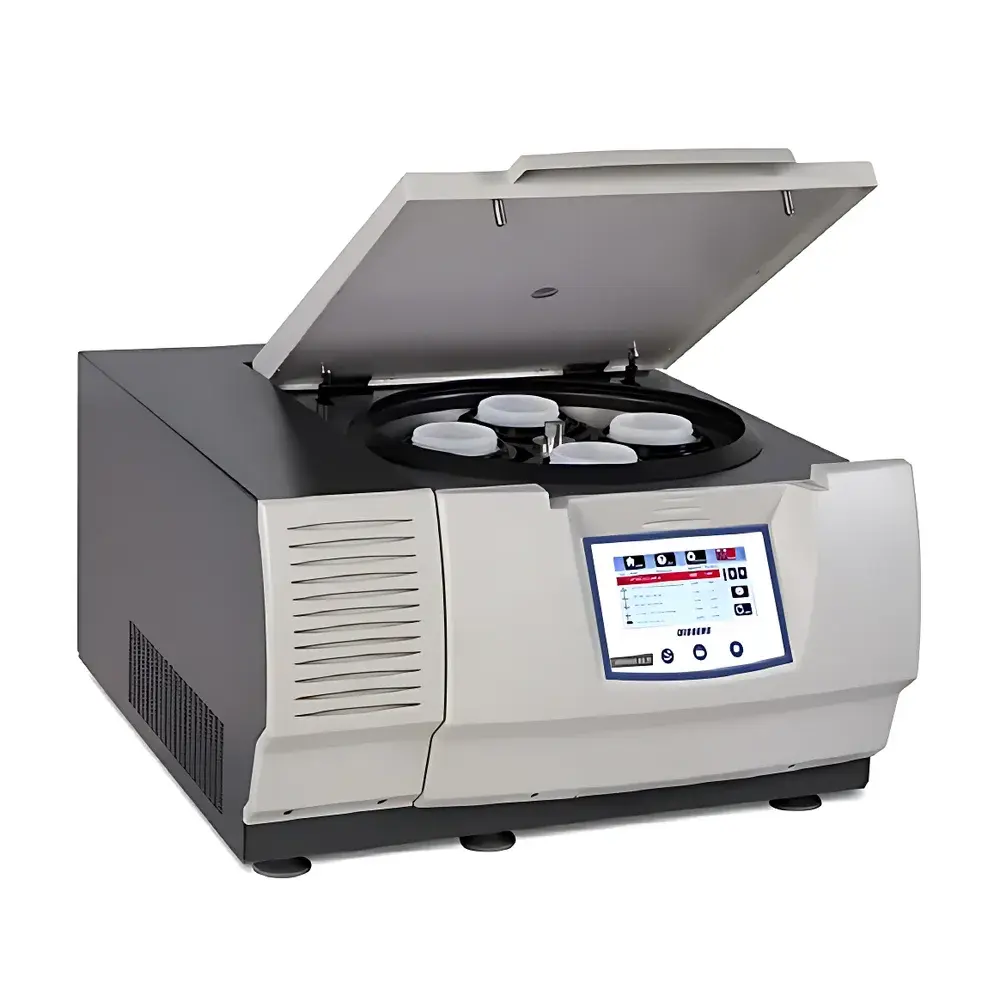
WIGGENS DILITCEN 22R Benchtop Refrigerated Centrifuge
| Brand | WIGGENS |
|---|---|
| Origin | Germany |
| Model | DILITCEN 22R |
| Type | Benchtop Refrigerated Centrifuge |
| Maximum Speed | 14,300 rpm |
| Maximum RCF | 21,948 × g |
| Maximum Capacity | 4 × 1000 mL |
| Temperature Range | −20 °C to +40 °C (±1 °C) |
| Dimensions (W × D × H) | 720 × 790 × 430 mm |
| Noise Level | <60 dB(A) |
| Power Supply | 220–230 V, 50–60 Hz |
| Power Consumption | 1420 W |
| Refrigerant | R-449A (HFO-based, CFC-free) |
| Compliance | EN 61010-1, EN 61010-2-020, EN 61326-1, EN 61326-2-6, EU Directives 2011/65/EU, 2012/19/EU, 2014/30/EU, 2014/35/EU, 98/79/EC |
Overview
The WIGGENS DILITCEN 22R is a high-performance benchtop refrigerated centrifuge engineered for precision separation in demanding laboratory environments. Utilizing brushless DC motor technology and active refrigeration with R-449A—a low-global-warming-potential (GWP), non-ozone-depleting refrigerant—the instrument maintains precise thermal control across its full operating range of −20 °C to +40 °C (±1 °C accuracy). Its rotor dynamics are governed by Couette-flow-optimized chamber geometry and digitally regulated acceleration/deceleration profiles (PCBS), ensuring minimal sample disturbance during spin-up and braking. Designed for reproducible high-g separations up to 21,948 × g at 14,300 rpm, the DILITCEN 22R supports large-volume processing (up to 4 × 1000 mL) while maintaining compliance with IEC/EN 61010-2-020 safety requirements for centrifugal equipment. The system integrates real-time RCF calculation based on actual rotor geometry and load configuration—eliminating manual conversion errors and supporting traceable method execution per GLP and ISO/IEC 17025 frameworks.
Key Features
- TFT color touchscreen interface with >3 m visibility, supporting dual-unit display (rpm / ×g) and real-time graphical feedback of acceleration, deceleration, temperature, and elapsed time
- Unbalance Localization System (ULS): automatically identifies and displays the angular position (e.g., “Position 3”) of unbalanced load—enabling rapid correction without rotor removal
- Programmable PCBS (Progressive Control Braking System): 175 selectable acceleration/deceleration ramp profiles to prevent resuspension of pelleted fractions or shear-induced degradation of sensitive biologics
- 40 user-programmable methods with password protection, including multi-step protocols with pause, hold, and automatic lid-opening functions
- Automatic rotor recognition and overspeed protection—prevents operation beyond certified limits for each installed rotor type
- Stainless-steel centrifuge chamber with integrated forced-air cooling circuit; rotor and adapters autoclavable (121 °C, 20 min, steam sterilization)
- Integrated safety architecture: dual mechanical lid locks, emergency manual release, anti-drop lid mechanism, transparent observation window, and automatic shutdown upon imbalance detection
- Energy-saving mode with configurable auto-power-off after idle period; compliant with EU Ecodesign Directive 2009/125/EC
Sample Compatibility & Compliance
The DILITCEN 22R accommodates a broad spectrum of primary containers—including conical-bottom tubes (15–1000 mL), microplates (96-/384-well), cell culture flasks (T75/T175), and custom adapter configurations—without requiring hardware modification. All rotors are validated per ISO 15189 Annex A.3 for metrological traceability and undergo factory calibration against NIST-traceable tachometers and thermistors. The unit conforms to essential requirements of the In Vitro Diagnostic Medical Devices Directive (IVDD) 98/79/EC and carries CE marking under the Low Voltage (2014/35/EU) and EMC (2014/30/EU) Directives. Full documentation—including Declaration of Conformity, risk assessment file (per EN ISO 14971), and test reports—is provided for audit readiness in FDA-regulated (21 CFR Part 11), GMP, and CLIA-certified laboratories.
Software & Data Management
Operation is fully programmable via the onboard microcontroller with timestamped event logging (start/stop, lid status, temperature deviation, error codes). Each run generates a digital log containing rotor ID, speed profile, temperature history, and ULS diagnostics—exportable via USB to CSV for LIMS integration. The system supports ALCOA+ data integrity principles: attributable (user ID login), legible (TFT-rendered timestamps), contemporaneous (real-time logging), original (non-editable binary log files), accurate (CRC-32 checksum validation), complete (full session records), consistent (chronological sequence), enduring (flash memory retention >10 years), and available (read-only export). Audit trail functionality complies with FDA 21 CFR Part 11 Annex 11 requirements when paired with validated networked data capture.
Applications
The DILITCEN 22R is routinely deployed in upstream bioprocessing (harvesting CHO or HEK293 cell cultures), clinical diagnostics (plasma/serum separation from whole blood), pharmaceutical QC (particle sedimentation assays per USP ), environmental microbiology (waterborne pathogen concentration), and academic research (subcellular fractionation, exosome isolation, nucleic acid purification). Its −20 °C pre-cool function enables cold-start protocols critical for protease-sensitive workflows, while the 1 s timer resolution and RPM/RCF interconversion support method transfer between instruments per ASTM E29-23 guidelines.
FAQ
What is the maximum certified rotor capacity for continuous operation at 14,300 rpm?
The DILITCEN 22R achieves rated performance (21,948 × g) with the standard swing-out rotor (Cat. No. WIG-ROT-22R-SW4x1000) when loaded symmetrically with four 1000 mL bottles at ≤1.2 g/mL density.
Does the system support remote monitoring or Ethernet connectivity?
No built-in Ethernet or Wi-Fi interface is provided; however, USB-host data export and RS-232 serial output (optional module) enable integration with centralized lab automation platforms.
Is rotor calibration required after autoclaving?
No recalibration is necessary—rotors are stress-relieved and balanced post-autoclave during factory certification; routine verification is performed using the integrated ULS and vibration-spectrum analysis during commissioning.
Can the centrifuge operate without refrigeration enabled?
Yes; the refrigeration system can be disabled independently while retaining all speed, timing, and safety controls—permitting ambient-temperature high-speed runs where thermal management is not required.
What documentation is supplied for regulatory submissions?
A complete Technical Construction File (TCF), IQ/OQ/PQ templates, calibration certificates (traceable to DAkkS-accredited labs), and software validation summary (per GAMP 5) are included with each unit.



