
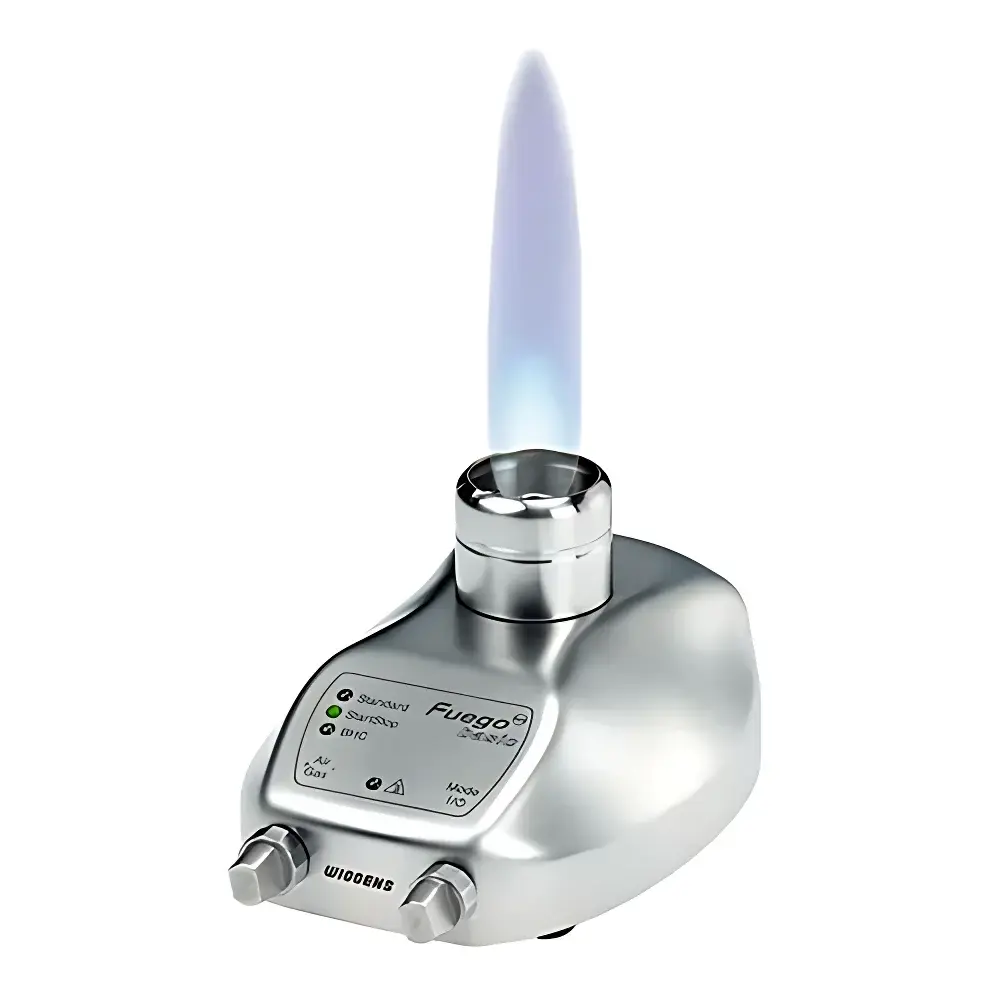
WIGGENS Fuego Basic Bunsen Burner
| Brand | WIGGENS |
|---|---|
| Origin | Germany |
| Model | Fuego Basic |
| Gas Supply | Liquefied Petroleum Gas (LPG) 20–50 mbar / Natural Gas E/LL 18–25 mbar |
| Maximum Flame Temperature | 1350 °C (LPG), 1300 °C (Natural Gas) |
| Gas Consumption | 70 g/h |
| Power Input | 100–240 V, 50/60 Hz, ≤0.3 A |
| Dimensions | 103 × 49 × 130 mm |
| Weight | 700 g |
| Safety Certification | DIN EN 13861, CE, EEC |
| Ignition Nozzle Diameter | Ø23 mm |
| Control | Microprocessor-based rotary knob + wired footswitch (standard) |
| Housing | One-piece stainless steel, fully insulated external components |
| Tilt Function | Left/right manual tilt via spring-loaded base plate |
| Sterilization Accessories | Rear-mounted sterilization needle holder, swivel-lock gas connector, included tools (screwdriver & wrench), universal power adapter kit |
Overview
The WIGGENS Fuego Basic Bunsen Burner is a precision-engineered laboratory flame source designed for reproducible, high-temperature thermal applications—including rapid sterilization of inoculation loops and needles, glassware annealing, microbial loop flaming, and localized heating in microbiology, molecular biology, and general chemistry workflows. Unlike conventional Bunsen burners relying on passive air-gas mixing, the Fuego Basic employs an aerodynamically optimized burner head geometry that minimizes ambient airflow disruption, enabling stable, laminar, stoichiometrically balanced blue flames with consistent thermal output. Its microprocessor-controlled combustion management system continuously monitors operational parameters—including gas pressure, ignition status, and thermal load—ensuring flame stability across variable line voltage (100–240 V AC) and diverse fuel sources (LPG or natural gas). With a maximum flame temperature of 1350 °C (LPG) and certified compliance to DIN EN 13861, CE, and EEC directives, the Fuego Basic delivers regulatory-aligned performance for GLP-compliant laboratories requiring traceable, repeatable thermal treatment.
Key Features
- Aerodynamic burner head design reduces turbulence-induced flame flicker, ensuring uniform blue flame geometry and thermal profile across extended operation.
- Integrated SCS (Safety Control System) continuously verifies gas supply integrity, flame presence, and surface temperature—automatically cutting off gas flow in case of overheat (>150 °C housing surface), flameout, or abnormal pressure deviation.
- BHC (Burner Head Check) algorithm monitors physical obstruction of the ignition nozzle (e.g., liquid residue or particulate blockage) and validates correct mounting orientation prior to ignition.
- Residual heat warning system activates audible alerts and visual indicators when the burner head remains above 60 °C post-use, preventing accidental contact burns.
- One-piece stainless steel housing provides corrosion resistance, mechanical robustness, and seamless cleanability—critical for ISO 14644-compliant cleanroom or biosafety cabinet integration.
- Manual left/right tilt adjustment via spring-loaded base plate enables ergonomic flame positioning without repositioning the entire unit.
- Dual activation modes: tactile rotary knob (press-to-ignite, turn-to-adjust gas flow) and standard wired footswitch supporting both momentary and timed operation (1-hour auto-shutoff).
Sample Compatibility & Compliance
The Fuego Basic accommodates standard microbiological sterilization tools—including platinum/iridium inoculation loops (up to 3.5 mm diameter), straight and calibrated needles, and glass Pasteur pipettes—within its precisely defined thermal envelope. Its gas inlet supports both LPG (20–50 mbar) and natural gas (E/LL grade, 18–25 mbar) without hardware modification, with dedicated interface fittings supplied. All electrical and pneumatic components meet DIN EN 13861 (laboratory gas appliances), CE Machinery Directive 2006/42/EC, and Electromagnetic Compatibility Directive 2014/30/EU. The device is compatible with ISO/IEC 17025-accredited calibration protocols and supports audit-ready documentation through its embedded safety event logging (flame failure count, overheat incidents, ignition attempts).
Software & Data Management
While the Fuego Basic operates as a standalone instrument without cloud connectivity or firmware-upgradable software, its microcontroller implements deterministic real-time control logic with non-volatile memory for safety event timestamping. Each ignition cycle, flame loss detection, and thermal shutdown is logged with millisecond-resolution timestamps accessible via diagnostic mode (service technician only). These logs satisfy FDA 21 CFR Part 11 requirements for electronic records when exported manually via service port—supporting GMP/GLP environments where equipment qualification (IQ/OQ/PQ) mandates traceable operational history. No external drivers or proprietary software are required; all user interaction occurs via physical controls and audible/visual feedback.
Applications
- Routine sterilization of microbiological transfer tools in BSL-1 and BSL-2 laboratories.
- Flame polishing of glass capillaries and microelectrodes in electrophysiology setups.
- Localized thermal treatment during thin-film deposition or ceramic sintering pre-steps.
- Emergency flame-based decontamination of metallic surfaces in field-deployable labs.
- Teaching laboratories requiring fail-safe ignition, predictable flame behavior, and student-accessible safety interlocks.
FAQ
Does the Fuego Basic support wireless footswitch operation?
No—the Fuego Basic includes only a wired footswitch. Wireless footswitch functionality is exclusive to the Fuego Basic RF model.
Can the burner be used inside a laminar flow hood without disrupting airflow?
Yes—its low-profile dimensions (103 × 49 × 130 mm), rear-mounted gas inlet, and laminar flame profile minimize convective interference, making it suitable for Class II A2 and B2 biosafety cabinets when installed per manufacturer clearance guidelines.
Is routine calibration required?
No scheduled calibration is mandated; however, annual verification of gas pressure regulation, flame temperature consistency (using calibrated thermocouple at 10 mm above nozzle), and SCS self-test functionality is recommended per ISO/IEC 17025 Clause 6.4.
What maintenance intervals are advised?
Visual inspection of nozzle cleanliness before each use; quarterly disassembly and ultrasonic cleaning of the burner head assembly; biannual torque verification of gas connector locking mechanism using supplied wrench.
Is the unit compatible with propane-only gas lines?
Yes—propane (n-propane/n-butane blends) is supported within the specified 20–50 mbar LPG pressure range. Ensure regulator output matches this specification and install the included LPG-specific gas interface.



