
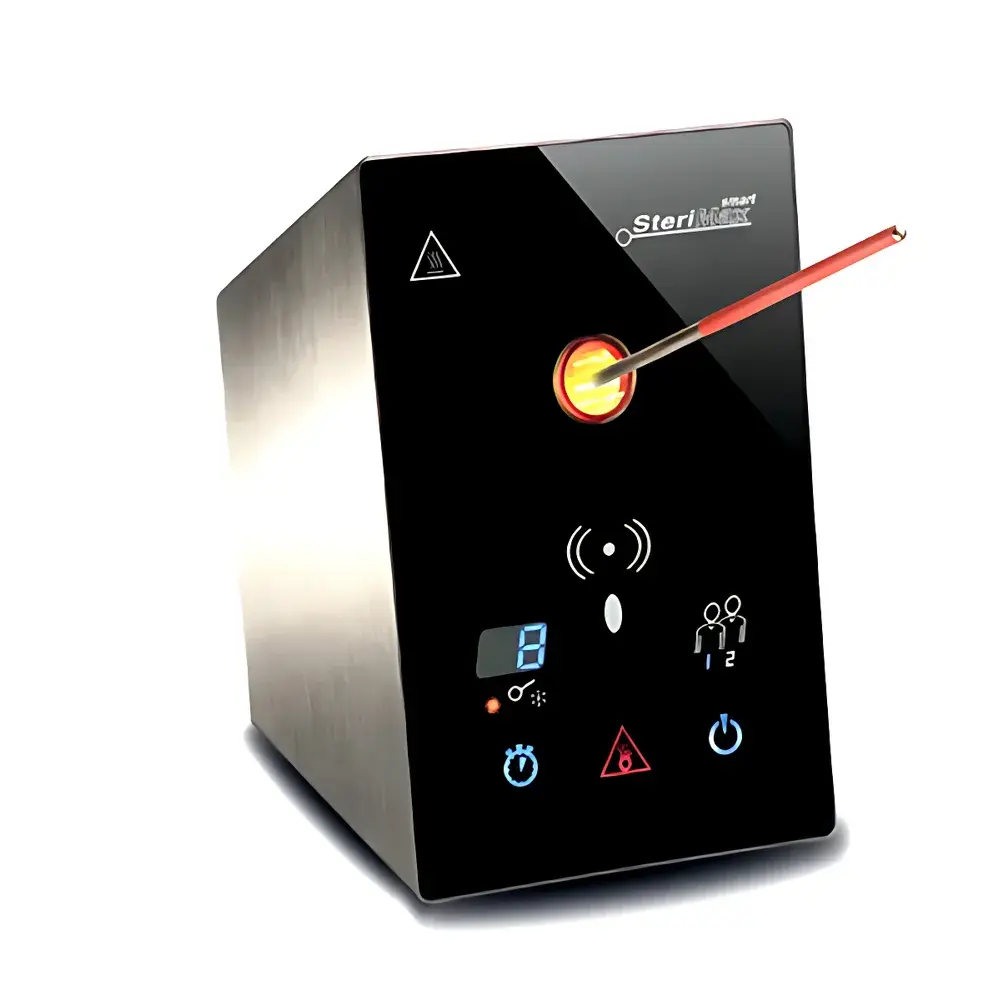
WIGGENS SteriMax Smart Infrared Sterilizer
| Brand | WIGGENS |
|---|---|
| Origin | Germany |
| Model | SteriMax Smart |
| Sterilization Temperature Range | 750–1000 °C |
| Sterilization Time | 5–10 s |
| Cooling Time Adjustment | 0–25 s |
| Power Supply | 220–240 V, 50/60 Hz |
| Rated Power | ~600 W (short-time burst) |
| Heating Source | Infrared Lamp |
| Sterilization Tube Material | Fused Quartz |
| Tube Dimensions | Ø19 mm (OD) × Ø16 mm (ID) × 112 mm (L) |
| Enclosure | Stainless Steel with Touch-Control Glass Panel |
| Protection Class | IP20 |
| Certifications | CE (EN 61326-1, EN 61010-1, EN 62471), EEC Directives 2004/108/EC, 2006/95/EC, 2006/25/EC |
| Dimensions (W×H×D) | 110 × 170 × 180 mm |
| Weight | 1.8 kg |
Overview
The WIGGENS SteriMax Smart Infrared Sterilizer is an engineered solution for rapid, flame-free, and contactless sterilization of microbiological tools—primarily inoculation loops, needles, forceps, and small metallic or ceramic instruments. Unlike traditional Bunsen burners or hot-air ovens, the SteriMax Smart employs high-intensity infrared radiation emitted from a precisely focused quartz-encapsulated lamp. This radiant heat transfer mechanism enables instantaneous thermal delivery to instrument surfaces without convective air movement or open flame, minimizing lab fire risk, reducing ambient heat load, and eliminating combustion byproducts (e.g., CO₂, soot, or volatile organic compounds). The device operates on the principle of selective infrared absorption: metallic elements in sterilization tools absorb IR energy efficiently within the 1.5–4.0 µm spectral band, achieving surface temperatures exceeding 750 °C within seconds. This ensures complete microbial inactivation—including spores, mycobacteria, and non-enveloped viruses—per ISO 15883-1 and EN 556-1 requirements for critical-level disinfection.
Key Features
- Infrared heating system with fused quartz sterilization tube (Ø19 mm OD / Ø16 mm ID / 112 mm L), resistant to UV degradation and chemical corrosion (e.g., ethanol, bleach, acidic reagents)
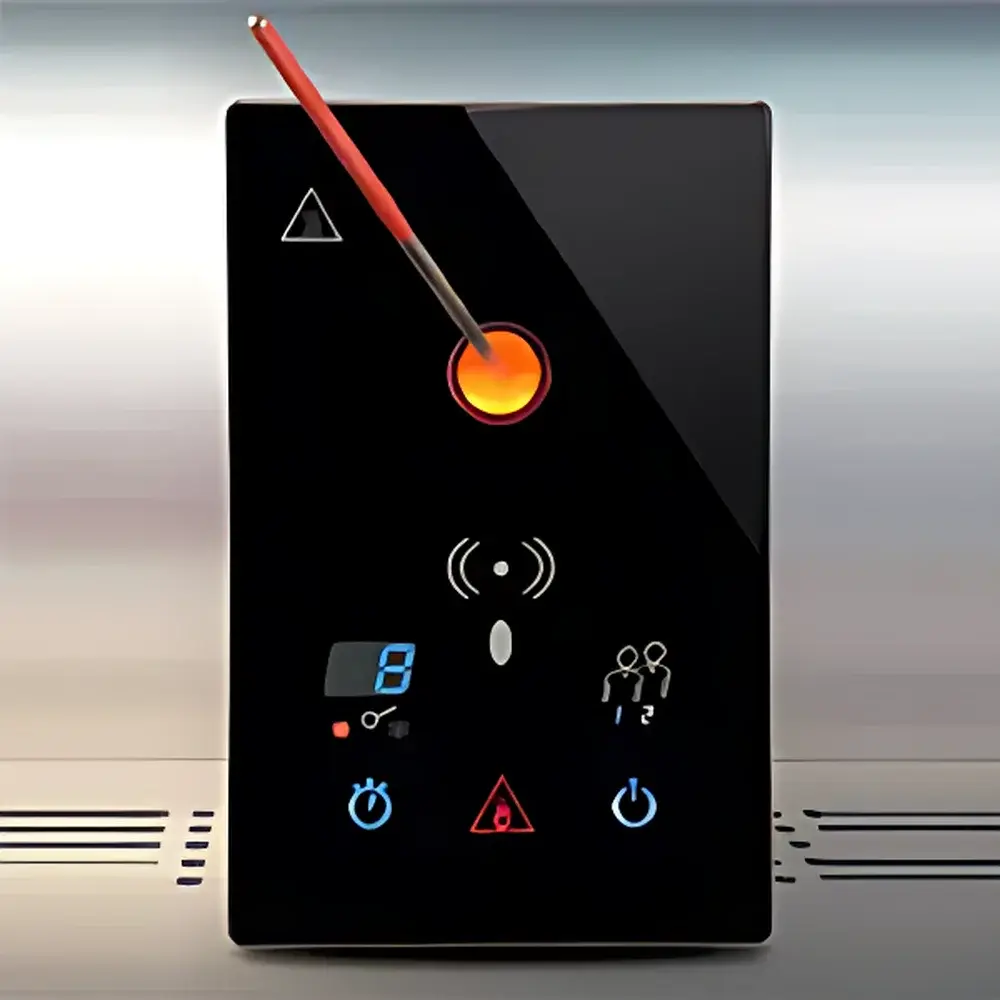
- Touch-sensitive glass control panel with intuitive interface for parameter adjustment and real-time status feedback
- Non-contact IR proximity sensor with 8-level sensitivity adjustment; automatically initiates sterilization cycle upon tool insertion
- Programmable sterilization time (5–10 s) and post-cycle cooling delay (0–25 s), each confirmed via audible tone
- No preheating required—full operational temperature reached within <2 s of activation; residual thermal energy retained between cycles for energy efficiency
- Thermal circuit breaker and automatic shutdown after user-defined idle periods (15 / 30 / 60 min)
- Stainless steel housing (AISI 304 grade) with IP20 ingress protection, suitable for laminar flow hoods, biosafety cabinets, and low-oxygen environments
- Low standby power consumption (<0.5 W); dynamic power modulation ensures minimal heat dissipation during idle and precise thermal delivery during operation
Sample Compatibility & Compliance
The SteriMax Smart is validated for use with standard microbiology tools including stainless steel, platinum, and nickel-chromium inoculation loops (diameters 0.6–1.0 mm), straight or bent needles, microspatulas, and small tweezers up to 120 mm in length. It is not intended for sterilizing plastic, coated, or temperature-sensitive components. The device complies with international safety and electromagnetic compatibility standards: CE marking per EN 61010-1 (electrical safety for laboratory equipment), EN 61326-1 (EMC for measurement/control devices), and EN 62471 (photobiological safety of lamps). Its design adheres to EU directives 2006/95/EC (Low Voltage Directive), 2004/108/EC (EMC Directive), and 2006/25/EC (physical agents—optical radiation). While not a medical device per MDR 2017/745, it supports GLP-compliant workflows where documented, repeatable sterilization of reusable tools is required.
Software & Data Management
The SteriMax Smart operates as a standalone hardware-controlled unit with no embedded firmware-based data logging or network connectivity. All operational parameters are set locally via the capacitive touch interface, and no configuration history or cycle logs are stored internally. This architecture eliminates cybersecurity risks associated with connected lab instruments and aligns with ITAR- and FDA-aligned environments where audit trail simplicity and device isolation are prioritized. For laboratories requiring electronic records, integration with external environmental monitoring systems (e.g., Vaisala viewLinc or DeltaTrak) can be achieved through optional dry-contact relay outputs (available via third-party adapters). The absence of software dependencies ensures long-term operational consistency and avoids obsolescence due to OS or driver updates.
Applications
- Routine sterilization of inoculation loops and needles in academic, clinical, and industrial microbiology labs
- Aseptic technique support in Class II biosafety cabinets and ISO 5 cleanrooms where flame prohibition is enforced
<liHigh-throughput plating workflows requiring sub-10-second turnaround between samples
<liSterilization in oxygen-restricted enclosures (e.g., anaerobic chambers, gloveboxes) where open-flame devices pose explosion hazards
<liTeaching laboratories emphasizing safety, reproducibility, and reduced training overhead for new users
<liQC/QA environments where traceable, parameter-controlled thermal treatment replaces subjective flame-based methods
FAQ
Does the SteriMax Smart require calibration or routine maintenance?
No scheduled calibration is required. Users should visually inspect the quartz tube for cracks or clouding before each shift and clean it weekly with lint-free wipes and >70% isopropanol. Replacement tubes (Order No. 4.000.400) are field-swappable in <60 seconds.
Can the device sterilize plastic or coated instruments?
No. Only metal or ceramic tools rated for continuous exposure to ≥1000 °C may be processed. Melting, warping, or off-gassing will occur with polymers, silicone, or lacquered surfaces.
Is the infrared emission hazardous to eyes or skin?
The integrated quartz tube filters out UV-C and most UV-B radiation. However, direct viewing of the glowing element at close range (5 seconds is discouraged. The device meets EN 62471 Risk Group 1 (Exempt) for optical radiation safety.
What happens if the sterilization tube becomes contaminated with biological residue?
Carbonized residue reduces IR transmission efficiency. Clean using a soft brass brush followed by ethanol wipe. Persistent deposits may necessitate tube replacement to maintain thermal consistency.
Is the SteriMax Smart compatible with 110 V / 60 Hz power supplies?
No. It is designed exclusively for 220–240 V, 50/60 Hz mains input. Use with voltage converters is not recommended and voids CE compliance and warranty.



