
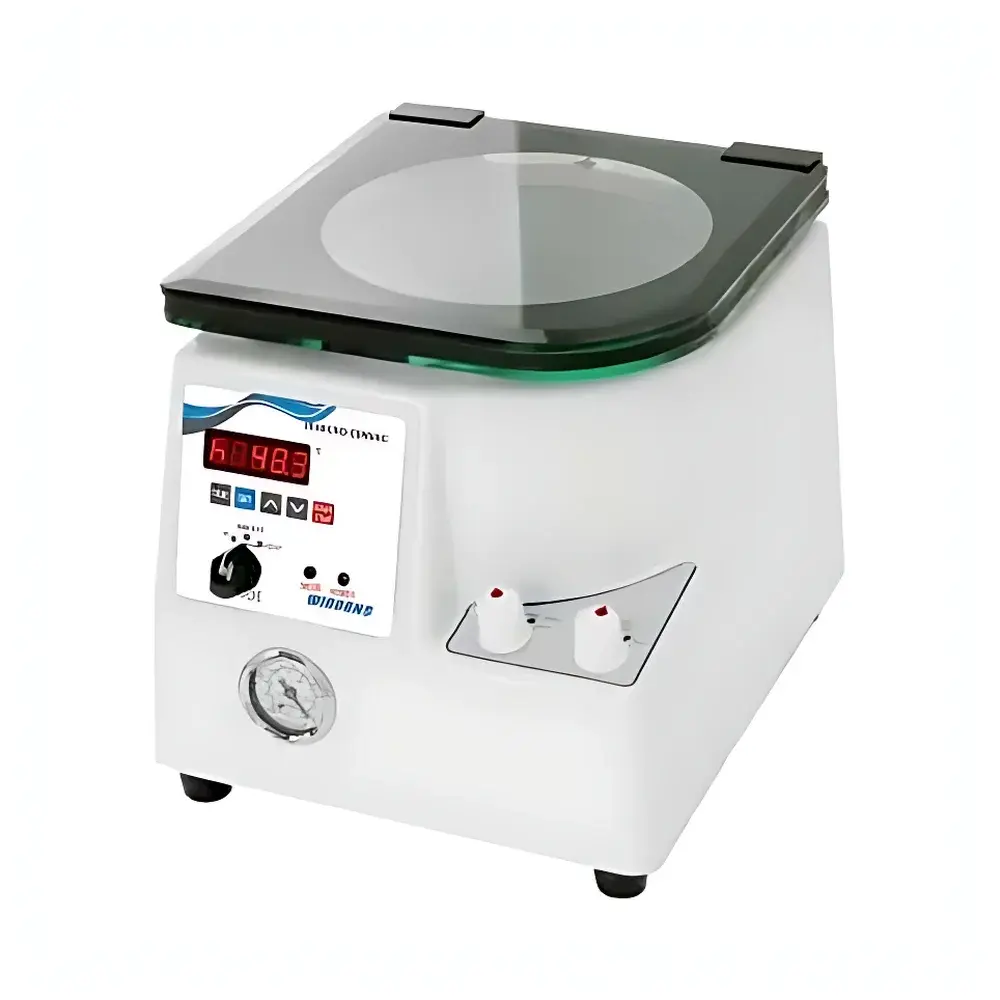
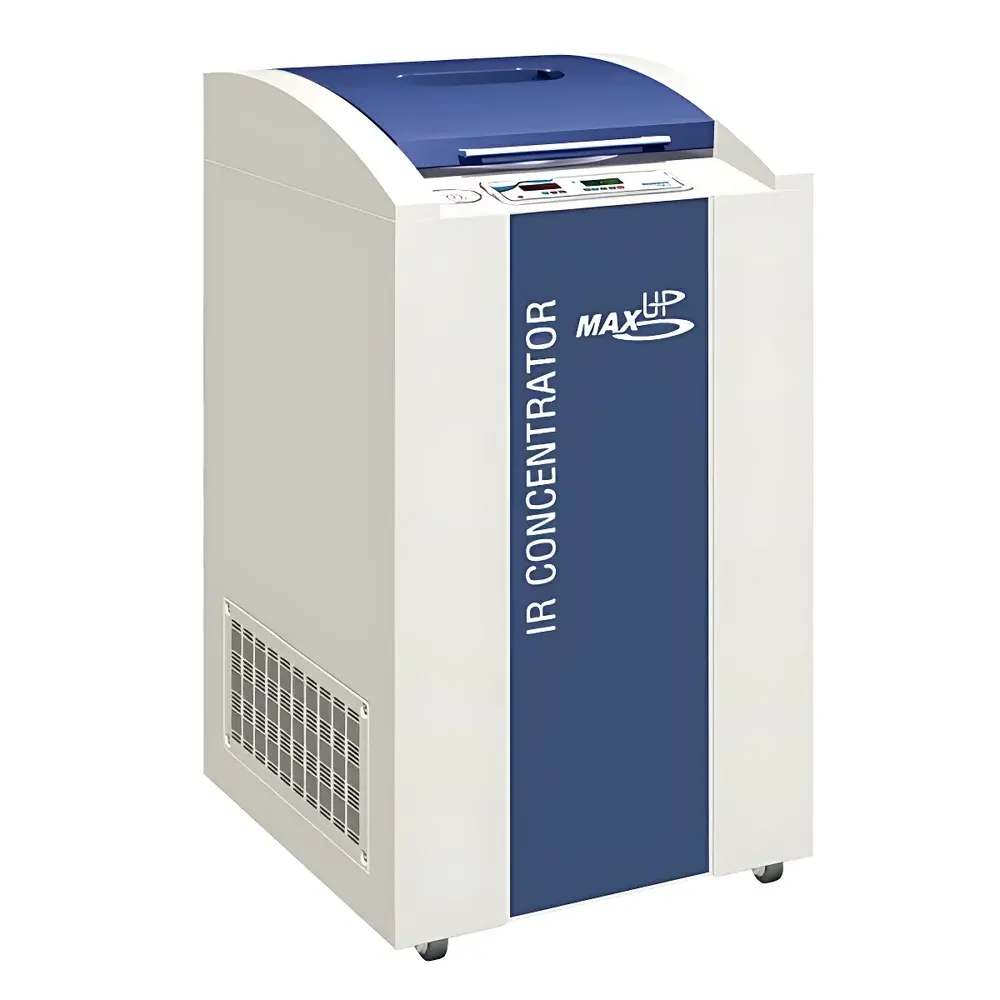
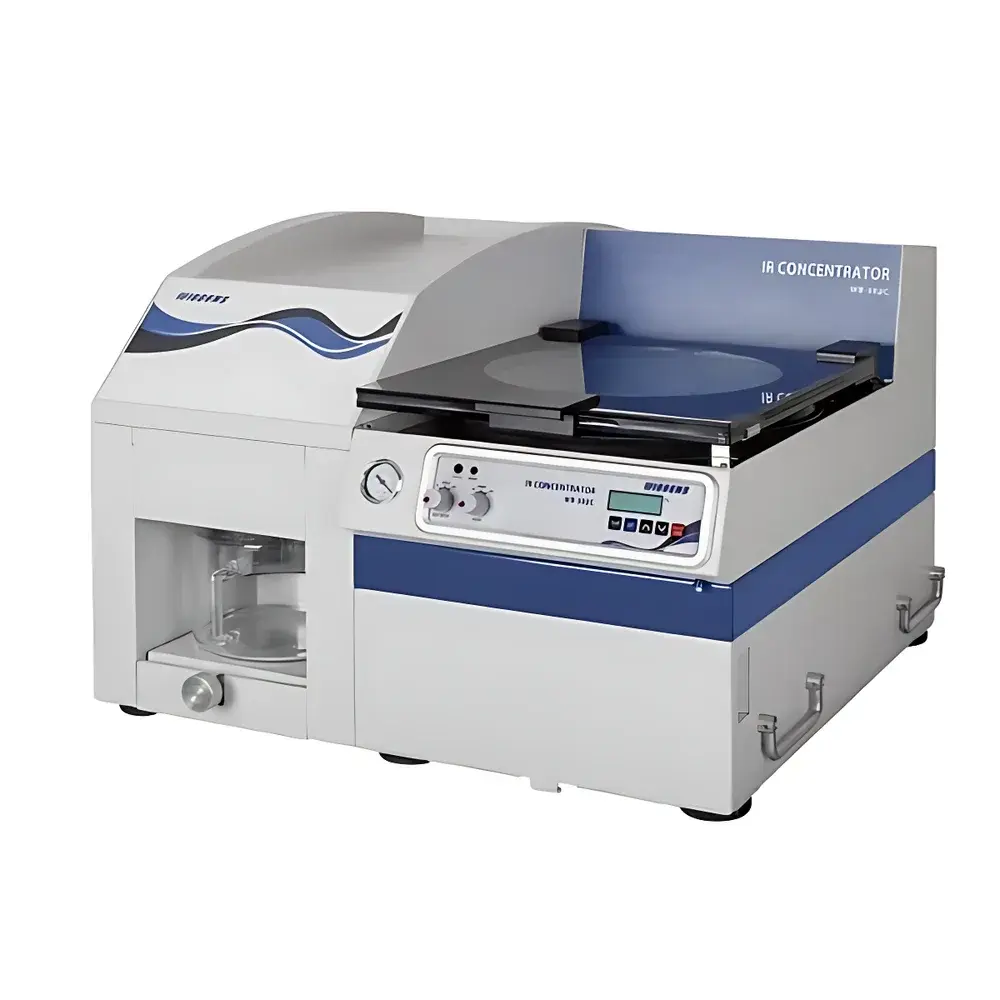
WIGGENS WB-504C Vacuum Centrifugal Concentrator with Integrated Cryo-Cold Trap and IR Heating
| Brand | WIGGENS |
|---|---|
| Origin | Germany |
| Model | WB-504C |
| Temperature Range | 35–65°C |
| Temperature Control Accuracy | ±0.1°C |
| Maximum Rotational Speed | ≤1500 rpm |
| Vacuum Level | ≥2 mbar |
| Integrated Cold Trap | −20°C, 2 L capacity |
| Chamber Dimensions (W×D×H) | 600 × 630 × 1085 mm |
| Weight | 138 kg |
| Power Supply | 220 V, 50/60 Hz |
Overview
The WIGGENS WB-504C Vacuum Centrifugal Concentrator is an engineered solution for gentle, high-efficiency sample concentration and solvent removal in life science and analytical laboratories. It operates on the principle of simultaneous vacuum-assisted evaporation and controlled infrared (IR) radiation heating—minimizing thermal stress while maximizing reproducibility. Unlike conventional conductive heating systems, the WB-504C’s patented IR glass lid delivers targeted energy directly to the liquid surface, enabling rapid solvent vaporization without bulk heating of the sample matrix. This makes it especially suitable for thermolabile biomolecules including DNA, RNA, proteins, peptides, enzymes, hormones, and small-molecule metabolites. The system integrates a corrosion-resistant PTFE diaphragm vacuum pump (WIGGENS C610), a −20°C active cryo-cold trap, and dual temperature sensing—one at the chamber wall and another embedded in the rotor bucket—to ensure precise thermal feedback and uniform heat distribution across heterogeneous sample loads.
Key Features
- Infrared glass heating lid with three selectable heating modes: IR-only, IR + conductive heating, or conductive heating only—enabling method optimization for diverse sample types and solvents.
- Dual Pt100 temperature sensors (chamber and rotor zone) coupled with PID control deliver ±0.1°C stability across the full operating range (35–65°C).
- Integrated chemical-resistant PTFE diaphragm pump eliminates oil contamination and reduces maintenance; achieves ultimate vacuum ≤2 mbar for efficient low-boiling-point solvent removal (e.g., ethanol, acetonitrile, chloroform).
- Active cold trap (−20°C, 2 L capacity) condenses vapors in real time, preventing backstreaming and protecting the vacuum pump—critical for long-duration runs and volatile organic solvent applications.
- Automatic rotor imbalance detection continuously monitors centrifugal load distribution during operation and initiates immediate deceleration if threshold deviation exceeds safety limits—ensuring operational integrity and personnel protection.
- Preset pre-heating mode allows chamber temperature stabilization prior to sample loading, reducing total cycle time and improving inter-run consistency.
- Centralized vacuum inlet positioned at the top of the central shaft minimizes aerosol carryover and cross-contamination between samples—validated for use in GLP-compliant nucleic acid purification workflows.
- Compact footprint with integrated pump and cold trap eliminates external tubing and auxiliary equipment, supporting flexible lab layout and mobile deployment within shared core facilities.
Sample Compatibility & Compliance
The WB-504C accommodates a wide range of sample formats: 1.5 mL microtubes (132 positions), 15 mL conical tubes (12 positions), 50 mL tubes (8 positions), 250 mL bottles (4 positions), and dual 96-well plates—enabling parallel processing across discovery, QC, and clinical research applications. All wetted surfaces are chemically inert (electropolished stainless steel chamber, PTFE-coated rotor components), ensuring compatibility with aggressive solvents including TFA, DCM, and HFIP. The system complies with IEC 61010-1:2010 for laboratory equipment safety and carries CE marking. Its architecture supports audit-ready data integrity requirements: temperature setpoints, vacuum levels, run duration, and rotor speed are logged with timestamped records—facilitating alignment with FDA 21 CFR Part 11 and ISO/IEC 17025 documentation standards when paired with validated software extensions.
Software & Data Management
While the WB-504C features a standalone LED touchscreen interface with intuitive tactile controls, its embedded firmware supports RS232/USB data export for integration into centralized LIMS or ELN platforms. All critical process parameters—including actual vs. setpoint temperature profiles, real-time vacuum pressure curves, and rotational speed history—are timestamped and exportable as CSV files. Optional firmware upgrades enable automated method recall, user access level management (administrator/operator), and electronic signature capture—meeting ALCOA+ principles for data attribution and traceability. The system does not require proprietary drivers; exported logs are natively readable in Excel and compatible with JMP, Python pandas, or LabArchives ingestion pipelines.
Applications
- Nucleic acid concentration and buffer exchange in NGS library preparation workflows.
- Proteomic sample cleanup prior to LC-MS/MS analysis—removing urea, SDS, or high-salt buffers without denaturation.
- Metabolite recovery from tissue extracts or cell culture supernatants using methanol/acetonitrile precipitation protocols.
- Concentration of antibody fragments, recombinant proteins, or viral vectors under GMP-aligned conditions where thermal degradation must be minimized.
- Preparative-scale lyophilization support: partial desolvation prior to freeze-drying improves cake morphology and reconstitution kinetics.
- Environmental chemistry: concentration of trace pesticides or pharmaceutical residues from aqueous environmental matrices prior to GC-MS quantification.
FAQ
What is the maximum allowable solvent volume per tube when using the 250 mL rotor configuration?
For optimal vacuum efficiency and condensation capacity, WIGGENS recommends ≤120 mL of solvent per 250 mL tube to prevent bumping and cold trap overload.
Can the WB-504C be used with trifluoroacetic acid (TFA) or hydrochloric acid solutions?
Yes—the PTFE pump head, stainless steel chamber, and IR heater assembly are fully resistant to TFA and dilute HCl (<1 M); however, extended exposure to concentrated mineral acids requires post-run chamber purging with isopropanol.
Is remote monitoring or control possible via Ethernet or Wi-Fi?
No native Ethernet/Wi-Fi module is included; however, third-party serial-to-Ethernet converters (e.g., Moxa NPort) can be deployed to enable networked status polling and alarm notification via SNMP.
How often should the cold trap collection flask be emptied during continuous operation?
Under typical ethanol/water evaporation at 45°C and ≤1500 rpm, the 2 L flask requires emptying every 8–12 hours; frequency increases with higher boiling point solvents (e.g., DMSO) or elevated temperature settings.
Does the system support IQ/OQ/PQ validation documentation packages?
WIGGENS provides a comprehensive User Requirement Specification (URS) template and factory-verified calibration certificates for temperature, vacuum, and rotational speed—serving as foundational inputs for site-specific qualification protocols.
Related Products



