
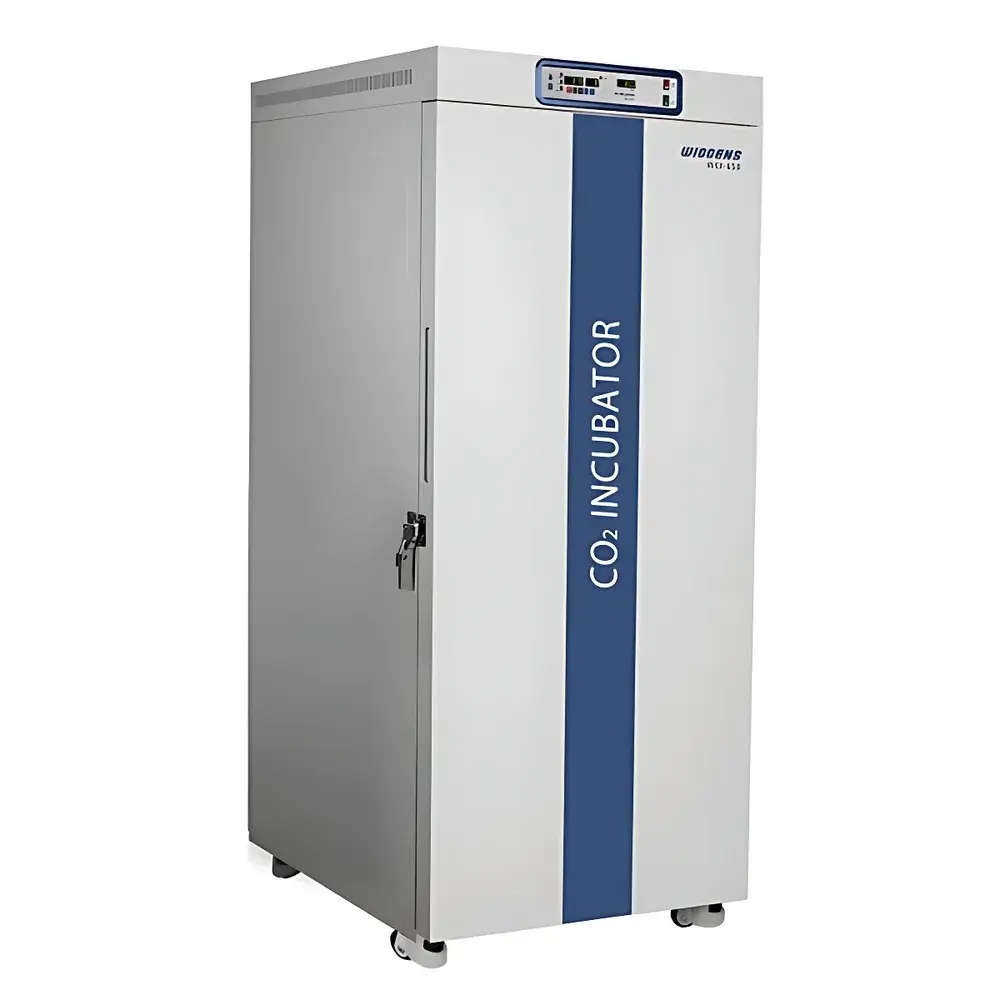
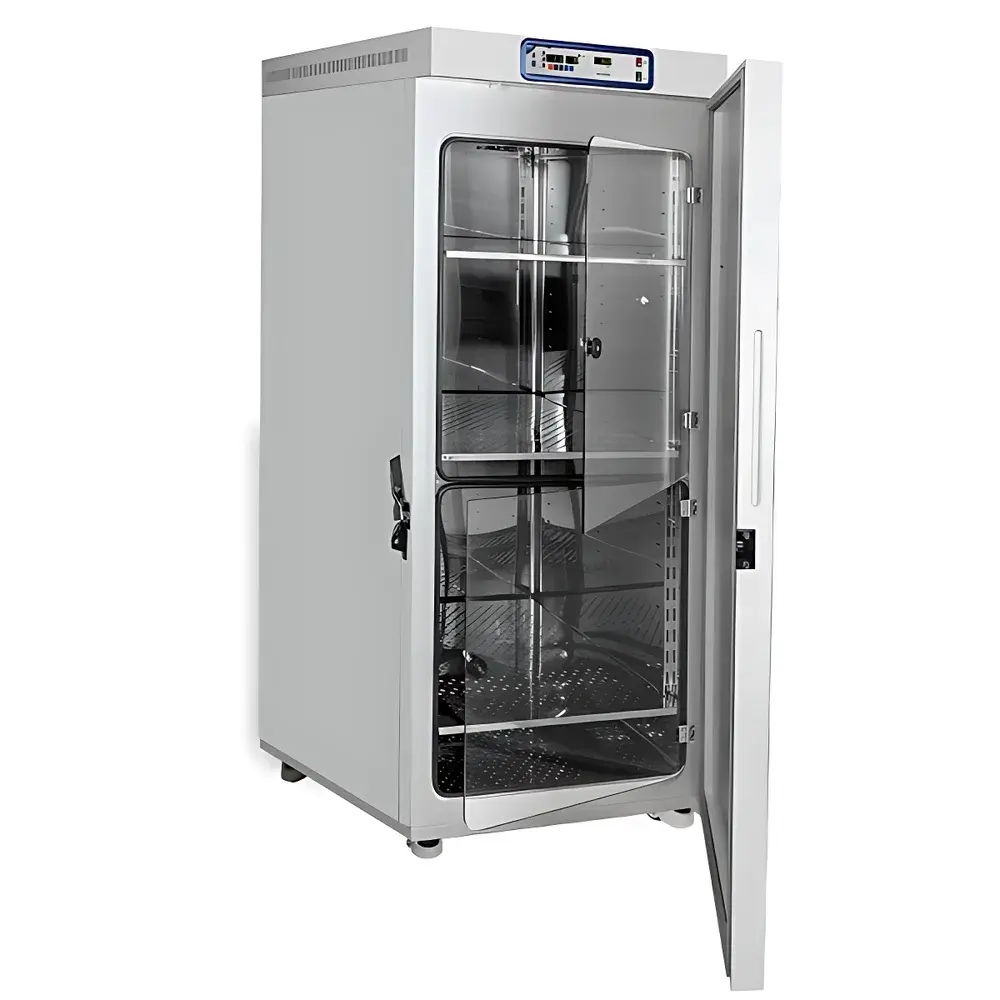
WIGGENS WCI-650 Carbon Dioxide Incubator
| Brand | WIGGENS |
|---|---|
| Origin | Germany |
| Model | WCI-650 |
| Type | Air-jacketed CO₂ Incubator |
| Temperature Range | +5°C above ambient to 60°C |
| Temperature Uniformity | ±0.5°C (at 37°C / 20°C ambient) |
| Chamber Volume | 650 L |
| External Dimensions | 820 × 780 × 1740 mm |
| CO₂ Range | 0–20% |
| CO₂ Accuracy | ±0.3% (at 5% setpoint, 37°C) |
| CO₂ Sensor | Dual-beam infrared |
| Temperature Display Resolution | 0.1°C |
| CO₂ Display Resolution | 0.1% |
| Heating Power | 1100 W |
| Chamber Material | AISI 304 Stainless Steel |
| Standard Shelves | 3 (max. 15) |
| Internal Dimensions | 700 × 650 × 1430 mm |
| Weight | 230 kg |
| Inlet Pressure | 0.7–1.0 bar |
Overview
The WIGGENS WCI-650 Carbon Dioxide Incubator is an air-jacketed, high-capacity (650 L) laboratory incubator engineered for precise, stable, and contamination-controlled cell culture environments. It employs a six-sided gradient heating system—where heating elements are embedded between the stainless steel chamber and the insulation layer—to achieve rapid thermal equilibration, minimal heat loss, and exceptional temperature uniformity (±0.5°C at 37°C). Unlike water-jacketed designs, this air-jacket architecture eliminates the risk of leakage, reduces maintenance overhead, and enables faster recovery after door openings—a critical performance metric in high-throughput cell culture workflows. The incubator maintains physiological CO₂ concentrations (0–20% range) via a dual-beam infrared sensor that delivers high specificity and immunity to cross-interference from ambient humidity or temperature fluctuations. Its microprocessor-based PID control system independently regulates temperature, CO₂ concentration, and alarm thresholds, ensuring compliance with fundamental requirements for mammalian cell propagation, stem cell expansion, and hybridoma culture.
Key Features
- Six-sided air-jacket heating with independent triple-point temperature monitoring: three calibrated Pt100 sensors—one in each chamber zone—enable real-time spatial validation and dynamic thermal compensation.
- Dual-beam non-dispersive infrared (NDIR) CO₂ sensor with factory calibration traceability, delivering ±0.3% accuracy at 5% CO₂ and 37°C—meeting ISO 13485-aligned verification protocols.
- Passive humidification system: bottom-mounted water pan heater generates saturated vapor; integrated circulation fan ensures homogeneous humidity distribution without condensation formation.
- Heated anti-condensation door and frame-integrated heating elements eliminate dewing on observation windows and interior surfaces—critical for uninterrupted microscopic observation and long-term culture integrity.
- HEPA-filtered gas inlet (99.99% @ 0.3 µm) provides continuous sterile air supply during CO₂ replenishment, reducing bioburden accumulation and supporting GLP-compliant operation.
- Optional ozone (O₃) sterilization module (model W6012650) delivers automated, residue-free decontamination cycles validated per EN 17128 for microbial reduction ≥6 log₁₀ CFU of Bacillus atrophaeus spores.
Sample Compatibility & Compliance
The WCI-650 accommodates standard T-flasks (up to 175 cm²), multi-well plates (6–96-well), Petri dishes, roller bottles, and custom bioreactor vessels—supported by up to 15 adjustable stainless steel shelves (AISI 304, electropolished finish). Its chamber geometry (700 × 650 × 1430 mm internal) allows unobstructed access and ergonomic loading. The incubator meets IEC 61010-1:2010 safety standards for laboratory equipment and complies with electromagnetic compatibility (EMC) requirements per IEC 61326-1. For regulated environments, its microcontroller supports audit trail generation (optional firmware upgrade), aligning with FDA 21 CFR Part 11 data integrity expectations when paired with validated network logging systems. Routine performance qualification (PQ) can be executed using ASTM E1288-22 protocols for temperature mapping and CO₂ stability testing.
Software & Data Management
The LED interface features dual-channel keypad navigation for simultaneous, independent adjustment of temperature and CO₂ setpoints. Real-time values—including chamber temperature, CO₂ %, relative humidity estimate, and system status—are displayed with 0.1°C/0.1% resolution. While the base unit operates without PC connectivity, optional RS-485 or Ethernet modules enable integration into centralized lab management platforms (e.g., LabVantage, Thermo Fisher SampleManager). Logged parameters—including timestamps, deviations, alarm events, and sterilization cycle records—are exportable as CSV files for review under ISO/IEC 17025 quality management systems. Firmware updates maintain backward compatibility and support future regulatory enhancements, including enhanced event logging for GMP Annex 1 alignment.
Applications
- Mammalian cell line maintenance (e.g., HEK293, CHO, HeLa) requiring strict pH control via 5% CO₂ buffering of bicarbonate-based media.
- Stem cell culture workflows where thermal homogeneity and low-vibration operation minimize differentiation drift.
- Primary neuron and organoid cultures demanding extended incubation periods (>72 h) with minimal environmental perturbation.
- Biopharmaceutical process development labs performing parallel seed train expansions under controlled CO₂ gradients.
- Academic core facilities supporting shared-resource access with configurable user profiles and cycle-based usage tracking.
FAQ
What is the recommended calibration frequency for the CO₂ sensor?
Annual verification against NIST-traceable gas standards is advised; field checks using certified 5.0% CO₂ test gas may be performed quarterly.
Can the incubator operate without external CO₂ supply?
No—it requires a regulated CO₂ gas source (0.7–1.0 bar inlet pressure) and is not designed for ambient-air-only operation.
Is the stainless steel chamber passivated per ASTM A967?
Yes—electropolished AISI 304 surfaces undergo citric acid passivation to enhance corrosion resistance and reduce metal ion leaching.
Does the heated door consume additional power during operation?
The door heating circuit draws 10°C, minimizing energy impact.
How is humidity level monitored and controlled?
Humidity is indirectly maintained via water pan temperature control and airflow optimization; no active RH sensor is included, consistent with ISO 13408-1 guidance for non-critical humidity ranges in cell culture.
Related Products




