
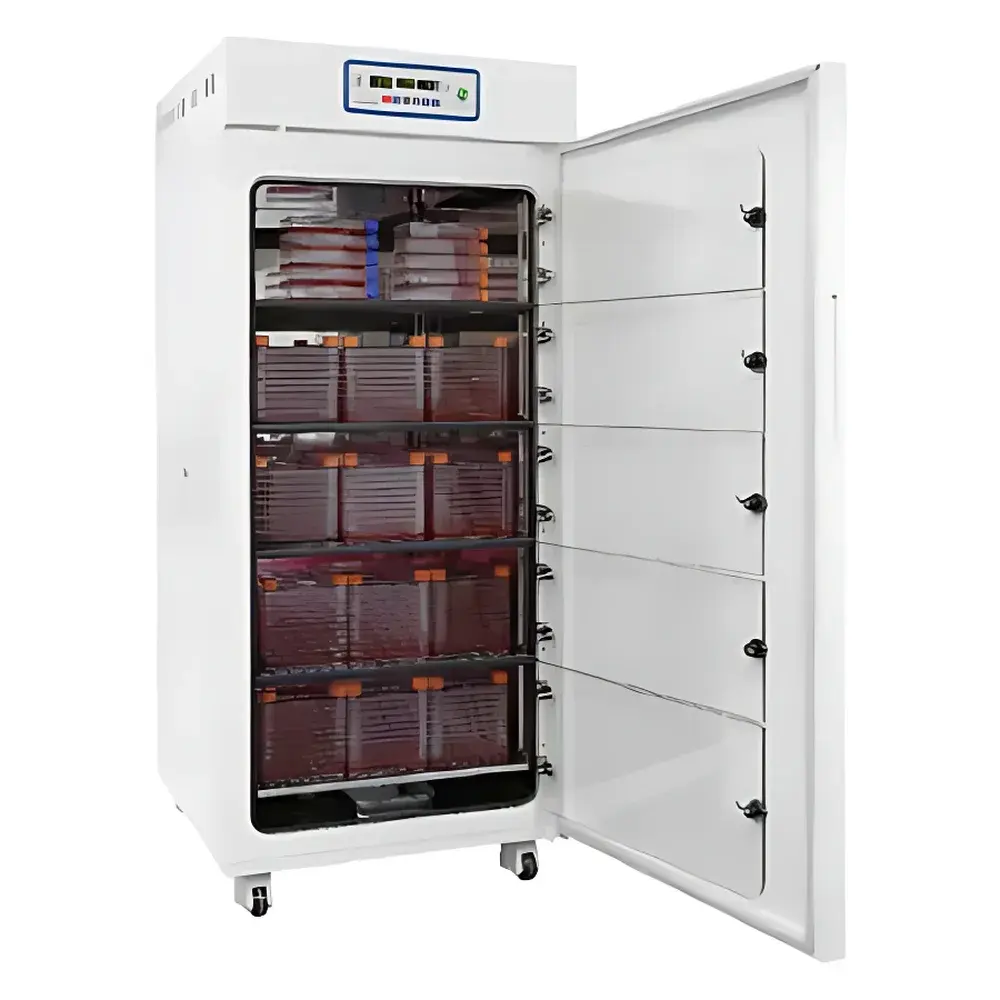
WIGGENS WCI-850C Advanced Cell Factory CO₂ Incubator
| Brand | WIGGENS |
|---|---|
| Origin | Germany |
| Model | WCI-850C |
| Instrument Type | Air-Jacketed CO₂ Incubator |
| CO₂ Detection | Dual-Beam Infrared (IR) Sensor |
| Temperature Range | Ambient +5°C to 60°C |
| Temperature Uniformity | ±0.1°C (at 37°C) |
| CO₂ Concentration Range | 0–20% |
| CO₂ Control Accuracy | ±0.1% (at 5% setpoint, 37°C) |
| Chamber Volume | 850 L |
| External Dimensions (W×D×H) | 820 × 930 × 1840 mm |
| Internal Dimensions (W×D×H) | 700 × 800 × 1530 mm |
| Heating Power | 1400 W |
| Shelf Capacity | 5 stainless steel perforated shelves, 50 kg load per shelf |
| Sterilization | Dry-heat up to 120°C |
| Control System | Digital PID with LED touchscreen interface |
| Chamber Material | AISI 304 stainless steel |
| Door Configuration | Five independent tempered glass observation doors with integrated heating |
| Gas Inlet Pressure | 0.7–1.0 bar |
| Weight | 260 kg |
| Max. Cell Factory Load | 23 × 10-layer Nunc™ cell factories |
Overview
The WIGGENS WCI-850C is a high-capacity, air-jacketed CO₂ incubator engineered specifically for large-scale adherent cell culture operations using multi-layer cell factories. Designed around the rigorous requirements of biopharmaceutical manufacturing, academic core facilities, and contract development and manufacturing organizations (CDMOs), it integrates six-sided gradient wall heating, top-mounted forced-air circulation, and dual-beam infrared CO₂ sensing to maintain exceptional environmental stability across its 850 L chamber. Its measurement principle relies on real-time feedback control of temperature (via platinum resistance thermometers), CO₂ concentration (via non-dispersive infrared absorption at two wavelengths to compensate for drift and cross-sensitivity), and relative humidity (indirectly stabilized via heated door and frame architecture). Unlike water-jacketed systems, the air-jacket design enables rapid thermal recovery after door openings—critical when handling multiple cell factory stacks—and minimizes condensation through active perimeter heating of all five observation doors and structural framing.
Key Features
- Six-sided air-jacketed heating system with independent thermal zoning ensures ±0.1°C temperature uniformity at 37°C—validated per ISO 13408-2 and ASTM E2921 guidelines for incubator performance verification.
- Dual-beam infrared CO₂ sensor provides long-term stability and immunity to contamination, delivering ±0.1% accuracy at 5% CO₂ (37°C), with 0.1% resolution across the full 0–20% range.
- Five independently operable tempered glass doors divide the chamber into isolated sub-compartments—each capable of hosting six 10-layer cell factories—enabling parallel culture of different cell lines under identical or differentiated conditions without cross-contamination risk.
- Perforated AISI 304 stainless steel shelves (5 total), load-rated to 50 kg each, facilitate optimal gas exchange and heat transfer beneath stacked cell factories while resisting corrosion from repeated ethanol or hydrogen peroxide vapor (HPV) decontamination cycles.
- Integrated dry-heat sterilization mode (up to 120°C) complies with ISO 14644-1 Class 5 cleanroom-compatible decontamination protocols and supports GMP-aligned validation studies (IQ/OQ/PQ).
- LED touchscreen interface with digital PID control logs all critical parameters—including temperature, CO₂, door status, alarm events—with timestamped audit trails compliant with FDA 21 CFR Part 11 requirements when connected to a validated networked data management system.
Sample Compatibility & Compliance
The WCI-850C accommodates standard 10-layer cell factories (e.g., Nunc™, Corning® CellSTACK®), supporting up to 23 units simultaneously. Its internal geometry—700 × 800 × 1530 mm—allows vertical stacking with ≥100 mm clearance above the topmost unit for unimpeded airflow. All wetted surfaces are electropolished AISI 304 stainless steel, meeting USP material compatibility standards for mammalian cell culture. The incubator conforms to IEC 61010-1 (Safety Requirements for Electrical Equipment), EN 60335-1 (Household and Similar Electrical Appliances), and carries CE marking for in vitro diagnostic (IVD) ancillary use. Optional IQ/OQ documentation packages are available to support GLP, GMP, and ISO 9001 quality system integration.
Software & Data Management
The embedded controller stores 30 days of continuous parameter history (temperature, CO₂, door open/close events) with configurable export via USB or Ethernet. Alarm thresholds—CO₂ deviation >±0.3%, temperature excursion >±0.5°C—are fully programmable and trigger visual alerts on-screen plus audible buzzer activation. When integrated with WIGGENS’ optional LabLink™ software suite, users gain remote monitoring, automated report generation (PDF/CSV), electronic signature capability, and role-based access control—facilitating compliance with Annex 11 (EU GMP) and ALCOA+ data integrity principles.
Applications
- Scalable production of therapeutic proteins and monoclonal antibodies in adherent CHO or HEK293 cell lines.
- Stem cell expansion workflows requiring strict CO₂ and temperature fidelity across heterogeneous batches.
- Viral vector manufacturing (e.g., AAV, lentivirus) where sterility assurance and environmental consistency directly impact titer and infectivity.
- Regulatory submission-supporting studies requiring documented environmental stability per ICH Q5D and Q5A(R2).
- High-throughput screening platforms integrating automated cell factory handlers and inline pH/O₂ sensors.
FAQ
What is the maximum number of 10-layer cell factories supported?
Up to 23 standardized 10-layer cell factories (e.g., Nunc™ 10-layer) can be loaded simultaneously, utilizing all five compartments and optimized shelf spacing.
Does the WCI-850C support humidification control?
Humidity is maintained indirectly via heated door and frame architecture, eliminating visible condensation; no active humidification system is included, consistent with ISO 13408-2 recommendations for low-maintenance CO₂ incubators used in serum-free or defined-media cultures.
Can the incubator undergo VHP (vaporized hydrogen peroxide) decontamination?
Yes—the AISI 304 chamber, perforated shelves, and IR sensor housing are compatible with standard VHP cycles (≤1000 ppm, 60% RH, 25–30°C); sensor recalibration is recommended post-cycle per manufacturer guidelines.
Is dry-heat sterilization validated for endotoxin reduction?
At 120°C for ≥6 hours, the dry-heat cycle achieves ≥3-log reduction of bacterial endotoxins per ISO 11138-1, suitable for pre-use conditioning prior to sterile process simulation (media fill) studies.
How is temperature uniformity verified during qualification?
Uniformity is assessed using 15 calibrated PT100 probes placed per ISO 14644-3 Annex B methodology—9 in central grid, 6 near walls/doors—at 37°C and 5% CO₂ over 24 hours; results must demonstrate ≤±0.5°C spatial variation (as specified in technical datasheet).



