
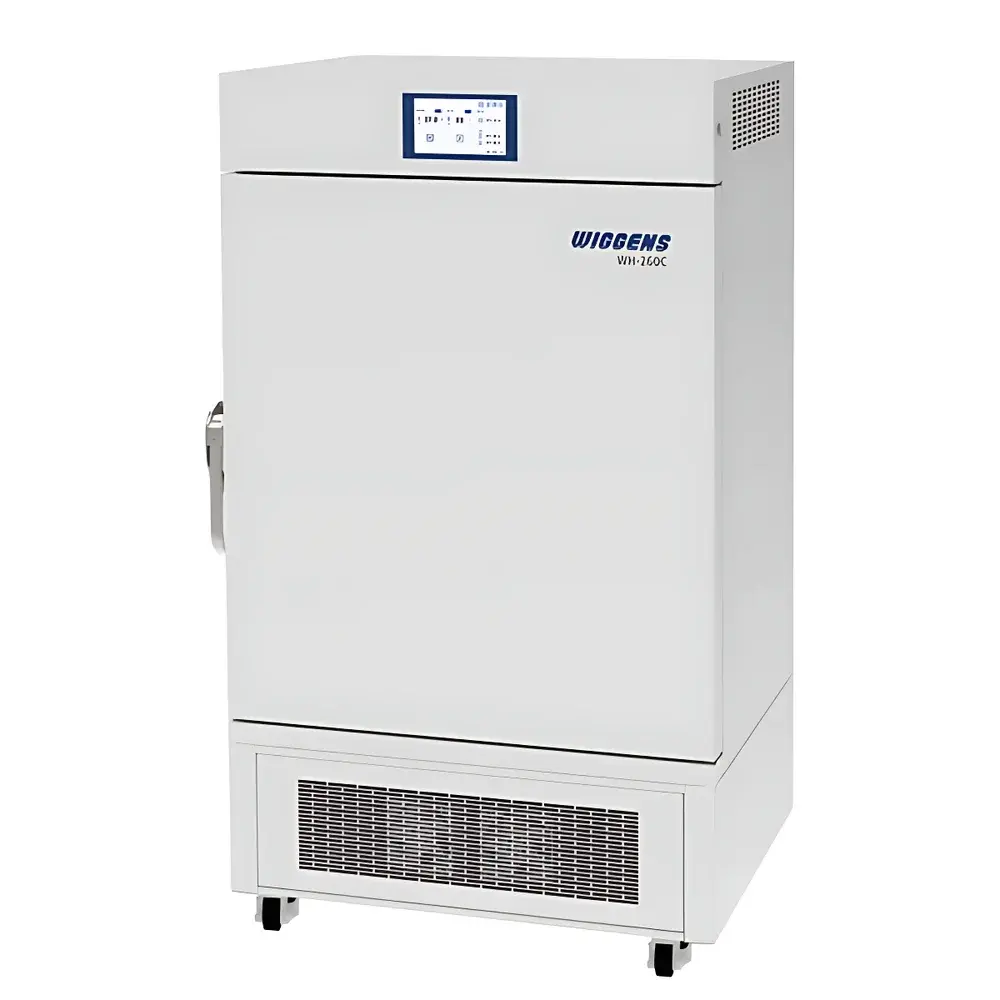
WIGGENS WH-150C Biochemical Incubator
| Brand | WIGGENS |
|---|---|
| Origin | Germany |
| Model | WH-150C |
| Heating Method | Air-jacketed |
| Cooling Method | Compressor-based |
| Air Circulation | Forced convection |
| Temperature Range | +4 to +60 °C |
| Temperature Accuracy | ±0.1 °C |
| Temperature Uniformity | <±0.3 °C |
| Capacity | 150 L |
| External Dimensions (W×D×H) | 740 × 672 × 1220 mm |
| Internal Chamber Material | 304 Stainless Steel |
| Internal Dimensions (W×D×H) | 560 × 500 × 535 mm |
| Standard Shelves | 2 (max. 5) |
| Shelf Load Capacity | 30 kg per shelf |
| Heating Power | 650 W |
| Cooling Power | 350 W |
| Total Power Consumption | 1200 W |
| Ambient Operating Temperature | 10–35 °C |
| Power Supply | 220 V, 50/60 Hz |
| Net Weight | 145 kg |
| Communication Interfaces | DB9 & RJ45 (RS485 protocol), USB port for data logging (CSV export) |
Overview
The WIGGENS WH-150C Biochemical Incubator is a precision-engineered, air-jacketed temperature-controlled environment system designed for reproducible, long-term cultivation and storage of biological samples in life science, pharmaceutical, clinical, and academic research laboratories. Its dual-mode thermal management—combining independent air-jacketed heating and compressor-based cooling—enables rapid temperature stabilization and high-fidelity maintenance across the full operational range of +4 °C to +60 °C. Unlike water-jacketed or natural-convection units, the WH-150C employs forced-air circulation with optimized duct geometry and fan speed regulation to minimize thermal gradients and ensure spatial uniformity better than ±0.3 °C throughout the 150 L stainless steel chamber (304 grade). The incubator’s architecture complies with fundamental design principles outlined in ISO 13408-1 (aseptic processing environments) and supports GLP-compliant workflows through deterministic control logic, audit-ready event logging, and fail-safe hardware interlocks.
Key Features
- Air-jacketed heating system surrounding the entire inner chamber provides fast ramp-up times and superior thermal decoupling from ambient fluctuations.
- Compressor-based refrigeration enables stable sub-ambient operation down to +4 °C—critical for enzyme assays, microbial culture preservation, and cold-adapted cell line maintenance.
- PID-controlled digital temperature regulation with 0.1 °C setpoint resolution ensures minimal overshoot and steady-state deviation within specification limits.
- Real-time temperature curve display with adjustable screen brightness enhances usability under varied lighting conditions; historical trace data is stored onboard and exportable via USB.
- Comprehensive safety architecture includes overtemperature cutoff, overcurrent protection, door-open detection (with automatic heater/fan shutdown and audible alert), and optional autostart functionality upon power recovery.
- Modular shelving system: two stainless steel shelves included (up to five installable); each rated for 30 kg load capacity and compatible with standard labware including petri dishes, flasks, and multiwell plates.
- Robust mechanical construction: cold-rolled steel exterior with electrostatic epoxy-polyester coating; environmentally inert polyurethane insulation eliminates off-gassing and particulate shedding—meeting ISO 14644-1 Class 8 cleanroom compatibility requirements for ancillary equipment.
Sample Compatibility & Compliance
The WH-150C accommodates a broad spectrum of sample formats—including suspension cultures, adherent monolayers, tissue explants, diagnostic reagents, and stability-test formulations—without compromising sterility or thermal integrity. Its 304 stainless steel interior resists corrosion from routine disinfectants (e.g., 70% ethanol, hydrogen peroxide vapor) and facilitates validated cleaning protocols. The unit meets CE marking requirements under the EU Machinery Directive 2006/42/EC and Low Voltage Directive 2014/35/EU. While not certified as an IEC 61010-1 Class II device, its electrical safety design conforms to EN 61010-1:2019 Annex BB for laboratory equipment used in non-hazardous locations. Data integrity features—including time-stamped alarm logs, parameter change history, and CSV-exportable temperature traces—support alignment with FDA 21 CFR Part 11 expectations when deployed within validated computerized systems.
Software & Data Management
The WH-150C integrates seamlessly into networked lab infrastructure via RS485 communication over DB9 or RJ45 interfaces using standard Modbus RTU protocol—enabling remote monitoring, parameter adjustment, and alarm acknowledgment through SCADA or LIMS platforms. Local data acquisition is supported via plug-and-play USB interface: insertion of a FAT32-formatted USB drive initiates continuous timestamped logging at user-selectable intervals (1–600 seconds), generating comma-separated value (CSV) files compatible with Excel, Python pandas, or MATLAB for statistical process control (SPC) analysis. All logged events—including door openings, temperature excursions, and power interruptions—are retained with millisecond-resolution timestamps and persist through power cycles. No proprietary software installation is required; raw data files are human-readable and interoperable with third-party validation tools.
Applications
- Long-term maintenance of mammalian and insect cell lines requiring tight thermal control between 30–37 °C.
- Cold-chain simulation studies for biologics and mRNA vaccine intermediates at +4–8 °C.
- Enzyme kinetics assays where reaction rates are highly temperature-sensitive (e.g., polymerases, kinases).
- Microbial growth profiling across thermal niches—from psychrotolerant strains (50 °C).
- Stability testing of pharmaceutical excipients and final drug products per ICH Q1A(R2) guidelines.
- Pre-incubation of diagnostic kits and ELISA plates prior to assay execution.
- Environmental simulation for ecotoxicology studies involving aquatic or soil microcosms.
FAQ
What is the minimum operating temperature of the WH-150C, and how is sub-ambient stability achieved?
The WH-150C maintains temperatures as low as +4 °C using a dedicated hermetic compressor system integrated with the air-jacket thermal envelope. This architecture avoids condensation-related risks associated with Peltier-based units while delivering consistent cooling performance even at high ambient humidity.
Does the incubator support 21 CFR Part 11 compliance for electronic records?
While the WH-150C does not include built-in electronic signatures or role-based access control, its audit-trail-capable event logging, immutable timestamping, and CSV export functionality provide foundational elements for Part 11 compliance when implemented within a validated site-specific computerized system.
Can external sensors be connected for independent temperature verification?
Yes—the RJ45/DB9 interface supports integration with calibrated external PT100 or thermistor probes via custom Modbus register mapping, enabling redundant monitoring and calibration cross-checks.
Is the internal chamber suitable for use with CO₂-enriched atmospheres?
No. The WH-150C is a temperature-only incubator without gas-tight sealing, humidification, or CO₂ concentration control. It is not intended for CO₂-dependent cell culture applications.
What maintenance is required to sustain long-term accuracy and reliability?
Annual verification of temperature uniformity and accuracy using NIST-traceable reference probes is recommended. Condenser coil cleaning every six months (in dusty environments) and periodic inspection of door gasket integrity ensure optimal thermal efficiency and energy consumption.




