
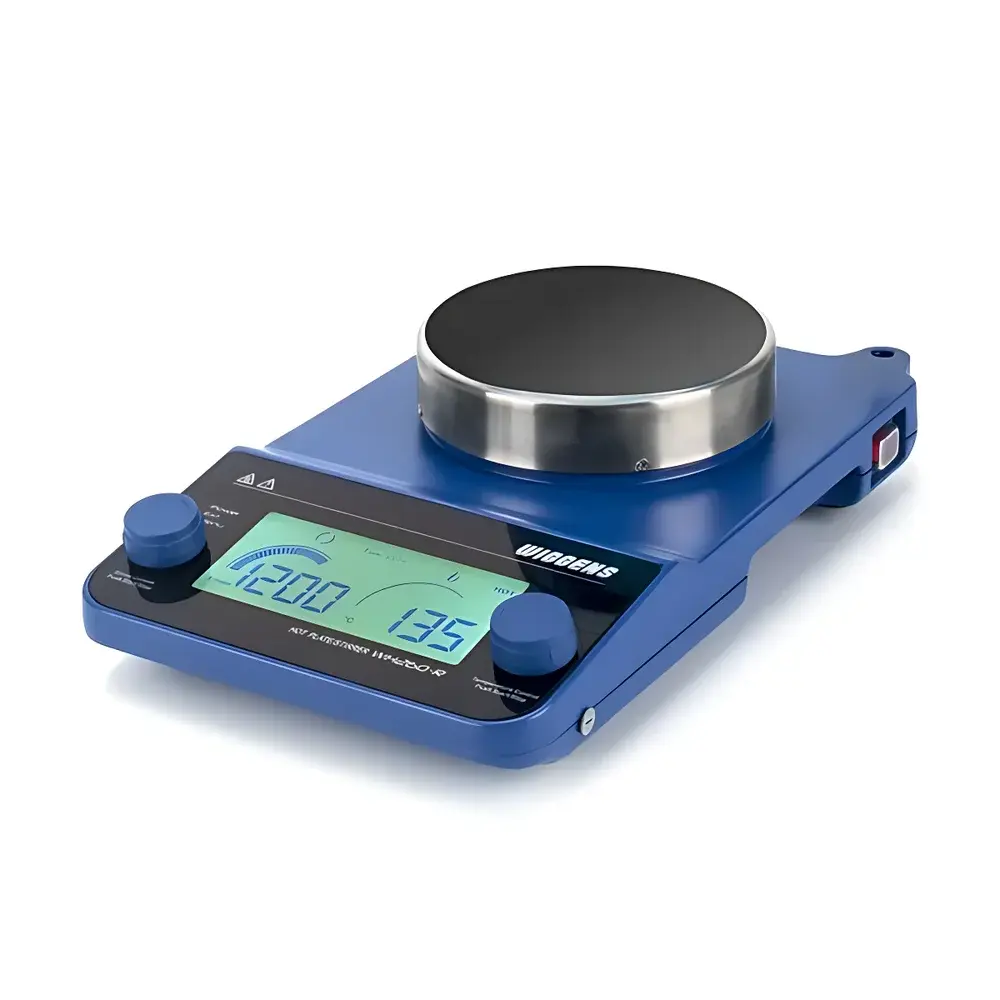
WIGGENS WH260-RL Digital Heating Magnetic Stirrer
| Brand | WIGGENS |
|---|---|
| Origin | Germany |
| Model | WH260-RL |
| Maximum Stirring Volume | 20 L |
| Speed Range | 100–1500 rpm |
| Heating Plate Temperature | ≤450 °C |
| Sample Temperature Control Range (with Pt100) | ≤300 °C |
| Safety Cut-off Temperature Range | 50–500 °C (adjustable) |
| Over-Temperature Protection ΔT | 10–50 °C (adjustable) |
| Temperature Stability (with Pt100) | ±1 °C |
| Heating Power | 800 W |
| Display | LCD |
| Control Interface | Rotary Knob + USB-A Port |
| Timer Function | 1–1999 min or Continuous |
| Plate Material | Enamel-Coated Glass |
| Plate Dimensions | Ø145 mm |
| External Temperature Sensor | Pt100 |
| PID Control | Triple Preset Algorithms (PID1–PID3) |
| Enclosure | Sealed, Corrosion-Resistant Housing |
| Compliance | Designed for GLP-compliant laboratory environments |
Overview
The WIGGENS WH260-RL is a high-performance digital heating magnetic stirrer engineered for precision thermal and mechanical control in research, quality control, and production laboratories. It integrates advanced infrared-enhanced heating technology with microprocessor-driven magnetic stirring to deliver rapid, uniform heating and stable rotational mixing across volumes up to 20 L of aqueous media. Unlike conventional hotplate stirrers relying on resistive coil heating, the WH260-RL employs an optimized infrared heating element beneath a chemically inert enamel-coated glass plate—enabling faster thermal response, reduced surface temperature gradients, and improved energy efficiency. Its core architecture supports closed-loop temperature regulation via external Pt100 probe feedback, ensuring accurate sample temperature maintenance within ±1 °C under dynamic load conditions. The system operates on a robust 220 V / 50 Hz supply and features a fully sealed enclosure with integrated corrosion-resistant liquid containment channels—designed to withstand routine exposure to solvents, acids, and bases commonly encountered in analytical and synthetic workflows.
Key Features
- Triple-mode PID temperature control with three factory-preset algorithms (PID1, PID2, PID3), each optimized for distinct thermal mass scenarios: PID1 for low-thermal-inertia samples (e.g., <50 mL aqueous solutions), PID3 for rapid ramping of high-volume or high-heat-capacity media (e.g., ≥5 L buffers or viscous polymer solutions)
- High-resolution LCD display showing real-time setpoints and actual values for temperature, speed, timer status, and safety thresholds
- Programmable over-temperature protection (ΔT) with adjustable offset from setpoint (10–50 °C), plus independent hardware-based thermal cut-off switch (50–500 °C range)
- Auto-recall function retains last-used parameters—including speed, target temperature, timer duration, and active PID profile—minimizing setup time for standardized protocols
- Integrated liquid containment groove above control panel prevents ingress of spilled reagents into electronics housing
- USB-A interface enables firmware updates and optional data logging integration (when paired with compatible WIGGENS software platforms)
- Stainless-steel structural frame and enamel-glass heating surface provide long-term resistance to chemical etching and mechanical abrasion
Sample Compatibility & Compliance
The WH260-RL accommodates standard laboratory vessels including borosilicate glass beakers (up to 5 L), stainless-steel reaction flasks, and polypropylene containers—provided magnetic stir bars are appropriately sized and coated (e.g., PTFE or glass-coated). It supports temperature-sensitive applications requiring adherence to ISO/IEC 17025 calibration traceability and GLP documentation standards. While not intrinsically rated for hazardous area use, its sealed electronics architecture meets IP20 environmental protection requirements per IEC 60529. The device is compatible with Pt100 Class A sensors conforming to DIN EN 60751, enabling traceable temperature monitoring aligned with USP , ASTM E2877, and EU GMP Annex 15 validation expectations. No internal battery or wireless transmission components are present; all control logic resides in deterministic embedded firmware compliant with IEC 61508 functional safety principles.
Software & Data Management
Although the WH260-RL operates as a standalone instrument, its USB-A port supports future interoperability with WIGGENS’ LabLink™ configuration utility—a Windows-based application used for parameter backup, firmware revision management, and audit trail generation. All user-modifiable settings—including PID selection, timer presets, and safety limits—are stored in non-volatile memory with write-cycle endurance exceeding 100,000 operations. Event logs (e.g., thermal cut-off triggers, sensor disconnects, power interruptions) are retained for the most recent 100 occurrences and accessible via diagnostic mode. For regulated environments, the system permits manual recording of operational parameters in paper-based or electronic lab notebooks (ELN) without requiring 21 CFR Part 11-compliant electronic signatures, as no automated data export or remote command capability is implemented at the device level.
Applications
- Precipitation and crystallization studies requiring simultaneous thermal ramping and homogeneous nucleation
- Buffer preparation and pH adjustment workflows where temperature-dependent dissociation equilibria must be maintained
- Enzyme kinetics assays conducted at controlled temperatures between 4 °C and 80 °C (using external cooling accessories)
- Synthesis of metal-organic frameworks (MOFs) and nanoparticle dispersions demanding extended heating durations (>12 h) with minimal thermal drift
- Standardization of reference materials per ISO Guide 35, where batch-to-batch reproducibility depends on consistent thermal-mechanical input
- Preparation of culture media in microbiology labs adhering to CLSI M22-A3 guidelines for sterility assurance during heating phases
FAQ
Does the WH260-RL support external temperature probes other than Pt100?
No—only standardized 2-wire or 3-wire Pt100 sensors meeting DIN EN 60751 Class A tolerances are supported.
Can the unit be operated without a temperature probe?
Yes; it functions as a non-contact heated stirrer using plate temperature mode, though sample temperature accuracy cannot be guaranteed without direct probe feedback.
Is the enamel-glass plate resistant to hydrofluoric acid exposure?
No—HF rapidly degrades silicate-based coatings. Use only with HF-compatible alternatives (e.g., PTFE-coated hotplates) when handling hydrofluoric acid.
What is the maximum ambient operating temperature for continuous duty?
The device is rated for continuous operation at ambient temperatures up to 35 °C and relative humidity ≤80 % non-condensing.
How often should the unit undergo preventive maintenance?
WIGGENS recommends annual verification of temperature accuracy against NIST-traceable references and visual inspection of plate integrity, especially after exposure to thermal shock or corrosive spills.



