
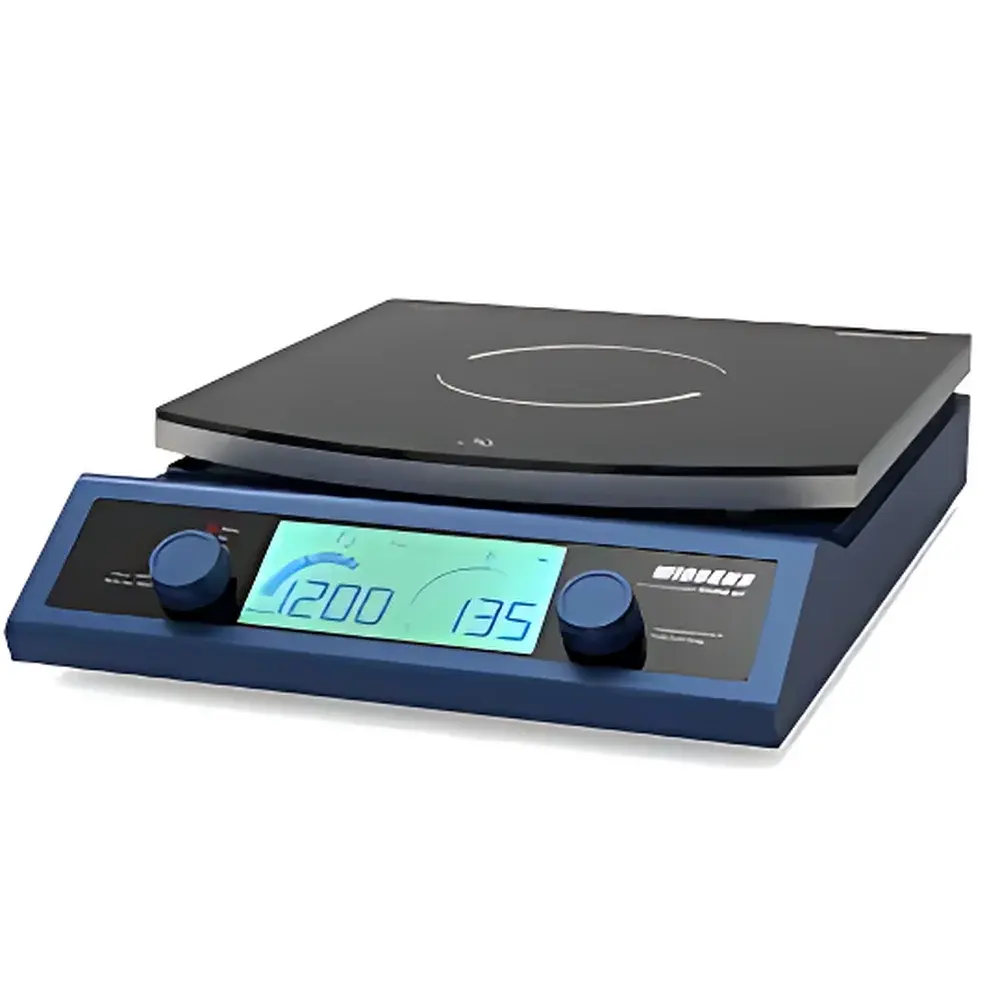
WIGGENS WH390 Series Infrared Heating Magnetic Stirrer
| Brand | WIGGENS |
|---|---|
| Origin | Germany |
| Model | WH390 / WH390-NH / WH395 |
| Max. Stirring Volume | 30 L |
| Speed Range | 100–1500 rpm |
| Heating Temperature Range (Plate) | ≤550 °C |
| Sample Temp Control Range (with Pt100) | ≤300 °C |
| Heating Power | 1800–2000 W |
| Temp Stability (with Pt100) | ±1 °C |
| Safety Overtemperature Cut-off | Adjustable 50–600 °C |
| ΔT Overheat Protection | Adjustable 10–50 °C |
| Display | LCD (WH390, WH390-NH) / TFT (WH395) |
| Interface | RS232/RS485 |
| Plate Material | Vitreous Enamel with Nano-Metal Coating (WH390), Vitreous Enamel (WH390-NH, WH395) |
| Plate Dimensions | 280 × 280 mm |
| Heating Zone Diameter | 190 mm |
| Housing | Sealed, Corrosion-Resistant Enclosure |
| External Sensor Input | Pt100 (all models) |
| Timer Range | 1–1999 min or continuous (WH390/WH390-NH) |
| Power Supply | 220 V / 50 Hz |
| Weight | 4.1 kg |
| Dimensions (W×D×H) | 450 × 290 × 120 mm (WH390/WH395), 450 × 290 × 80 mm (WH390-NH) |
Overview
The WIGGENS WH390 Series Infrared Heating Magnetic Stirrer is an engineered solution for laboratories requiring precise, rapid, and contamination-free thermal management during magnetic stirring. Unlike conventional resistive-heated hotplates, the WH390 series employs high-efficiency infrared radiation to transfer thermal energy directly to the vessel bottom—minimizing heat loss, reducing ambient heating, and enabling faster ramp rates without compromising temperature uniformity across the 280 × 280 mm ceramic-glass plate surface. Its core design integrates a robust permanent magnet drive system with closed-loop PID (WH390/WH390-NH) or ICC (Intelligent Current Control, WH395) speed regulation, ensuring stable rotational torque delivery from 100 to 1500 rpm—even under viscous or high-volume (up to 30 L) conditions. The system supports both plate-surface temperature control and real-time sample temperature feedback via external Pt100 probe input, making it suitable for applications demanding strict thermal protocol adherence, such as polymer dissolution, catalyst activation, or buffer equilibration in analytical sample preparation.
Key Features
- Infrared heating technology delivering rapid thermal response and energy efficiency—plate surface withstands thermal shock up to 700 °C while maintaining structural integrity
- Vitreous enamel plate with nano-metal coating (WH390) or standard vitreous enamel (WH390-NH/WH395) offering exceptional chemical resistance against acids, alkalis, and organic solvents
- Sealed, corrosion-resistant housing with IP-rated ingress protection—designed for long-term reliability in humid, fume-intensive, or cleanroom-adjacent lab environments
- Adjustable safety overtemperature cut-off (50–600 °C) and differential overheat protection (ΔT = 10–50 °C), compliant with IEC 61010-1 safety standards for laboratory equipment
- Integrated timer function supporting extended unattended operation: 1–1999 minutes or continuous mode (WH390/WH390-NH); high-resolution time setting up to 99 hours 59 minutes (WH395)
- RS232/RS485 serial interface enabling remote parameter configuration, data logging, and integration into centralized lab automation systems (e.g., LIMS or SCADA)
Sample Compatibility & Compliance
The WH390 series accommodates standard borosilicate glass vessels (e.g., beakers, flasks, crystallization dishes) ranging from 10 mL to 30 L capacity. Its non-inductive infrared heating mechanism eliminates electromagnetic interference with sensitive electronic instrumentation nearby. All models support external Pt100 sensor input for direct sample temperature monitoring—critical for GLP/GMP-compliant workflows where traceable, probe-based thermal validation is required. The system’s temperature stability of ±1 °C (with Pt100 feedback) meets ASTM E2479-21 criteria for thermal uniformity in heating platforms used in pharmaceutical stability testing. Safety features—including visual high-temperature warning LED and automatic thermal shutdown—align with EN 61000-6-3 (EMC) and EN 61000-6-4 emission standards. No moving parts contact the sample; therefore, no lubricant contamination risk exists—ensuring suitability for ultra-trace metal analysis (e.g., ICP-MS sample digestion prep) and cell culture reagent warming.
Software & Data Management
While the WH390 series operates as a standalone instrument via front-panel controls (rotary encoder or touch interface on WH395), its RS232/RS485 port enables bidirectional communication with third-party software platforms. Users may configure setpoints, log real-time temperature/speed data, and trigger alarms via ASCII command protocols compatible with LabVIEW, Python (PySerial), or MATLAB. Audit trail functionality—including timestamped parameter changes and thermal event logs—can be implemented using external data acquisition software compliant with FDA 21 CFR Part 11 requirements when paired with appropriate electronic signature and access control layers. Firmware updates are delivered via serial interface, ensuring long-term regulatory adaptability without hardware replacement.
Applications
- Routine dissolution testing of APIs and excipients under controlled thermal profiles (USP )
- Preparation of homogeneous colloidal suspensions and nanoparticle dispersions requiring shear-controlled heating
- Accelerated solvent extraction (ASE) and Soxhlet pre-heating stages
- Enzyme kinetics assays requiring simultaneous temperature stabilization and gentle agitation
- Calibration of thermocouples and RTDs using traceable Pt100 reference points
- Environmental sample digestion (EPA Method 3050B, 3051A) where low-volatility acid mixtures demand precise thermal ramping
FAQ
Can the WH390 series be used with metal containers?
No. Infrared heating requires transparent or semi-transparent bottom surfaces (e.g., borosilicate glass, quartz, or certain ceramics). Metal vessels reflect IR radiation and prevent effective heating.
Is the Pt100 sensor included with the unit?
No. The WH390 series provides a dedicated Pt100 input port but does not include the probe. Compatible Class A or AA Pt100 sensors with 2-, 3-, or 4-wire configurations may be connected per IEC 60751.
What is the difference between PID and ICC speed control?
PID maintains constant rotational speed under varying load by dynamically adjusting motor current. ICC (available on WH395) adds adaptive torque compensation—particularly beneficial for non-Newtonian fluids or sudden viscosity changes during reaction progress.
Does the WH390-NH model support sample temperature control?
Yes. All three models accept external Pt100 input for closed-loop sample temperature regulation up to 300 °C, though the WH390-NH plate maximum is limited to 450 °C for enhanced thermal safety in low-boiling-point applications.
How is calibration verified for temperature accuracy?
Users may perform field verification using NIST-traceable reference thermometers placed in standardized test vessels (e.g., 500 mL water at 80 °C, per manufacturer specification). Calibration certificates for factory verification are available upon request.



