
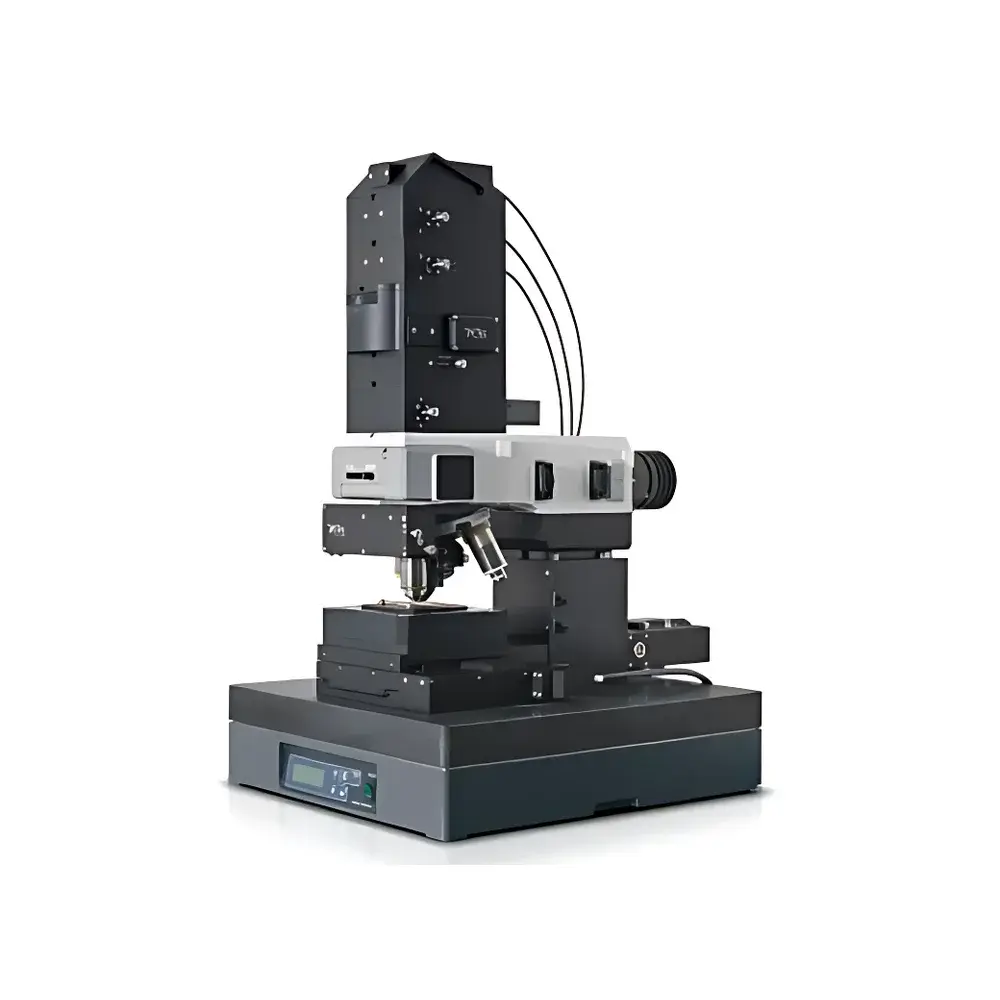
WITec alpha300 RA Raman-AFM Integrated Microscopy System
| Brand | WITec |
|---|---|
| Origin | Germany |
| Model | alpha300 RA |
| Instrument Type | Confocal Raman Microscope with Integrated Atomic Force Microscopy |
| Spectral Range | 90–9000 cm⁻¹ |
| Spectral Resolution | ≤0.2 cm⁻¹ |
| Spatial Resolution | Lateral 350 nm, Vertical 800 nm |
| Minimum Wavenumber | 10 cm⁻¹ |
| Spectral Reproducibility | ≤±0.02 cm⁻¹ |
Overview
The WITec alpha300 RA is the world’s first fully integrated, modular Raman-AFM correlative microscopy system engineered for simultaneous, truly in situ chemical identification and nanoscale topographic/functional characterization. It combines a high-performance confocal Raman spectrometer (alpha300 R platform) with a precision atomic force microscope (alpha300 A platform) within a single, shared optical and mechanical architecture—without performance compromise to either modality. The system operates on the principle of confocal Raman spectroscopy, where laser excitation is focused to a diffraction-limited spot and collected through a spatially filtered detection path, enabling depth-resolved spectral acquisition. Simultaneously, the AFM module employs piezoelectric scanning and laser-interferometric deflection detection to deliver quantitative nanomechanical, electrical, and magnetic property mapping. This dual-modal architecture ensures strict positional correlation between Raman spectral data and AFM-derived physical parameters—critical for materials science, polymer physics, semiconductor metrology, and life sciences applications requiring sub-350 nm lateral registration fidelity.
Key Features
- Fully integrated Raman and AFM hardware sharing a common sample stage, objective turret, and active vibration isolation platform—eliminating sample relocation or re-alignment between measurements.
- Single-software control environment (WITec Project PLUS) for synchronized acquisition, co-registered image overlay, spectral–topographic correlation analysis, and batch processing of hyperspectral Raman datasets with AFM force curves, phase, adhesion, and dissipation maps.
- Motorized 6-position objective turret enabling rapid, software-triggered switching between Raman-optimized and AFM-optimized objectives; automatic calibration of optical path alignment upon turret rotation.
- UHTS (Ultra-High Throughput Spectrometer) series fiber-coupled spectrometers with >70% throughput across UV–VIS–NIR configurations, optimized for low-light Raman signal collection and symmetric peak profiles without optical aberration.
- Comprehensive AFM operational modes including Contact, AC (Tapping), Digital Pulse Force Microscopy (DPFM), Lift Mode, MFM, EFM, Phase Imaging, Force-Distance Curve Analysis, Lateral Force Microscopy (LFM), Chemical Force Microscopy (CFM), and Conductive AFM—expandable via optional modules.
- Research-grade optical microscope with LED Köhler illumination, motorized XYZ stage (25 × 25 × 20 mm travel), and CCD-based live-view imaging—supporting brightfield, darkfield, DIC, polarization, and fluorescence observation methods.
Sample Compatibility & Compliance
The alpha300 RA accommodates solid, thin-film, and micro-patterned samples ranging from conductive substrates (Si wafers, ITO glass) to insulating polymers, biological tissues, and 2D materials. Its non-destructive, label-free operation complies with ISO/IEC 17025 requirements for analytical instrument validation and supports GLP/GMP workflows when configured with audit-trail-enabled software logging (WITec Project PLUS v5.5+). Raman spectral calibration traceability follows NIST-traceable standards (e.g., silicon 520.7 cm⁻¹ line), while AFM force calibration adheres to ASTM E2546–22 guidelines for cantilever spring constant determination. The system meets CE marking requirements for electromagnetic compatibility (EMC Directive 2014/30/EU) and low-voltage safety (LVD Directive 2014/35/EU).
Software & Data Management
WITec Project PLUS serves as the unified acquisition, visualization, and analysis platform. It provides native support for HDF5-based data storage—ensuring metadata-rich, self-describing files compliant with FAIR (Findable, Accessible, Interoperable, Reusable) principles. Time-series Raman imaging, Z-stack acquisition, and multi-region automated mapping are scriptable via Python API. Spectral preprocessing includes cosmic ray removal, baseline correction (asymmetric least squares), and multivariate analysis (PCA, cluster analysis, spectral unmixing). AFM data is processed using standardized algorithms for roughness (Sa, Sq), mechanical property extraction (Young’s modulus via Hertzian modeling), and nanomechanical parameter correlation with Raman shifts (e.g., stress-induced Si–Si bond frequency shifts). Data export supports CSV, TXT, TIFF, and vendor-neutral formats compatible with MATLAB, Origin, and ImageJ/Fiji.
Applications
- Multi-phase polymer systems: Correlative mapping of chemical composition (Raman band assignment: PS at 1000 cm⁻¹, SBR at 1600 cm⁻¹, EHA at 1730 cm⁻¹) with nanoscale surface morphology, phase separation, and local viscoelasticity (via DPFM and adhesion mapping).
- Stress/strain analysis in semiconductors: In situ quantification of pressure-induced Raman shift in monocrystalline silicon beneath diamond anvil indentations, spatially overlaid with AFM topography and elastic modulus gradients.
- 2D material heterostructures: Identification of layer stacking order (via G/2D band ratios), strain distribution, and interfacial defects—correlated with AFM height, friction, and electrostatic potential maps.
- Pharmaceutical solid dispersions: Detection of amorphous–crystalline phase segregation, API–polymer interactions, and localized hygroscopicity through Raman peak broadening and AFM adhesion/hysteresis loops.
- TERS readiness: Modular upgrade path to tip-enhanced Raman spectroscopy (TERS) with compatible apertured or plasmonic AFM probes and polarization-controlled excitation optics.
FAQ
Can the alpha300 RA perform true simultaneous Raman and AFM acquisition?
Yes—the system uses time-synchronized triggering between the Raman CCD/EMCCD detector and AFM position encoder, enabling pixel-matched, real-time correlation without temporal drift or stage hysteresis.
Is spectral calibration maintained across different laser wavelengths and objectives?
Yes—automated wavelength calibration routines run before each measurement using internal reference sources (e.g., Ne lamp or Si edge), ensuring ≤±0.02 cm⁻¹ reproducibility regardless of optical configuration.
What is the maximum achievable Raman imaging speed in hyperspectral mode?
With optional EMCCD detector and piezo-driven fast-scanning stage, frame rates reach up to 1300 spectra per second—enabling sub-second full-field Raman mapping at 256 × 256 pixel resolution.
Does the system support automated multi-point or multi-region analysis?
Yes—Project PLUS includes scripting tools for grid-based, feature-targeted, or ROI-driven automated acquisition across hundreds of locations, with customizable pause/resume and error-handling protocols.
Are third-party AFM probes compatible?
The system accepts standard commercial AFM probes (e.g., Bruker, Nanoworld, Olympus) with standard holder geometry; WITec provides probe compatibility guides and calibration templates for optimal deflection sensitivity and Q-factor matching.
Related Products





