
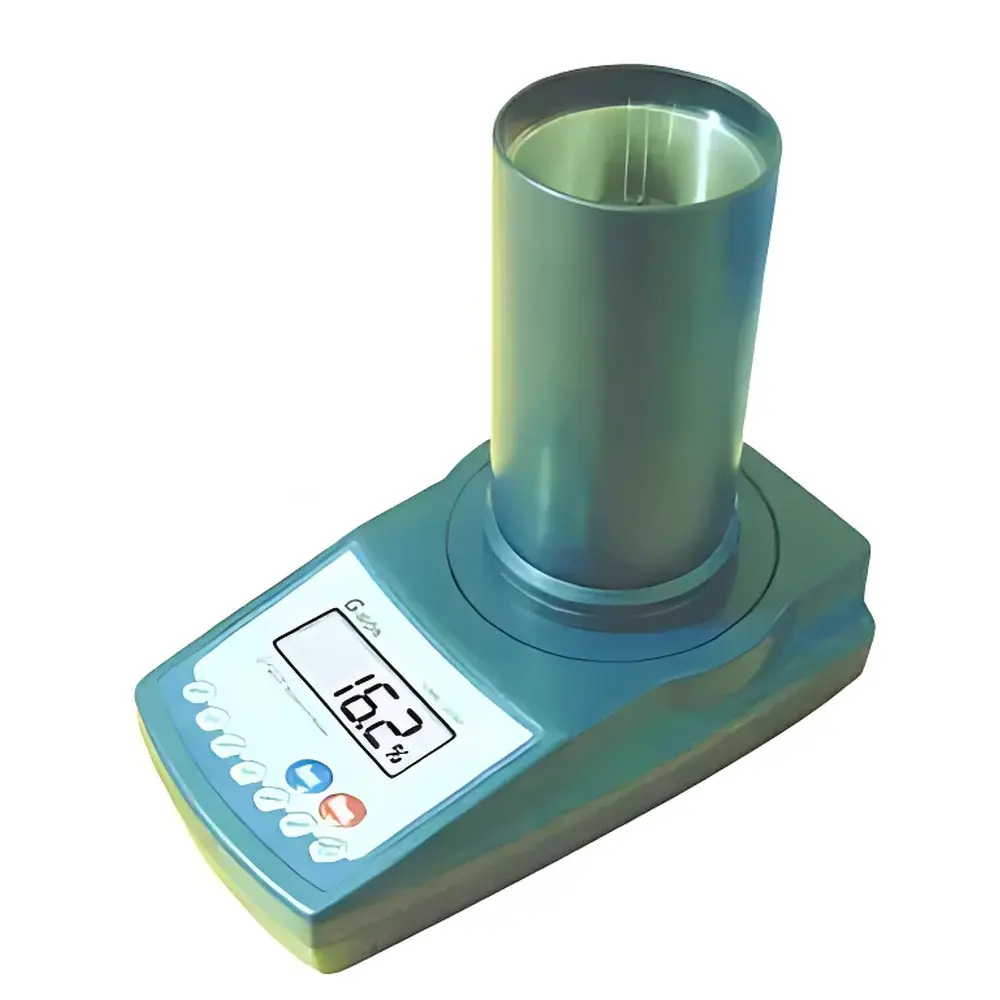
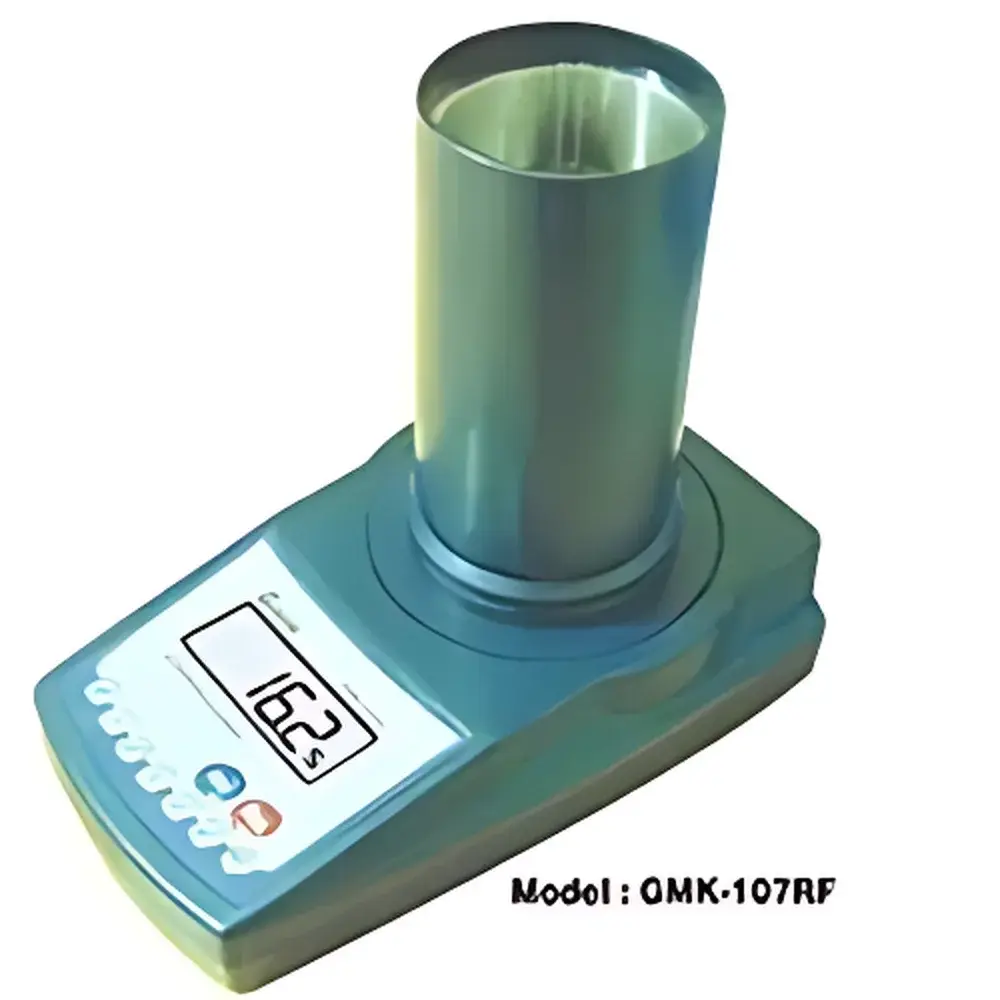
G-WON GMK-106RF/107RF Capacitance-Based Multi-Parameter Grain Moisture Analyzer
| Brand | G-WON |
|---|---|
| Origin | South Korea |
| Model | GMK-106RF / GMK-107RF |
| Measurement Principle | Capacitance Method |
| Accuracy | ±0.5% w/w |
| Resolution | 0.1% w/w |
| Response Time | 1.5 s |
| Sample Volume | ~180 mL |
| Display | Large LCD |
| Temperature Compensation | Automatic |
| Auto Power-Off | After 3 min inactivity |
| Power Supply | 9 V DC (1 × 9 V battery) |
| Dimensions (Instrument) | 150 W × 230 L × 56 H mm |
| Sample Cup Dimensions | 143 H × 75 Ø mm |
| Net Weight | 3 kg |
| Grain-Specific Calibration Ranges | GMK-106RF — Soybean (large): 6.0–30.0%, Soybean (small): 7.0–30.0%, Peanut: 5.0–20.0%, Mung Bean: 7.0–20.0%, Rice: 12.5–22.5%, Paddy: 8.0–32.0%, Corn: 8.0–32.0% |
| GMK-107RF — Millet | 7.0–30.0%, Pea: 9.7–21.5%, Rapeseed: 7.0–20.0%, Rye: 9.8–25.0%, Barley: 7.0–30.0%, Wheat: 7.0–30.0%, Corn: 7.0–30.0% |
Overview
The G-WON GMK-106RF and GMK-107RF are handheld, capacitance-based grain moisture analyzers engineered for rapid, field-deployable, and laboratory-grade moisture quantification in bulk agricultural commodities. Unlike loss-on-drying (LOD) or Karl Fischer titration methods, these instruments employ high-frequency capacitive sensing—measuring the dielectric permittivity shift induced by water content within a defined grain matrix. This non-destructive, solvent-free principle enables real-time measurement without sample preparation, heating, or chemical reagents. The dual-model architecture reflects G-WON’s calibration strategy: GMK-106RF is optimized for coarse- and medium-density grains including soybeans, peanuts, rice, paddy, and corn; GMK-107RF targets finer or higher-oil-content cereals and oilseeds such as wheat, barley, rye, millet, peas, rapeseed, and specialty corn varieties. Both models operate on a fixed-volume sampling chamber (~180 mL), ensuring consistent electrode-grain interaction geometry and minimizing operator-induced variability.
Key Features
- Capacitance-based sensing with automatic temperature compensation—ensuring stable readings across ambient conditions from 5 °C to 40 °C
- Dual-model calibration sets aligned with ISO 712:2016 and AACCI Method 44-15A for cereal and oilseed moisture determination
- 1.5-second response time with 0.1% w/w resolution and ±0.5% w/w accuracy (verified against reference oven-dry method per ASTM D4442)
- Large backlit LCD display supporting mean-value calculation across up to 9 sequential measurements
- Low-power architecture powered by a single 9 V alkaline battery (typical service life > 5000 measurements)
- Ergonomic, ruggedized housing (IP54-rated ingress protection) suitable for grain elevators, farm co-ops, and QC labs
- Auto power-off after 3 minutes of inactivity—preserving battery integrity during intermittent use
Sample Compatibility & Compliance
The GMK-106RF/107RF series supports over 14 major grain and oilseed types, each assigned a dedicated calibration curve validated using representative regional lots. Calibration ranges comply with maximum permissible moisture limits defined in national standards: e.g., U.S. FDA 21 CFR Part 110 (Current Good Manufacturing Practice), EU Regulation (EC) No 1881/2006 (contaminant thresholds linked to moisture), and Korean MFDS Notice No. 2022-102 (grain storage safety). While not designed for regulatory submission without parallel validation, the instruments meet GLP-aligned operational requirements for in-process moisture screening—particularly where rapid pass/fail decisions impact drying scheduling, storage risk assessment, or trade documentation. Sample homogeneity is critical; users must ensure representative subsampling per ISO 6497:2002 prior to loading into the standardized cup.
Software & Data Management
These standalone analyzers do not feature Bluetooth, USB, or PC connectivity. All data remain local to the device—displayed and averaged in real time. For traceability, users are advised to manually record batch ID, date/time, instrument model, and reading alongside environmental notes (e.g., ambient RH, grain temperature). When integrated into QA workflows, the GMK series functions as a Tier-1 screening tool preceding confirmatory LOD testing per AOAC Official Method 950.46. Its deterministic calibration approach—based on empirical dielectric databases rather than generic algorithms—enhances inter-laboratory reproducibility when used within specified grain type and density envelopes.
Applications
- On-site moisture verification at harvest points, grain receiving docks, and silo inlets
- Pre-storage conditioning control to mitigate mold growth (e.g., keeping maize ≤14% w/w for safe 6-month storage)
- Quality assurance during milling, malting, and feed formulation
- Contractual moisture adjustment calculations for commodity trading (e.g., applying USDA moisture deduct tables)
- Educational use in agronomy and food science curricula for demonstrating dielectric property–moisture relationships
FAQ
Can the GMK-106RF be used for wheat or barley?
No—wheat and barley fall outside its calibrated range. Use GMK-107RF for those grains to maintain ±0.5% accuracy.
Does the instrument require annual recalibration?
Not inherently. However, G-WON recommends biannual verification using certified reference grain samples traceable to NIST SRM 1881 (corn) or equivalent national standards.
Is the 180 mL sample volume adjustable?
No—the cup geometry is fixed to preserve sensor-field uniformity. Under- or over-filling invalidates calibration.
How does temperature compensation work?
An internal thermistor monitors ambient temperature and applies a linear correction factor derived from multi-point dielectric mapping across 5–40 °C.
Can results be exported to LIMS?
No native export capability exists. Manual transcription remains the only data capture method.






