
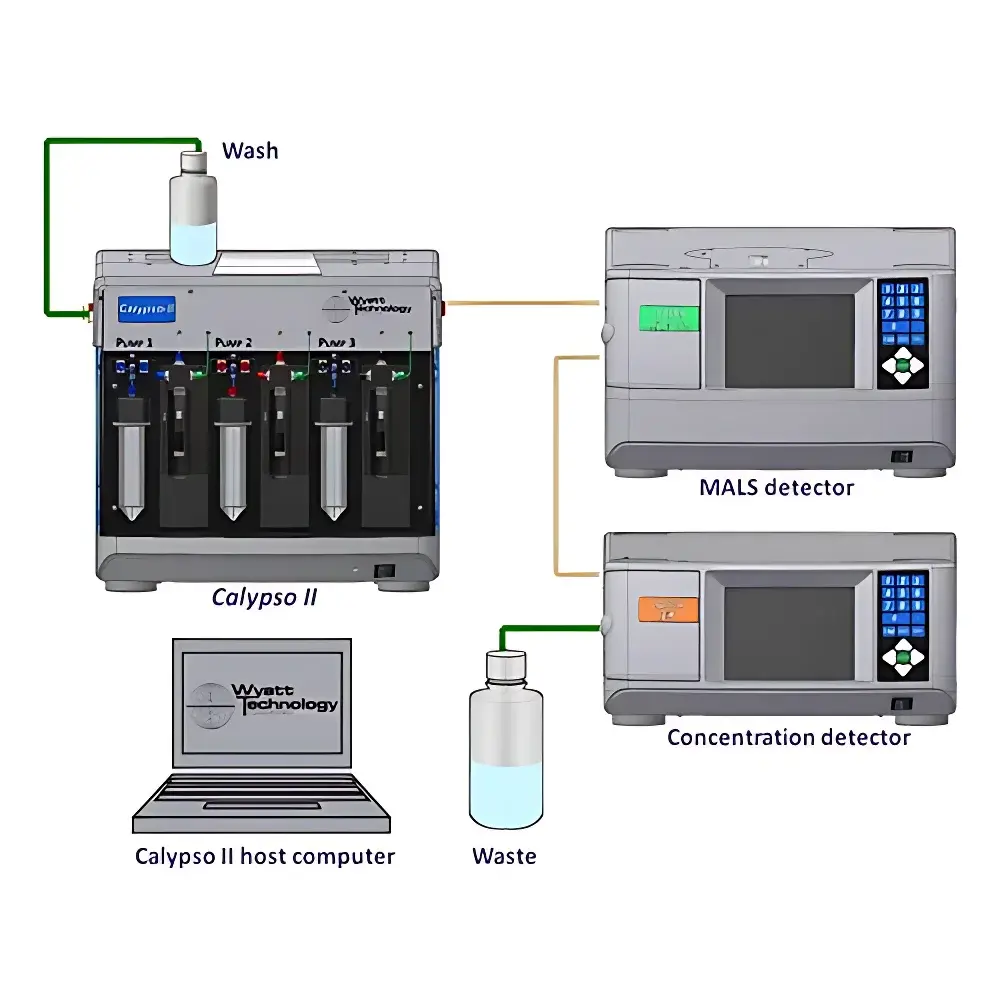
Wyatt Calypso II Component-Gradient Multi-Angle Light Scattering (CG-MALS) System
| Brand | Wyatt |
|---|---|
| Origin | USA |
| Manufacturer | Wyatt Technology Corporation |
| Product Type | Imported Instrument |
| Model | Calypso II |
| Pricing | Available Upon Request |
Overview
The Wyatt Calypso II is an automated, in-solution analytical platform engineered for quantitative characterization of biomolecular interactions without covalent labeling, immobilization, or surface confinement. It implements Component-Gradient Multi-Angle Light Scattering (CG-MALS), a first-principles technique that directly measures changes in weight-average molar mass (Mw) and root-mean-square radius (Rg) as a function of component concentration gradients. Unlike affinity-based methods (e.g., SPR or ITC), CG-MALS detects interaction-induced shifts in absolute molecular mass—enabling model-free determination of stoichiometry, equilibrium dissociation constants (Kd), second virial coefficients (B22), and association/dissociation kinetics—all within native buffer conditions. The system integrates precision fluidics, MALS detection (18 angles, 658 nm laser), inline UV/RI concentration monitoring, and real-time data acquisition to deliver thermodynamically rigorous interaction parameters across pM–mM Kd ranges.
Key Features
- Fully automated gradient generation and sample delivery—eliminates manual pipetting errors and ensures reproducible composition series
- Label-free, solution-phase analysis preserving native conformation, post-translational modifications, and weak/transient interactions
- Simultaneous determination of Mw, Rg, A2, and A3 from Zimm plot construction using integrated MALS and concentration detectors
- Quantitative resolution of homo- and hetero-associations—including self-assembly, heterodimerization, and higher-order complexes
- Direct calculation of binding stoichiometry (n), equilibrium constants (Ka/Kd), and non-specific interaction parameters (B22) from first principles
- Real-time kinetic profiling of association/dissociation processes under controlled temperature and buffer conditions
- Compliance-ready architecture supporting audit trails, electronic signatures, and instrument qualification documentation per FDA 21 CFR Part 11 requirements
Sample Compatibility & Compliance
The Calypso II accommodates a broad range of biomolecules—including monoclonal antibodies, antibody fragments, enzymes, inhibitors, antigens, polysaccharides, nucleic acids, and synthetic polymers—in aqueous buffers compatible with physiological or formulation-relevant conditions (pH 3–9, ionic strength 0–500 mM, temperature 4–40 °C). No derivatization, biotinylation, or surface coupling is required. Sample recovery post-analysis is routine, enabling downstream functional validation. The system meets ISO/IEC 17025 calibration traceability standards and supports GLP/GMP-compliant workflows through secure user access control, change-controlled method templates, and raw-data archiving aligned with ALCOA+ principles.
Software & Data Management
ASTRA software (v8.x) provides end-to-end CG-MALS data processing—from raw scattering intensity deconvolution to global fitting of interaction models (e.g., monomer-dimer, 1:1 hetero-association, cooperative binding). Built-in algorithms generate Zimm plots, calculate B22 via Debye extrapolation, and extract Kd values with confidence intervals using nonlinear regression. All processing steps are scriptable, version-controlled, and exportable in FAIR-compliant formats (CSV, HDF5, PDF reports). Audit logs record operator actions, parameter modifications, and calibration events. Data integrity is enforced via role-based permissions and encrypted local storage compliant with HIPAA and GDPR requirements.
Applications
- Enzyme-inhibitor binding thermodynamics and kinetics for lead optimization
- Antigen-antibody affinity ranking and epitope binning without immobilization artifacts
- Assessment of formulation-induced aggregation propensity and colloidal stability (via B22)
- Determination of optimal pH/ionic strength conditions for purification and storage
- Characterization of multi-protein complexes in signal transduction pathways
- Quantification of excipient effects on protein-protein interactions in biopharmaceutical development
- Validation of biosimilarity through orthogonal assessment of higher-order structure and interaction behavior
FAQ
What types of biomolecular interactions can Calypso II quantify?
It quantifies both specific (e.g., 1:1, 2:1, cooperative binding) and non-specific (e.g., electrostatic, hydrophobic) interactions—delivering Kd, stoichiometry, B22, and kinetic rate constants.
Does Calypso II require fluorescent labeling or surface immobilization?
No—measurements occur in free solution without chemical modification, preserving native structure and avoiding avidity or orientation artifacts.
How long does a typical CG-MALS experiment take?
A full concentration gradient series (6–12 points) with Mw/Rg/B22 output is completed in ≤30 minutes, including autosampler handling and data processing.
Can Calypso II be coupled with other detectors?
Yes—it is designed for seamless integration with SEC, FFF, or field-flow fractionation systems to resolve heterogeneous mixtures prior to CG-MALS analysis.
Is the system suitable for regulated environments?
Yes—ASTRA software supports 21 CFR Part 11 compliance, IQ/OQ/PQ documentation packages, and GxP-aligned validation protocols.





