
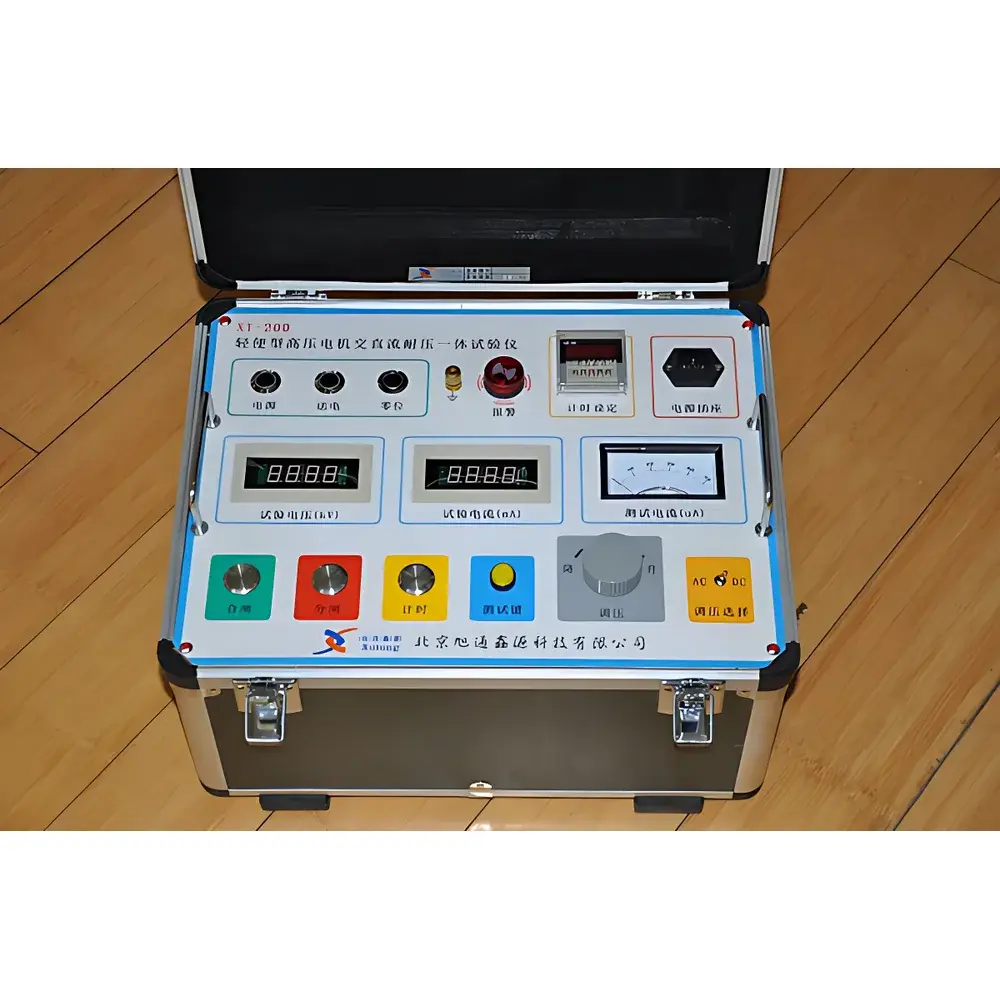
Xutongyongfu XT200-2 Portable AC/DC Dielectric Withstand Tester
| Brand | Xutongyongfu |
|---|---|
| Origin | Beijing, China |
| Manufacturer Type | Authorized Distributor |
| Country of Origin | China |
| Model | XT200-2 |
| Price Range | USD 7,000 – 14,000 (FOB) |
| Maximum Breakdown Voltage | 20 kV AC/DC |
| Output Current | Up to 550 mA (with compensating reactor) |
| Input Power | AC 220 V ±10%, 50 Hz ±1 Hz |
| Accuracy | ±1.5% of reading (voltage), ±0.5% (timer) |
| Timer Range | 0–999 s (selectable in seconds, minutes, hours) |
| Overcurrent Protection | 6.7 A |
| Operating Temperature | −15 °C to +50 °C |
| Relative Humidity | ≤90% at +25 °C |
| Dimensions | 400 × 300 × 300 mm |
| Weight | 22 kg |
| Compliance | GB 50150–2006, DL/T 596–2005, DL/T 848.2–2004 |
Overview
The Xutongyongfu XT200-2 Portable AC/DC Dielectric Withstand Tester is an integrated high-voltage test system engineered for field and workshop verification of insulation integrity in medium- and high-voltage rotating machinery—particularly induction and synchronous motors rated up to 10 kV. Unlike conventional test setups requiring separate AC test transformers and DC high-voltage generators, the XT200-2 employs a unified solid-state power conversion architecture with dual-mode output regulation. It delivers precisely controlled sinusoidal 50 Hz AC voltage and ripple-free DC voltage from a single compact chassis, eliminating logistical bottlenecks associated with transporting multiple heavy units. Its core measurement principle relies on real-time closed-loop feedback control of output voltage and current, ensuring stable stress application during dielectric withstand testing per IEC 60270 and IEEE Std 4–2013 methodologies. The instrument is designed for routine commissioning (acceptance) tests and periodic preventive maintenance in accordance with national and industry standards governing electrical equipment safety and reliability.
Key Features
- Integrated AC/DC high-voltage generation in one 22 kg unit—no external transformer or rectifier stack required
- Simultaneous AC (up to 20 kV RMS) and DC (up to 20 kV) output capability with independent mode selection and zero-crossing start logic
- Embedded multi-tap compensating reactor (included) enables capacitance current compensation up to 550 mA—critical for testing large stator windings with high stray capacitance
- Manual voltage ramping with mechanical zero-position interlock and auto-hold at setpoint to prevent accidental overvoltage
- Dual-stage overcurrent protection: fast-acting electronic cutoff at 6.7 A and programmable time-delayed trip for transient inrush mitigation
- Analog pointer display with calibrated scales for voltage (AC/DC), timer, and output current—designed for readability under variable ambient lighting
- Low-loss magnetic core construction using grain-oriented silicon steel and high-permeability nanocrystalline alloys; optimized thermal management for continuous operation at rated load
- IP54-rated enclosure with reinforced insulation barriers, moisture-resistant potting compounds, and dust-sealed rotary controls
Sample Compatibility & Compliance
The XT200-2 is validated for dielectric testing of stator windings in high-voltage AC motors (6 kV, 10 kV, and 20 kV classes), generator rotors, and auxiliary switchgear components. It supports both short-duration proof tests (e.g., 1-minute AC at 2×Un + 1 kV) and extended DC polarization index (PI) and dielectric absorption ratio (DAR) measurements. All operational parameters and safety interlocks comply with GB 50150–2006 (Electrical Installation Engineering – Acceptance Test Standards for Electrical Equipment), DL/T 596–2005 (Preventive Testing Regulations for Power Equipment), and DL/T 848.2–2004 (General Technical Requirements for Power Frequency High-Voltage Test Sets). While not certified to IEC 61010-1:2010 or UL 61010-1, its design incorporates equivalent creepage/clearance distances, double-insulated HV cabling, and grounded metal shielding aligned with Class I safety principles for portable HV instrumentation.
Software & Data Management
The XT200-2 operates as a standalone analog instrument without embedded microprocessor control or digital data logging. All settings—including voltage setpoint, timer duration, and mode selection—are configured manually via front-panel rotary dials and toggle switches. As such, it does not support USB/RS-232 connectivity, remote PC control, or electronic audit trails. This architecture prioritizes electromagnetic immunity, long-term calibration stability, and operational simplicity in electrically noisy industrial environments—making it suitable for GLP-aligned field labs where traceable manual recordkeeping (via calibrated analog meters and handwritten test logs) remains standard practice. Users are advised to maintain test records in accordance with ISO/IEC 17025 documentation requirements, including operator ID, ambient conditions, DUT identification, applied voltage/time profile, and pass/fail determination per clause 10.2 of GB 50150–2006.
Applications
- Commissioning tests on newly installed high-voltage motor windings prior to energization
- Periodic insulation resistance and dielectric withstand verification during predictive maintenance cycles
- Factory acceptance testing (FAT) of rewound stators and field coils in motor repair shops
- On-site troubleshooting of ground faults and partial discharge precursors in aged motor insulation systems
- Verification of epoxy varnish curing quality and void content in vacuum-pressure impregnated (VPI) windings
- Supporting condition-based maintenance programs requiring repeatable, low-variability stress application across multiple test points
FAQ
Does the XT200-2 support automatic voltage ramping or programmable test sequences?
No. It is a manually operated analog instrument with fixed-ramp rate determined by operator-controlled variac rotation speed.
Can it be used for partial discharge (PD) detection?
No. The XT200-2 lacks PD coupling capacitors, high-frequency sensors, or pulse acquisition circuitry required for PD measurement per IEC 60270.
Is the included compensating reactor rated for continuous duty?
Yes—the reactor is thermally rated for intermittent operation up to 30 minutes at full compensation current, with forced-air cooling recommended above 15 minutes.
What calibration interval is recommended?
Annual calibration against NIST-traceable HV reference standards is advised, with verification of voltage accuracy (±1.5%), timer drift (<0.5%), and overcurrent trip threshold before each major test campaign.
Does it meet FDA 21 CFR Part 11 requirements?
No—its analog-only architecture precludes electronic signatures, audit trails, or user access controls mandated under Part 11 for regulated pharmaceutical or biotech applications.



