
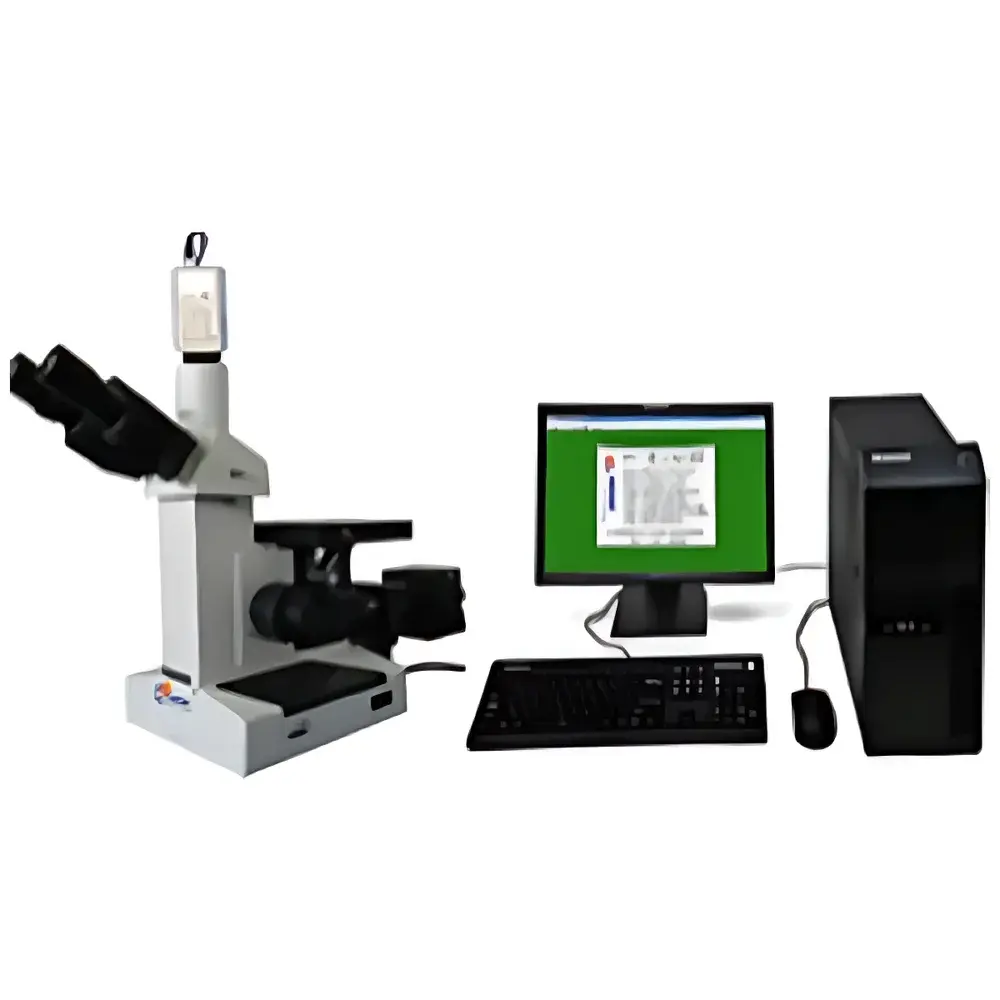
YANRUN 4XC-D Digital Imaging Metallurgical Microscope
| Brand | YANRUN |
|---|---|
| Origin | Shanghai, China |
| Manufacturer Type | Direct Manufacturer |
| Product Type | Inverted Metallurgical Microscope |
| Model | 4XC-D |
| Optical Total Magnification | 100×–1000× (up to 1600× with optional eyepiece/camera configuration) |
| Eyepieces | 10× wide-field (18 mm field number), adjustable diopter |
| Objectives | 10×/0.25, 20×/0.40, 40×/0.60, 100×/1.25 (oil immersion), WD = 8.8 mm / 8.6 mm / 3.7 mm / 0.44 mm |
| Mechanical Tube Length | 160 mm |
| Coaxial Coarse/Fine Focus | 30 mm travel, fine focus graduation 2 µm |
| Stage | Dual-layer mechanical stage, 180 × 150 mm base, 15 × 15 mm travel range, aperture options Ø10 mm / Ø20 mm |
| Illumination | Köhler illumination, 6 V / 20 W halogen lamp, continuously adjustable brightness |
| Power Supply | 220 V / 50 Hz (optional 110 V / 60 Hz) |
| Compliance | Designed for ISO 9001-aligned manufacturing and ASTM E3–22 specimen evaluation workflows |
Overview
The YANRUN 4XC-D Digital Imaging Metallurgical Microscope is an inverted optical instrument engineered for high-precision microstructural analysis of opaque, polished metallic and ceramic specimens. Its inverted configuration places the objective lenses beneath the specimen stage — enabling unobstructed access to large, heavy, or irregularly shaped samples commonly encountered in metallurgical laboratories, foundries, and failure analysis centers. The system operates on standard finite-conjugate optical principles (mechanical tube length: 160 mm), supporting conventional brightfield illumination and compatible with optional polarized light and differential interference contrast (DIC) modules. Designed for routine quality control, heat treatment verification, inclusion rating per ASTM E45, grain size measurement per ASTM E112, and phase identification in ferrous/non-ferrous alloys, the 4XC-D delivers consistent resolution and depth-of-field stability across its full magnification range.
Key Features
- Inverted optical architecture with fixed-stage design — accommodates specimens up to 50 mm in height and 1 kg in mass without repositioning.
- Three-port trinocular head (30° inclination, interpupillary adjustment 53–75 mm, ±5 D diopter correction) enables simultaneous visual observation, photomicrography, and real-time digital imaging.
- Parfocal, plan-apochromatic objective set (10×/0.25, 20×/0.40, 40×/0.60, 100×/1.25 oil) ensures minimal refocusing between magnifications and uniform flatness across the entire field of view.
- Precision coaxial focusing mechanism: 30 mm coarse travel with dual-speed fine adjustment (2 µm graduation), equipped with upper/lower limit stops and tension control for reproducible Z-axis positioning.
- Large-format mechanical stage (180 × 150 mm footprint, 15 × 15 mm XY travel) with dual aperture inserts (Ø10 mm and Ø20 mm) supports both standard metallographic mounts and custom sample holders.
- Köhler-optimized halogen illumination (6 V / 20 W) with continuous intensity control and centerable condenser ensures uniform, glare-free illumination critical for quantitative image analysis.
Sample Compatibility & Compliance
The 4XC-D accepts standard 25 mm and 30 mm diameter metallographic mounts, as well as oversized specimens mounted on auxiliary clamps or vacuum chucks. Its inverted geometry eliminates the need for specimen inversion during preparation — reducing risk of surface contamination or edge damage. The microscope meets functional requirements for ISO/IEC 17025-accredited testing labs conducting microstructural assessments per ASTM E3 (Standard Guide for Preparation of Metallographic Specimens), ASTM E112 (Grain Size Determination), and ASTM E45 (Determining Inclusion Content). While the base configuration does not include certified calibration documentation, traceable NIST-traceable stage micrometers and focus check standards are available as accessories to support GLP/GMP audit readiness.
Software & Data Management
The 4XC-D is designed for integration with third-party digital imaging platforms compliant with USB 2.0/3.0 and HDMI video output protocols. When paired with a C-mount adapter and industrial CMOS camera (e.g., 5 MP or higher resolution), the system supports live streaming, time-lapse capture, and multi-focus stacking via vendor-neutral software such as Ocular Image Pro, StreamPix, or open-source alternatives like Fiji/ImageJ. All acquired images retain embedded EXIF metadata (magnification, objective ID, exposure parameters), facilitating traceability in regulated environments. Optional hardware upgrades include motorized Z-drive and encoded XY stage for automated tile-scan acquisition — compatible with ASTM E1382-compliant stereological analysis pipelines.
Applications
- Microstructure characterization of steels, aluminum alloys, titanium, and superalloys post-heat treatment or welding.
- Porosity and void analysis in castings and additive-manufactured components per ASTM E1558.
- Carbide distribution mapping and martensite/austenite phase quantification in tool steels.
- Failure analysis of fractured surfaces, including cleavage, ductile dimple, and intergranular fracture morphology assessment.
- Coating thickness verification and interface integrity evaluation in thermal spray and PVD/CVD layers.
- Educational use in materials science curricula for hands-on metallography training aligned with ASM International curriculum guidelines.
FAQ
Is the 4XC-D compatible with oil immersion objectives?
Yes — the included 100×/1.25 NA objective is designed for immersion oil (n = 1.515) and requires standard Type A immersion oil for optimal resolution at 0.44 mm working distance.
Can I upgrade to motorized focusing or automated stage control?
Motorized Z-axis and encoded XY stage modules are available as factory-installed options or field retrofits; compatibility requires firmware revision ≥V2.3 and dedicated controller interface.
Does the microscope support fluorescence or polarized light observation?
The optical path is mechanically compatible with aftermarket polarizer/analyzer sets and reflected-light fluorescence cubes; however, no integrated excitation source or filter turret is supplied in the base configuration.
What camera interfaces are supported?
C-mount (1× or 0.5× reduction) is standard; HDMI and USB-C video outputs require optional digital imaging module (sold separately); native support for GenICam-compliant cameras is not implemented.
Is technical documentation available in English?
Yes — comprehensive English-language user manual, optical alignment guide, and maintenance checklist are provided with each unit; ISO/IEC 17025 calibration certificates are available upon request at additional cost.




