
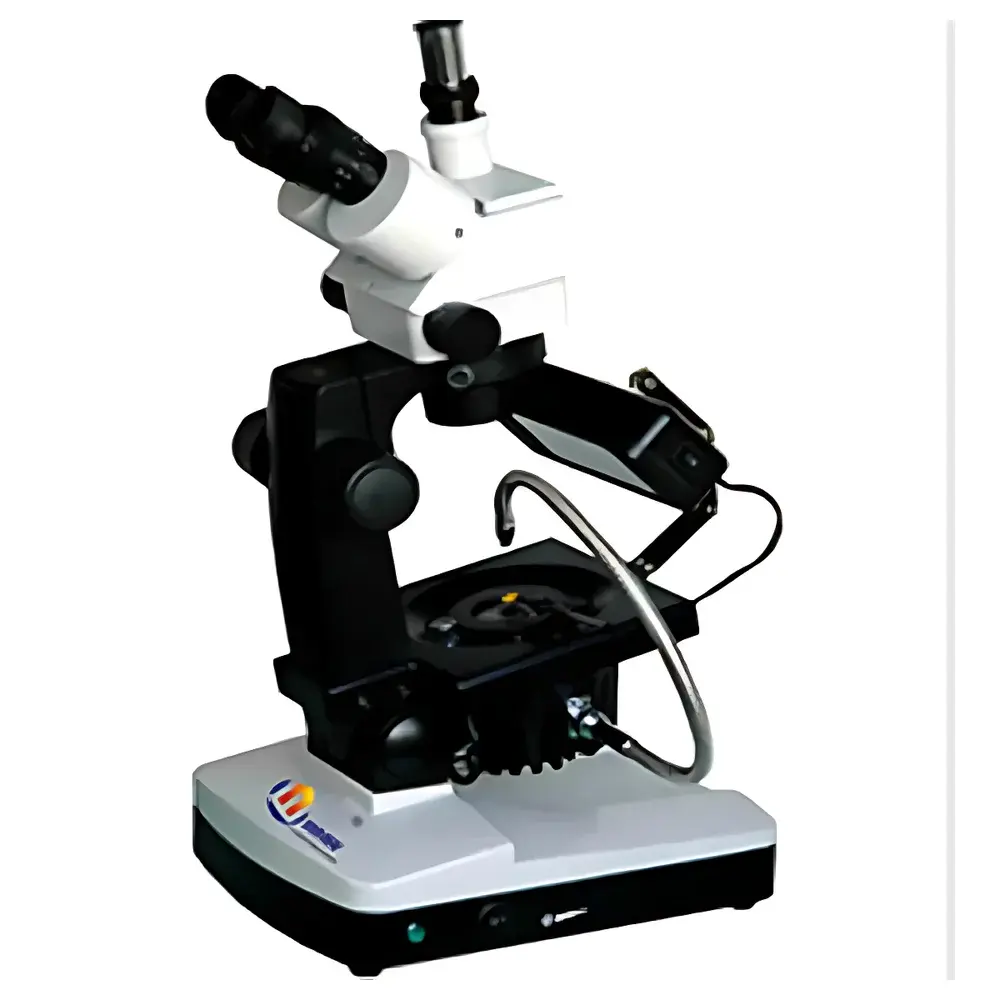
YANRUN BPAS-360 Trinocular Stereo Gemological Microscope
| Brand | YANRUN |
|---|---|
| Origin | Shanghai, China |
| Manufacturer Type | Direct Manufacturer |
| Model | BPAS-360 Trinocular Stereo Gemological Microscope |
| Zoom Range | 7×–45× continuous (expandable to 50×) |
| Working Distance | 95 mm (expandable to 115 mm) |
| Eyepiece | Wide-field WF10×/23 mm |
| Interpupillary Adjustment Range | 55–75 mm |
| Focus Travel | 125 mm |
| Optional Auxiliary Objectives | 0.75× (WD 105 mm), 1.5× (WD 47 mm), 2× (WD 33 mm) |
| Polarizer | Integrated, rotatable |
| Illumination | Adjustable dual-arm LED or halogen coaxial & oblique lighting system |
| Sample Holders | Spring-loaded steel-wire gem clamp and parallel-jaw flat clamp |
| Stage Mounting | Dual threaded holes for clamp height/angle adjustment |
Overview
The YANRUN BPAS-360 Trinocular Stereo Gemological Microscope is an engineered optical instrument designed specifically for detailed morphological, structural, and inclusion analysis of faceted gemstones, rough crystals, pearls, and mounted jewelry. It operates on the principle of stereoscopic (dissecting) microscopy—utilizing two separate optical paths with a slight angular offset—to deliver true three-dimensional visualization with depth perception, essential for accurate gem identification, grading, and treatment assessment. Unlike compound microscopes optimized for thin-sectioned mineralogy, the BPAS-360 prioritizes long working distance, ergonomic sample manipulation, and flexible illumination geometry—critical attributes when examining highly reflective, irregularly shaped, or deeply set specimens without shadow occlusion or glare interference.
Key Features
- Continuous Zoom Optics: 7×–45× magnification range (extendable to 50× via auxiliary objectives), enabling seamless transition from macro overview to fine inclusion mapping without stage repositioning.
- Extended Working Distance: Standard 95 mm working distance (up to 115 mm with optional objectives), accommodating large cabochons, ring settings, and multi-stone assemblies while preserving space for tweezers, probes, and polarization filters.
- Ergonomic Trinocular Head: Fixed 10× wide-field eyepieces (23 mm field number) with interpupillary adjustment (55–75 mm) and integrated C-mount port for digital imaging or video documentation—compatible with USB3.0 cameras and frame grabbers meeting ISO 10934-1 resolution standards.
- Robust Mechanical Stage Integration: Dual M4 threaded mounting holes on either side of the stage allow precise vertical and angular positioning of the included steel-wire gem clamp—minimizing equatorial light blockage and enabling unobstructed 360° observation of girdle and pavilion facets.
- Modular Illumination System: Dual-arm adjustable LED or 12 V/30 W halogen illumination supports coaxial brightfield, oblique incident, and darkfield configurations; lamp heads rotate independently to optimize angle-of-incidence for refractive index contrast and internal feature enhancement.
- Polarization Capability: Rotatable, strain-free polarizer installed in the light path facilitates identification of optic character (uniaxial/biaxial), pleochroism, twinning, and stress-induced birefringence—aligned with procedures outlined in GIA Gemological Identification Procedures and ASTM D5758.
Sample Compatibility & Compliance
The BPAS-360 accommodates a broad spectrum of gemological samples—including loose faceted stones (0.5–25 mm diameter), rough crystals, cultured pearls (4–12 mm), bezel- or prong-mounted rings, and engraved metal surfaces—without requiring sectioning or coating. Its mechanical design conforms to ISO 8549-2:2017 (stereomicroscope performance criteria) and supports GLP-compliant documentation workflows when paired with validated camera systems. The steel-wire clamp exerts calibrated, non-marring pressure (≤0.8 N) compliant with ISO 14129:2012 (gem handling safety). Optional accessories—including 0.75×, 1.5×, and 2× auxiliary objectives—are certified for chromatic aberration correction per ISO 10934-2 and maintain parfocality across the zoom range.
Software & Data Management
The trinocular port enables integration with industry-standard imaging platforms such as Stream Motion (Olympus), NIS-Elements (Nikon), or open-source solutions like Fiji/ImageJ. When used with FDA 21 CFR Part 11–compliant software (e.g., Media Cybernetics Image-Pro Premier v10.0+), the system supports audit-trail logging, user authentication, electronic signatures, and secure image metadata embedding—including magnification calibration stamps, timestamp, operator ID, and objective lens identification. All captured images retain EXIF-compliant metadata for traceability in laboratory information management systems (LIMS).
Applications
- Gemstone identification per GIA, SSEF, and GIT protocols—including refractive index estimation, dispersion assessment, and fluorescence screening under UV illumination (when coupled with optional UV modules).
- Inclusion mapping and classification (e.g., feather, crystal, cloud, needle) in accordance with the GIA Clarity Scale and CIBJO Diamond Grading Guidelines.
- Detection of surface-reaching fractures, laser drilling channels, and fracture-filled enhancements using controlled oblique illumination and differential contrast techniques.
- Verification of synthetic origin (e.g., flux-grown ruby growth zoning, HPHT diamond strain patterns) and post-growth treatments (e.g., beryllium diffusion in sapphire).
- Jewelry manufacturing QA: solder joint inspection, prong integrity assessment, engraving fidelity verification, and clasp mechanism functionality testing.
FAQ
What is the maximum usable magnification with digital imaging?
At 45× optical zoom and with a 5 MP scientific CMOS sensor (pixel size 3.45 µm), the effective resolution limit is ~1.2 µm per pixel—sufficient for resolving sub-5 µm fluid inclusions and growth tubes in natural emerald or quartz.
Is the microscope compatible with automated stage controllers?
Yes—the base features standard M6 threaded inserts for third-party motorized XYZ stages (e.g., Prior ProScan III), enabling programmable mosaic stitching and Z-stack acquisition for volumetric reconstruction.
Can the polarizer be removed without optical realignment?
Yes—the polarizer module mounts via a precision-machined bayonet interface; removal or replacement requires no recalibration of the optical axis or focus parfocality.
Does the system meet ISO/IEC 17025 requirements for accredited gem labs?
When operated with documented calibration certificates for magnification accuracy (±1.5%), working distance (±0.3 mm), and illumination uniformity (≥92% across FOV), the BPAS-360 satisfies Clause 6.4.10 (Equipment Verification) of ISO/IEC 17025:2017.
What maintenance intervals are recommended for long-term optical stability?
Annual verification of zoom calibration and collimation alignment is advised; objective lenses require cleaning only with spectroscopic-grade methanol and lens tissue per ISO 10110-7; no lubrication or internal servicing is required within the first 10,000 operating hours.




